
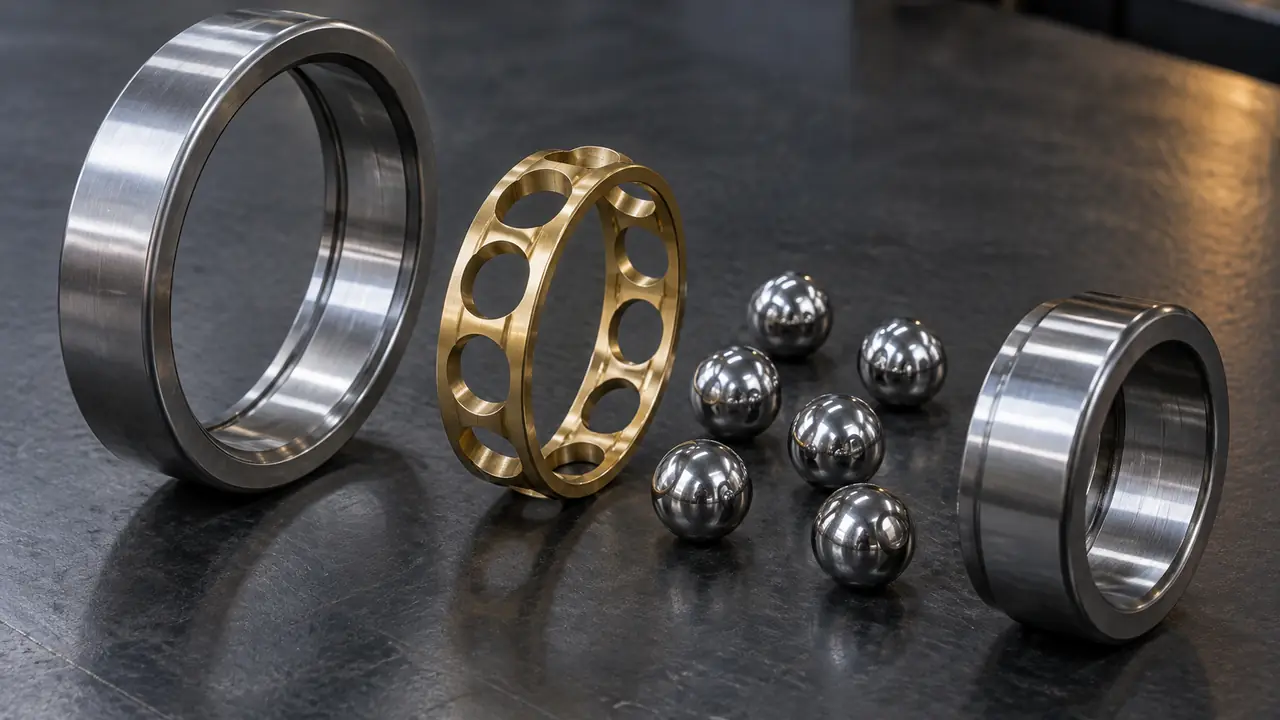
What makes a bearing a needle bearing
A needle roller bearing uses cylindrical rollers whose length is at least several times their diameter, which gives them the "needle" look. Because the rollers are so slim, the bearing has a very small difference between its outside and bore diameters, called the radial section height. Compare a deep groove ball bearing of a 20 mm bore with a needle bearing of the same bore: the needle bearing sits in a much smaller housing, yet its line contact still carries a substantial radial load.
That combination of small section and high load capacity is the reason designers reach for a needle bearing. Gear sets, rocker arms, universal joints, planetary carriers and small compressors all squeeze bearings into confined spaces, and the needle type was developed for them. Needle bearings carry radial load only; axial load must be taken by a separate thrust element, such as a thrust needle bearing or a washer.
Main configurations
| Type | Typical designation | How it is built | Typical use |
|---|---|---|---|
| Drawn cup | HK, BK | Thin pressed steel outer cup, needles and cage; BK has a closed end | Transmissions, small gearboxes, power tools |
| Machined ring, with inner ring | NA49, NA69 | Solid outer ring with shoulders, separate inner ring | Heavy-duty joints, machine tools |
| Machined ring, without inner ring | NK | Solid outer ring, shaft acts as inner raceway | Compact shafts with hardened journal |
| Cage and roller assembly | K | Cage and needles only, running between two hardened surfaces | Connecting rod ends, planetary gears |
Drawn-cup bearings are the economical choice and are pressed into a bored housing, which holds the cup in shape. Machined-ring bearings are stiffer and tolerate repeated loads. Cage and roller assemblies have the smallest section of all, but depend on the neighbouring parts for their raceways.
The shaft is part of the bearing
With an inner ring, a needle bearing is a complete unit, and a normal shaft finish is enough. Without an inner ring, the shaft itself becomes the inner raceway. That means it must be hardened, usually to a surface hardness in the range used for bearing steel, and ground to a fine finish and tight diametral tolerance. If the shaft is softer or rougher, the needles indent the surface and the bearing fails early.
Give the supplier the shaft material, hardness and surface finish with your enquiry, or ask for the version with an inner ring. The recommended shaft and housing tolerances come from the bearing datasheet, and they are tighter than for many ball bearings because there is less internal clearance to absorb error.
Strengths and limits
- Strength: space. Small radial section lets the shaft stay thick and stiff.
- Strength: load. Line contact over a long roller carries high radial load for the size.
- Strength: oscillation. Needle bearings handle swinging motion well when lubricated.
- Limit: axial load. They carry none and need a thrust partner.
- Limit: misalignment. Long rollers are sensitive to shaft deflection; skew creates edge loading.
- Limit: speed. Cages are thin and friction is higher than a ball bearing, so limiting speeds are lower.
Misalignment is the usual cause of failures in the field. If the shaft bends under load, the needle ends take the pressure and the raceway flakes at the edges. Where bending cannot be avoided, a spherical roller bearing or a design with a stiffer shaft is a better route.
Needle versus cylindrical roller in plain terms
A needle roller is simply a cylindrical roller that is thin and long, so the two families overlap. The practical line is drawn by the ratio of roller length to diameter and by the section height. When the roller length is not much more than its diameter, the bearing is called a cylindrical roller bearing and usually has precisely ground rings with ribs that guide the rollers. When the rollers are long and slender, the bearing is a needle bearing and the rings may be thin or absent.
The consequence for the buyer is straightforward. A cylindrical roller bearing is sturdier, carries some axial guiding load in NJ and NUP forms, and runs faster. A needle bearing wins on envelope size and on cost per unit of load in a confined space. A more detailed comparison is in needle vs cylindrical roller bearings.
Housing design deserves attention too. A drawn-cup needle bearing gets its roundness from the housing, so a thin or split housing will distort it. The bore must be round and within the tolerance on the datasheet, and a light press fit is normal. Press the cup in with a proper mandrel rather than hammering on its thin wall, and follow the supplier's pressing instructions for the marked end.
Lubrication and sealing
A needle bearing has little free space for grease, so lubrication is often by oil mist, splash or a grease nipple in the housing. Drawn-cup types with seals are packed with grease for life in appliance and power tool use. Check that the grease suits the temperature and the oscillating motion, because lightly moving needles can wipe the grease away from the contact, and the bearing then wears in place. The relevant details are explained in the lubrication guide.
What to confirm when ordering
- Designation, including the type prefix (HK, BK, NK, NA) and the size code.
- Whether an inner ring is needed or the shaft is hardened and ground.
- Housing bore tolerance and wall thickness: a drawn cup needs a rigid housing.
- Cage material, seal or open design, and grease if sealed.
- Tolerance class and quantity per designation.
Needle bearings are produced in several clusters, including Zhejiang and Jiangsu plants making small and mid-size sections. Industry analyses suggest those regions concentrate small and mid-size bearings, but the partner plant is shortlisted per project and verified by the desk. The reference MOQ and lead time bands are set out on the MOQ and lead time page, confirmed in writing per program. Send drawings or the old part number through the quote form.