
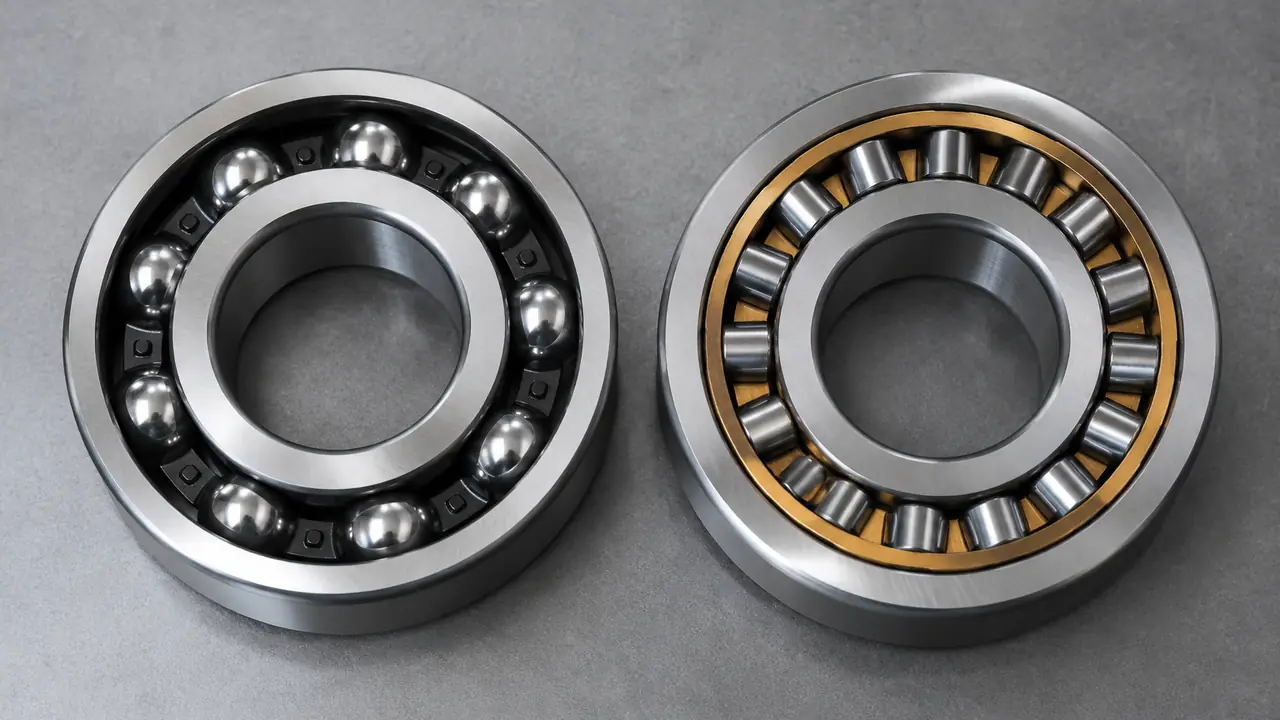
Same contact, different proportions
A needle roller is a cylinder with a length at least several times its diameter. A standard cylindrical roller is shorter, with a length close to its diameter. Both make line contact with the raceway, so both carry radial load well. The difference is what that proportion does to the bearing: needle rollers allow a very thin radial section and a high load per unit of height, while cylindrical rollers allow a stiffer, more robust bearing with better speed and axial location options.
Needle bearings come as drawn-cup types with a pressed outer ring (HK, BK), as full machined-ring types (NK with or without inner ring NA), and as cages with rollers only. Cylindrical roller bearings come as NU, NJ, NUP and N with different flange arrangements. Both appear in the roller bearings hub. The needle bearing primer and the cylindrical roller types note explain each in detail.
Side-by-side comparison
Relative terms only. Check ratings and limiting speeds in the supplier datasheet for the exact designation.
| Criterion | Needle roller | Cylindrical roller |
|---|---|---|
| Load direction | Radial only; no axial capacity (thrust needle types are separate) | Radial; limited axial with NJ, NUP or flanged types |
| Load capacity | High radial load for a very small section | Very high radial load; higher absolute capacity in larger sizes |
| Speed | Medium; rolling speed limited by roller skew | Medium to high, better with precision cages |
| Misalignment tolerance | Very low; edge loading shortens life | Very low; slightly more tolerant with crowned rollers |
| Friction and noise | Moderate torque; noise from roller skew at light load | Low torque; quiet when properly loaded |
| Maintenance | Needs lubrication; often fed by splash or oil mist | Grease or oil; accepts relubrication in housings |
| Typical applications | Gear pumps, transmissions, rocker arms, universal joints, cam followers | Gearboxes, large motors, pumps, rolling equipment, machine tools |
| Relative cost factors | Low cost for drawn cups; ground shaft often required | Several ring configurations, tighter manufacturing control |
Space: the usual reason to choose needles
If the design leaves little radial room, a needle roller bearing is often the only rolling bearing that fits. The section height is the smallest of all rolling bearing types, so the housing and shaft can be compact. This is why planetary gears, rocker arms, universal joint cross trunnions and small gearbox idlers use needle rollers. A drawn cup bearing (HK or BK) is pressed into a plain housing bore, and the housing then does the structural work.
A cylindrical roller bearing has a thicker section, so the bearing needs more room. In exchange, it provides rings that are stiffer, which matters on heavy shafts. In many machines, the question is therefore not which carries more load but which fits, and needle rollers settle it when space is the constraint.
Shaft, housing and the inner ring
A needle roller bearing without an inner ring (HK, BK, NK) runs directly on the shaft. That makes the shaft part of the bearing: it must be hardened and ground to a high surface finish, and its roundness and hardness set the life of the assembly. Where the shaft cannot be hardened, use a version with an inner ring (NA). A cylindrical roller bearing normally has its own inner ring, so the shaft requirements are those of a standard press fit, although the seat tolerance must still be tight.
In both cases, the housing bore must be accurately machined, because thin rings follow the shape of their seats. Fits and clearances are set out in the tolerance and clearance guide.
Axial location and speed
Needle roller bearings do not locate the shaft axially. The shaft must be held by other parts such as thrust washers or a separate thrust bearing. Cylindrical roller bearings in the NJ and NUP forms can carry small axial loads and hold the shaft in place. At high speed, the long thin needles are more prone to skewing, and the cage must guide them accurately. For fast shafts with heavy radial load, precision cylindrical roller bearings with machined cages are the stronger option.
Lubrication and life in practice
Needle bearings have less room for grease than a cylindrical roller bearing of similar capacity, and the long rollers need a steady film along their whole length. In gear pumps and transmissions the bearing is fed from the oil in the housing, which is ideal. In grease-lubricated applications, relubrication intervals can be short, and a missed service shows up as scoring on the roller ends. Cylindrical roller bearings hold more lubricant, run in oil baths or grease-filled housings and tolerate longer intervals. The lubrication guide sets out the grease and oil options, and they matter more here than the choice of roller shape in many field failures.
Sourcing and specification notes
For needle bearings, the enquiry should state the type (drawn cup, machined, with or without inner ring), the bore and outside diameter, the width, the cage and the lubrication. For cylindrical roller bearings, state the NU, NJ, NUP or N form, the series and the clearance group. Reference MOQ and lead time ranges are on the MOQ and lead time page and are confirmed in writing for each program. Packaging deserves a word: needle roller cages can deform in transit, so the desk checks cartons and inner packs, as described on the packaging and anti-rust page.
How to decide
- Measure the radial space available. If it is very tight, choose needle rollers.
- Check whether the shaft can serve as a hardened, ground raceway. If not, choose a version with inner ring.
- Check for axial load. If it exists and no other part takes it, choose a cylindrical bearing with flanges, or add a thrust element.
- Consider speed. For high speed and heavy radial load, choose a precision cylindrical roller bearing.
- Consider maintenance: if relubrication is planned through a housing, cylindrical rollers are easier to supply with a grease path.
- Confirm the choice with datasheet ratings and request samples of both for an assembly trial.
Include the shaft material, hardness and surface finish with your request through the quote form.