
| Designation | Type | d bore | D outside | B width |
|---|---|---|---|---|
| 22205 | Spherical roller | 25 | 52 | 18 |
| 22206 | Spherical roller | 30 | 62 | 20 |
| 22208 | Spherical roller | 40 | 80 | 23 |
| 22210 | Spherical roller | 50 | 90 | 23 |
| 22212 | Spherical roller | 60 | 110 | 28 |
| 22214 | Spherical roller | 70 | 125 | 31 |
| 22216 | Spherical roller | 80 | 140 | 33 |
| 22218 | Spherical roller | 90 | 160 | 40 |
| 22220 | Spherical roller | 100 | 180 | 46 |
| 22308 | Spherical roller | 40 | 90 | 33 |
| 22310 | Spherical roller | 50 | 110 | 40 |
| 22312 | Spherical roller | 60 | 130 | 46 |
Nominal ISO boundary dimensions for reference. Confirm against your drawing and the supplier datasheet.
What a spherical roller bearing does
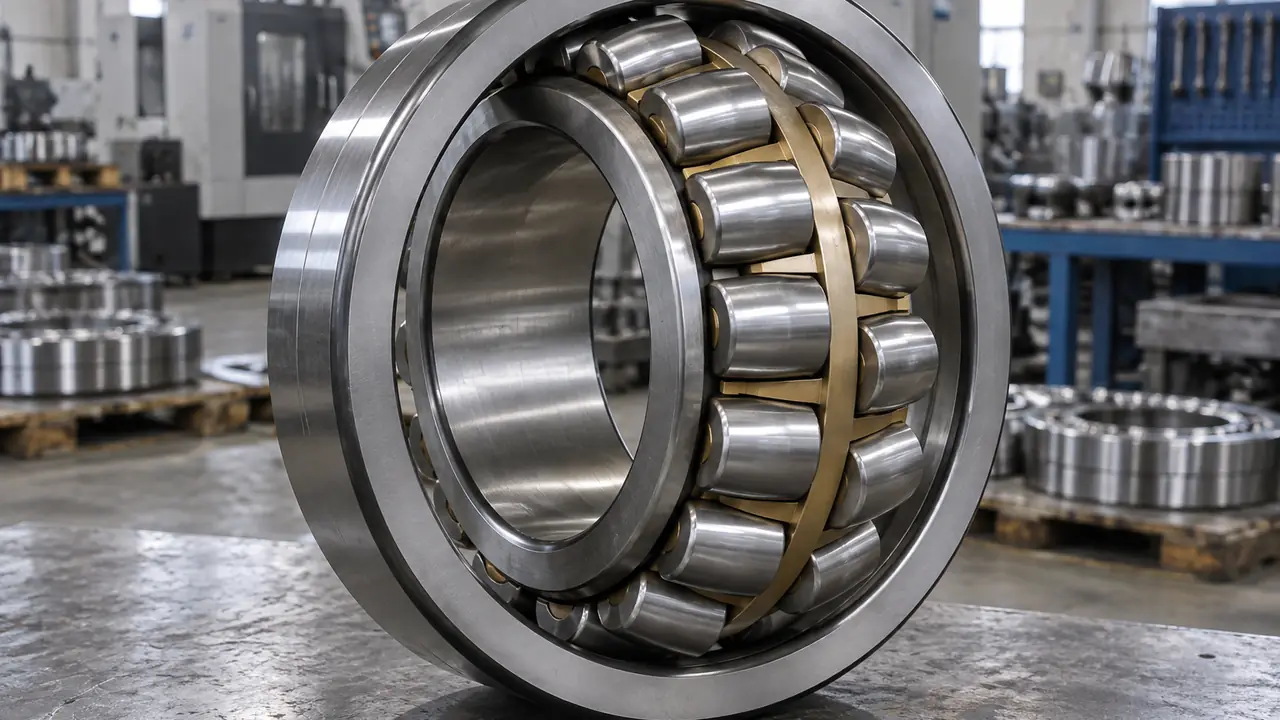
A spherical roller bearing has two rows of barrel-shaped rollers that run on two raceways in the inner ring and a single spherical raceway in the outer ring. Because the outer raceway is part of a sphere, the inner ring and roller set can tilt a small angle relative to the outer ring without edge loading. The rollers are asymmetric barrels, shaped so that they share the load between both rows and tolerate the bending of long shafts and the inaccuracy of fabricated or welded housings.
That combination - heavy radial load, moderate axial load in both directions, and self-alignment - is why this type is chosen where conditions are rough and housings are not machined to precision. It is not a high-speed bearing: friction and heat from the barrel rollers limit speed compared with cylindrical or ball designs. The allowed tilt depends on the series and load, and is given on the datasheet; it is small in absolute terms, a fraction of a degree to a few degrees, so it covers deflection rather than gross misalignment. Compare with self-aligning ball bearings, which tolerate misalignment but carry much less.
Series: 222, 223, 230, 231
| Series | Section | Typical use |
|---|---|---|
| 222 | Wide, light diameter series | Conveyor drives, fans, general heavy duty |
| 223 | Wide, medium diameter | Vibrating screens, crushers, higher load |
| 230 | Very wide, light diameter | Where capacity is needed in a small outside diameter |
| 231 | Very wide, medium diameter | Paper machine rolls, large gearboxes |
Nominal examples from ISO 15: 22208 is 40 x 80 x 23 mm, 22212 is 60 x 110 x 28 mm and 22308 is 40 x 90 x 33 mm. Confirm every dimension against the drawing. The bore code follows the usual multiply-by-five rule, and the extra letters matter: K means a tapered bore, C3 larger clearance, W33 an oil groove and lubrication holes in the outer ring, and E a reinforced internal design. See the designation guide.
Cylindrical or tapered bore
A cylindrical bore is fitted directly to the shaft with an interference fit. A tapered bore (K) fits on a matching tapered seat, or on an adapter sleeve or withdrawal sleeve over a plain shaft. Sleeves let you set the exact interference by driving the bearing along the taper, which also reduces radial internal clearance in a controlled way - you measure the clearance reduction while mounting. They also make removal practical on large, long shafts.
- Adapter sleeve (H series). Mounts the bearing at any point along a plain shaft, locked with a nut and washer.
- Withdrawal sleeve (AH series). Used on stepped shafts, pressed in during assembly and drawn out during removal.
- Locknut and washer. Sold with the sleeve; see bearing accessories.
Clearance selection is critical, because mounting on a taper consumes much of it. C3 is the usual choice on sleeve-mounted bearings in warm service. See C3 clearance explained.
Cages and housings
Pressed steel cages are standard on the lighter series; machined brass cages are used where shock, vibration or high load make a stronger cage worthwhile, as on vibrating screens. Spherical roller bearings run in split or solid housings, often with labyrinth seals; see bearing housings and pillow blocks.
Applications
Typical uses include vibrating screens and feeders, mining and crushing equipment, paper and pulp machine rolls, conveyor pulleys, industrial fans, gearboxes and marine propulsion shafts. Vibrating screens are a particularly demanding case: the bearing sees shock loads and high acceleration, so brass cages and special clearance are common. Industry sources describe the Wafangdian and Luoyang clusters as strong in large and heavy bearings, and the desk draws on plants with that experience for heavy series.
Inspection and ordering
Typical checkpoints: bore and taper form (gauge fit on K bearings), outside diameter and width, radial clearance of the assembled set, roller and raceway finish, cage and oil hole condition, and rust protection. Specify the full designation including suffixes and whether sleeves and nuts are required. Standard designations commonly start from 100-500 pieces; heavy sizes may be quoted in smaller lots; stock samples take 3-7 working days and production 25-45 days. These are typical reference ranges, confirmed in writing for each program. Send your list through the quote form.