
The design in one paragraph
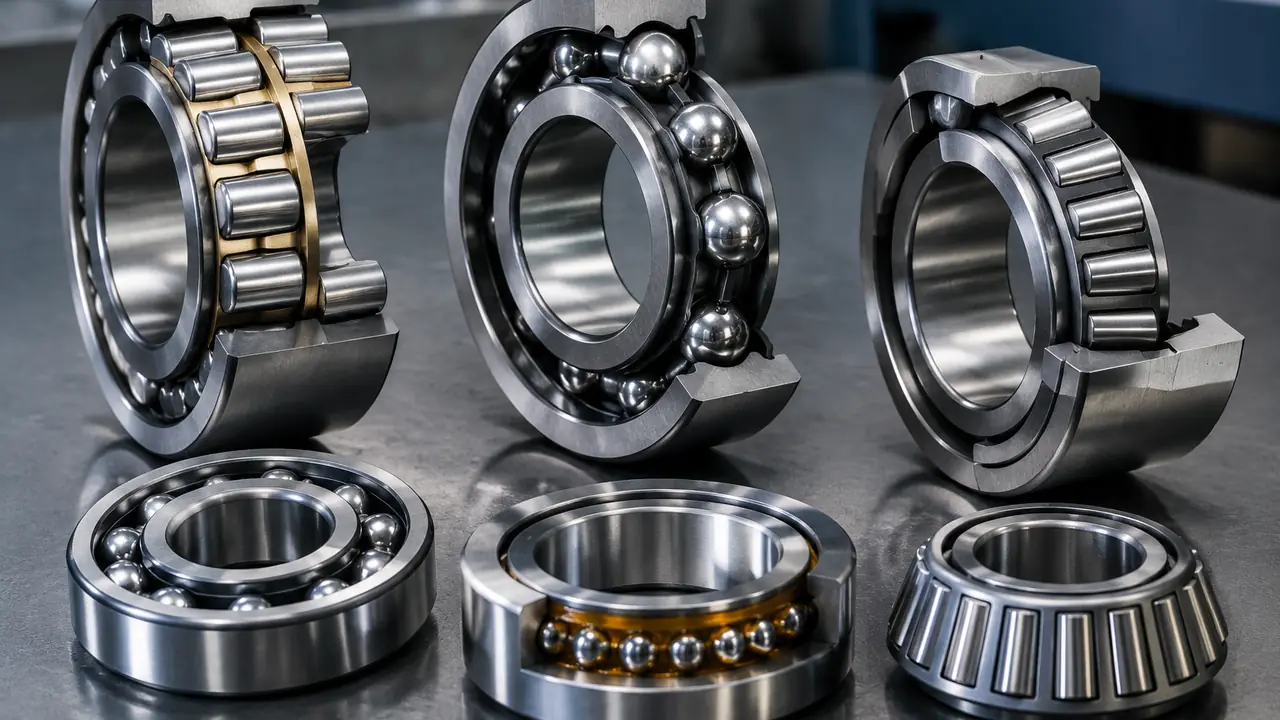
A spherical roller bearing has two rows of barrel-shaped rollers running on a common spherical raceway in the outer ring. Because that outer raceway is a section of a sphere, the inner ring and roller assembly can tilt inside the outer ring without losing contact. Shaft deflection under load, or housing bores that are not perfectly in line, are absorbed by the bearing itself instead of overloading one end of the rollers. The two rows also give the bearing a useful axial capacity in both directions, though its main job is radial load.
That combination makes the type the standard answer for heavy, slow-to-moderate-speed duties in dirty conditions: mining equipment, crushers, vibrating screens, paper-machine rolls, conveyor pulleys, large fans and gearboxes. The permissible tilt angle depends on the series and size and is stated on the supplier datasheet; do not assume a generic figure.
Series and nominal sizes
The common series are 222 (light width) and 223 (wider and heavier), with 230 and 231 for large bores. A heavier series has bigger rollers and rings, and so carries more load in the same bore at the cost of space.
| Designation | Series | Bore d | OD D | Width B |
|---|---|---|---|---|
| 22205 | 222 | 25 | 52 | 18 |
| 22208 | 222 | 40 | 80 | 23 |
| 22308 | 223 | 40 | 90 | 33 |
| 22212 | 222 | 60 | 110 | 28 |
The table is nominal ISO reference data; confirm against the drawing and datasheet. More sizes are in the size chart. Note the visible jump in width from 22208 to 22308 at the same 40 mm bore: it is the extra width and roller size that deliver the extra capacity of the heavier series.
Cylindrical or tapered bore
Spherical roller bearings are offered with a straight bore or with a tapered bore, shown by the suffix K. The standard taper is 1:12 for most sizes.
| Bore type | Mounting | Good for |
|---|---|---|
| Cylindrical | Pressed or heated onto a shaft with interference fit | Repeated production fitting of the same size |
| Tapered (K) | Driven up a tapered seat, or onto an adapter or withdrawal sleeve | Plain shafts, field replacement, easier removal |
Tapered-bore bearings are often mounted with an adapter sleeve on a plain shaft, which avoids machining a tapered seat and allows the bearing to be removed without damage. The sleeve, lock nut and washer are separate parts and must be ordered with the bearing; see bearing accessories and the notes on sleeves and locknuts. A wrong sleeve size is a common cause of delayed installation.
Clearance, cages and lubrication features
Internal clearance matters more here than in small ball bearings because the interference fit and the temperature difference between the rings close the clearance during operation. Normal clearance is the default, with C3 and C4 widely used on vibrating screens, in large motors and where heavy fits or hot shafts are present. State the clearance group by name. For tapered-bore bearings, the clearance is reduced as the bearing is driven up the taper, so the starting clearance and the drive-up must be matched; follow the supplier mounting instruction.
Cage choice affects speed, vibration tolerance and cost. Pressed steel cages are common in standard sizes; machined brass cages are widely used in heavy vibrating duties, and some plants offer window-type steel cages with a guide ring. Many designations also have a lubrication groove and holes in the outer ring, shown by a suffix such as W33, which allows grease to be applied through the housing. State whether you need that feature. The Wafangdian cluster is known for large bearings; the desk shortlists partner plants for large sizes per project (see industry clusters).
Housing, seals and the surrounding parts
A spherical roller bearing is rarely bought alone. It usually runs in a split or solid housing, often a plummer block with grease seals, and the sealing of that housing decides whether the bearing survives a quarry, a sawmill or a paper machine wet end. Sourcing the housing, seals, sleeve and lock hardware together reduces the risk that one missing part holds up a whole installation. The housing seat must be accurate and clean, with a bore tolerance suited to the outer ring, and the shaft seat must be within the diameter and roundness limits that the supplier specifies. See bearing housings for the housing families.
Remember that misalignment capacity is a safety margin, not a design target. A bearing running continuously at its maximum tilt will run hotter and wear faster, so aligned installation remains good practice. Vibration monitoring and grease sampling on site tell you more about the health of a large bearing than any single inspection at the receiving dock.
Spherical roller or self-aligning ball
If the load is moderate and the speed is higher, a self-aligning ball bearing may do the job at lower cost. If the load is heavy, shock is present or the site is dusty and wet, the spherical roller bearing is the usual choice. The two are compared in spherical roller vs self-aligning ball bearings. Speed capability is lower than for a deep groove bearing of the same bore; limiting speeds come from the datasheet.
Checklist for the RFQ
- Designation with series and bore, and K if a tapered bore is needed.
- Adapter sleeve, withdrawal sleeve, lock nut and washer, if required.
- Clearance group, cage type, and lubrication groove and holes.
- Application: vibrating, shock, speed, temperature, misalignment angle expected.
- Housing type if a plummer block is also being sourced.
- Quantity per designation, marking, packing and heavy-item handling.
Ask the partner plant for a dimensional and visual first-article report on the first lot, including bore taper where relevant, clearance group, cage fit and the surface condition of rollers and raceways. For large bearings, agree the handling method in advance, since a ring dropped on a concrete floor can be damaged invisibly. Heavy bearings need careful packaging: rust-preventive oil, VCI wrapping and wooden pallets or cases for the larger sizes. Reference MOQs for standard sizes are typically 100 to 500 pieces for small bores, while large bores are often ordered in single or small quantities, confirmed in writing per program. Check MOQ and lead time and send the specification through the quote form.