
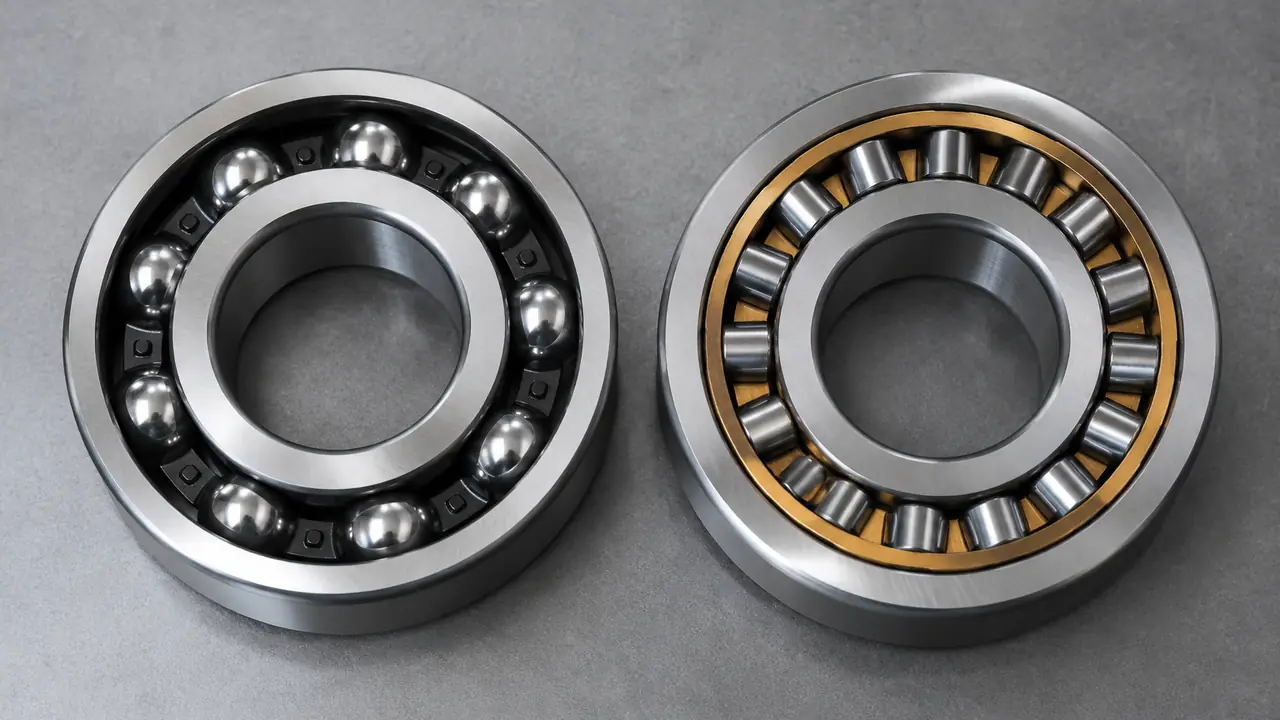
The shared idea: a spherical outer raceway
In most bearings, the raceway is a groove of constant radius around the ring, and the shaft must stay square to the housing. In both of these designs, the outer ring raceway is a section of a sphere. The inner ring and rolling elements can therefore tilt as a unit inside the outer ring, so the bearing keeps working when the shaft bends under load or when two housings do not line up exactly. That is why they appear in long drive lines, conveyor pulleys, fans and agricultural equipment.
The difference is in the rolling elements. The self-aligning ball bearing has two rows of balls running in a single spherical outer raceway; the spherical roller bearing has two rows of barrel-shaped rollers doing the same. Point contact against line contact brings the usual differences in load, speed and friction, as in the broader ball vs roller bearings comparison.
Side-by-side comparison
All comparisons are relative. Permissible misalignment angles, load ratings and limiting speeds depend on size and series (typical series are 12, 13, 22, 23 for self-aligning ball and 222, 223, 230 for spherical roller) and come from the supplier datasheet.
| Criterion | Spherical roller | Self-aligning ball |
|---|---|---|
| Load direction | Heavy radial plus moderate axial in both directions | Light to medium radial plus small axial in both directions |
| Load capacity | Very high; copes with shock and vibration | Low to moderate for the size |
| Speed | Medium; heat from roller friction limits it | High; low friction, low heat |
| Misalignment tolerance | High, sized for shaft deflection and mounting error | High; often the larger permissible angle for light duty |
| Friction and noise | Higher torque, audible under light load | Low torque, quiet |
| Maintenance | Relubrication via housing; often oil or grease with a feed | Often sealed and lubricated for life in small sizes |
| Typical applications | Mining, paper machines, vibrating screens, crushers, heavy fans | Agricultural shafts, light fans, line shafts, textile machines |
| Relative cost factors | High; complex rollers, cages, larger sizes, smaller volumes | Lower; simple balls, common in standard sizes |
Load: the first filter
Choose by load before anything else. A spherical roller bearing is built for heavy radial load, with line contact on barrel-shaped rollers and a high capacity for the size. It is used where a self-aligning ball bearing would be overloaded: crushers, vibrating screens, paper machine rolls, mining conveyors, heavy fans. It also carries axial load in both directions, in addition to the radial load, which is helpful on shafts with some thrust.
A self-aligning ball bearing is a light-duty solution. It carries moderate radial load and a small axial load, and is chosen when the load is modest but alignment cannot be assured. A frequent mistake is to use it in a heavy application because it tolerates misalignment, and then replace it repeatedly because it is overloaded.
Misalignment: both tolerate it, with limits
Both designs accept a shaft tilt that would damage a normal bearing, and both have a limit. Self-aligning ball bearings are often the more tolerant in angle for light duty. Spherical roller bearings accept less angle than they appear to, particularly under heavy load, where large tilt reduces life. The figure to rely on is the permissible misalignment given for the specific series by the supplier. Even self-aligning bearings do best when the misalignment is as small as possible, and mounting accuracy is never a substitute for sound design. For the effects of misalignment in general, see bearing misalignment: effects and tolerances.
Speed, friction and temperature
The self-aligning ball bearing wins on speed and friction because of point contact. It runs cool, starts easily and is quiet. The spherical roller bearing generates more heat, especially with high speed and light load, when the rollers can slip. It prefers steady load, and in some cases a minimum load is advised by the supplier. Cage material shapes behaviour too: machined brass cages and pressed steel cages are common in roller types, while steel and polymer cages appear in ball types; see nylon vs steel bearing cages.
Mounting, sleeves and housings
Both families are offered with a tapered bore, which allows mounting on a shaft with an adapter or withdrawal sleeve. This eases mounting on plain shafts and allows adjustment of internal clearance. Sleeves, locknuts and lock washers are part of the bearing accessories line. Also check the housing: a split housing or a pillow block suits spherical bearings in heavy equipment, while the pillow block bearing unit with a spherical outside surface is a different route to self-alignment, using a self-aligning seat rather than a self-aligning raceway.
Typical failure patterns
The two types fail in different ways, and knowing them helps in the specification. A self-aligning ball bearing that is overloaded shows early fatigue on the raceway and a rough, noisy run; because the contact area is small, damage spreads quickly. A spherical roller bearing that runs too lightly loaded shows smearing and scuffing, where rollers skid instead of rolling. Both suffer if the lubricant is wrong or contaminated. If you see these patterns on returned parts, review the load and the lubrication before changing supplier. The bearing failure causes note shows the common patterns.
Sourcing notes
For both types, state the series, the bore type (cylindrical or tapered), the cage, the internal clearance group and any sleeve. Spherical roller bearings are most often ordered in C3 clearance for heavy-duty or hot shafts; confirm the group against the application. Reference MOQ and lead time ranges are on the MOQ and lead time page and are confirmed in writing for each program. Larger spherical roller sizes tend to be made by specialist plants in the large-bearing clusters described on the industry clusters page.
How to decide
- Estimate the load and whether shock or vibration is present. Heavy or shock load points to spherical roller.
- Check the speed relative to the size. High speed with light load points to self-aligning ball.
- Estimate the misalignment from shaft deflection and housing positions. If it is small, a normal bearing may do.
- Check the axial load; both take small to moderate axial load in both directions.
- Decide the lubrication method. Heavy-duty housings with relubrication suit roller types; small sealed units suit ball types.
- Confirm the choice against the datasheet ratings, then request samples.
Send shaft diameter, load, speed and the source of misalignment through the quote form.