
| Designation | Type | d bore | D outside | B width |
|---|---|---|---|---|
| 1200 | Self-aligning ball | 10 | 30 | 9 |
| 1202 | Self-aligning ball | 15 | 35 | 11 |
| 1204 | Self-aligning ball | 20 | 47 | 14 |
| 1205 | Self-aligning ball | 25 | 52 | 15 |
| 1206 | Self-aligning ball | 30 | 62 | 16 |
| 1208 | Self-aligning ball | 40 | 80 | 18 |
| 2204 | Self-aligning ball | 20 | 47 | 18 |
| 2205 | Self-aligning ball | 25 | 52 | 18 |
| 2206 | Self-aligning ball | 30 | 62 | 20 |
| 2208 | Self-aligning ball | 40 | 80 | 23 |
Nominal ISO boundary dimensions for reference. Confirm against your drawing and the supplier datasheet.
What makes a bearing self-aligning
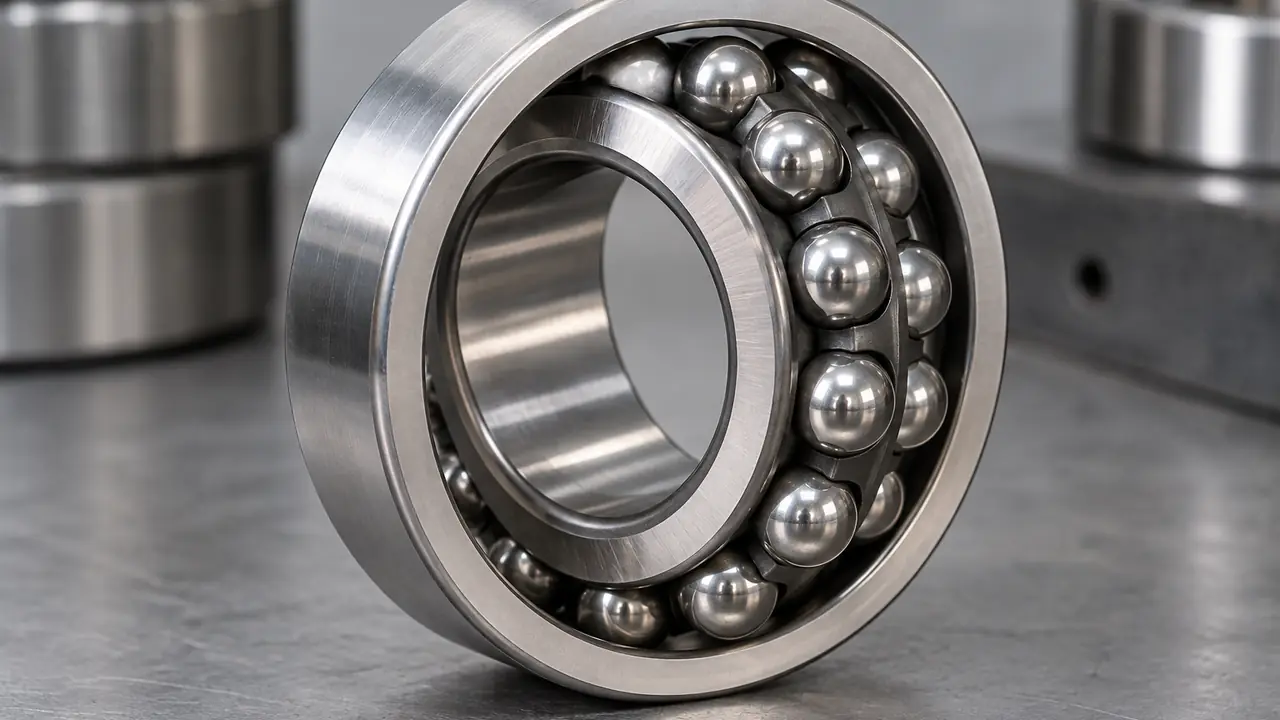
A self-aligning ball bearing has two rows of balls running on a single deep groove pair in the inner ring and a common spherical raceway in the outer ring. Because the outer raceway is part of a sphere centred on the bearing, the inner ring and ball set can tilt inside the outer ring without binding. The bearing therefore tolerates misalignment between shaft and housing that would overload a rigid bearing such as a deep groove ball bearing.
Misalignment arises more often than drawings suggest: long shafts deflect under load, welded or cast housings are bored at separate set-ups, and frames flex in service. Where two bearing seats cannot be machined in one pass, a self-aligning bearing removes the alignment requirement and protects the raceways from edge loading. The trade-off is lower load capacity than a rigid bearing of the same size, and the permitted tilt is small - it is not a substitute for a flexible coupling or a joint.
Series and sizes
The 12 and 13 series are the narrow double-row designs, and the 22 and 23 series are wider at the same bore and outside diameter, with larger balls and higher load capacity. Examples of nominal boundary dimensions:
| Designation | Bore d | Outside D | Width B |
|---|---|---|---|
| 1204 | 20 | 47 | 14 |
| 2204 | 20 | 47 | 18 |
| 1206 | 30 | 62 | 16 |
| 2206 | 30 | 62 | 20 |
The 1204 and 2204 share a bore and outside diameter but differ in width, which is the point of the wide series: more ball capacity in the same housing bore. The tables are nominal; load ratings and limiting speeds come from the supplier datasheet for each designation.
Cylindrical and tapered bore
Self-aligning ball bearings are available with a cylindrical bore or a tapered bore, shown by the suffix K, with a nominal taper of 1:12. A tapered-bore bearing is mounted on an adapter sleeve, a split sleeve with a nut and locking washer, so the bearing can sit on a plain shaft without a shoulder or a press fit. Moving the bearing along the sleeve reduces internal clearance, which is how the fit is set. This arrangement is common on line shafts, agricultural machinery and conveyor drives, where a long plain shaft carries several bearings. Matching sleeves, nuts and washers are covered on the bearing accessories page.
Where they are used
- Agricultural machinery with long shafts and welded frames.
- Conveyor and transmission shafts mounted on several pedestals.
- Textile, woodworking and packaging machinery with flexible frames.
- Fans and blowers where housings are cast and bored separately.
When load is heavy and misalignment is present, a spherical roller bearing is the stronger solution, as it combines the same self-aligning behaviour with much higher radial capacity. The self-aligning ball bearing is chosen for light to medium loads and higher speed.
Fits, mounting and limits
Self-aligning ball bearings are sensitive to how they are installed. On a cylindrical bore, a light interference fit on the shaft keeps the inner ring from creeping; on a tapered bore, the drive-up on the sleeve must be controlled so that the remaining radial clearance is not used up. Pushing a tapered-bore bearing too far is a common cause of early heat and noise. Outer rings should sit in the housing with a sliding fit so the bearing can float axially when it is the non-locating support on a shaft.
Keep in mind the limits as well. Self-aligning ball bearings carry little axial load compared with their radial capacity, and the axial load must stay light because the spherical raceway offers less contact support than a deep groove. If a shaft needs axial location, fix it with a different bearing at the other end. Speed capability is moderate, and contact seals add friction. For tighter control of heat and noise, ask the desk to confirm grease and fill with the partner plant before the first order.
Options and checks
State the bore type, clearance group (CN, C3 or C4 as the fit requires), cage, seals if required and grease. Typical checks per lot include bore and outside diameter, width, radial clearance for the ordered group, taper form for K bearings, rotation smoothness and appearance. The report ships with each lot; see testing and inspection.
Standard sizes typically start at 100-500 pieces per designation, with samples in 3-7 working days from stock and batch production commonly in 25-45 days, all confirmed in writing for each program. Send designations through the quote form.