
What misalignment is
A rolling bearing is designed to run with the inner and outer ring axes parallel and on the same line. Misalignment is any departure from that condition. It comes in two basic forms. Angular misalignment, or tilt, means the ring axes cross at a small angle. Offset misalignment means the housings are not on one line, so a shaft that passes through two bearings is forced into a bend between them. In practice both usually occur together, along with shaft deflection under load.
Because the rolling elements are shaped for a precise match with the raceway, any tilt changes the contact. Instead of an even stress along the roller line or around the ball track, load shifts to one edge or one side. Stress at that point rises sharply, the lubricant film thins locally and the cage is pushed unevenly. The result is higher temperature, noise and fatigue that begins far earlier than calculated.
Effects on different bearing types
| Bearing type | Tolerance to misalignment | Effect when exceeded |
|---|---|---|
| Deep groove ball | Very small; limit depends on clearance and load, from the datasheet | Noise, heat, cage stress, early fatigue |
| Angular contact ball | Very small, especially in pairs | Uneven load sharing, preload change, heat |
| Cylindrical roller | Very small | Edge stress at roller ends, skewing, spalling |
| Tapered roller | Very small | Edge loading on the rib, rapid wear |
| Self-aligning ball | Designed to accommodate it | Operates normally within the limit given by the supplier |
| Spherical roller | Designed to accommodate it | Operates normally within limit; heavy loads still need care |
| Housed unit with spherical seat | Accommodates mounting errors | Normal operation, but seat must be locked correctly |
The permitted angle is expressed in minutes of arc or in a ratio such as millimetres per metre, and values differ by series and load. Quote only figures from the supplier's datasheet or the equipment maker for a given designation; this note gives the principle, not limits. Typical rigid bearings can take only a very small tilt before life drops; the self-aligning designs described in self-aligning ball bearings and spherical roller bearings accept considerably more.
Where misalignment comes from
- Housing errors. Two housings bored in separate set-ups, a frame that distorts when bolted down, or a pillow block on an uneven base.
- Shaft errors. A bent shaft, a shoulder that is not square to the axis, a burr under the ring face, or a fit that tilts the ring.
- Mounting errors. A ring driven on crooked, a locknut face not square, or a bearing pressed against a worn seat.
- Deflection in service. Heavy loads bend long shafts. Thermal growth moves housings out of line.
- Coupling and belt effects. A misaligned coupling adds bending to the shaft; an over-tight belt pulls the shaft towards the load.
Housing machining accuracy and shoulder squareness are part of the same discussion as fits and clearance; see the tolerance and clearance guide and the shaft and housing fits note.
Signs of misalignment on a removed bearing
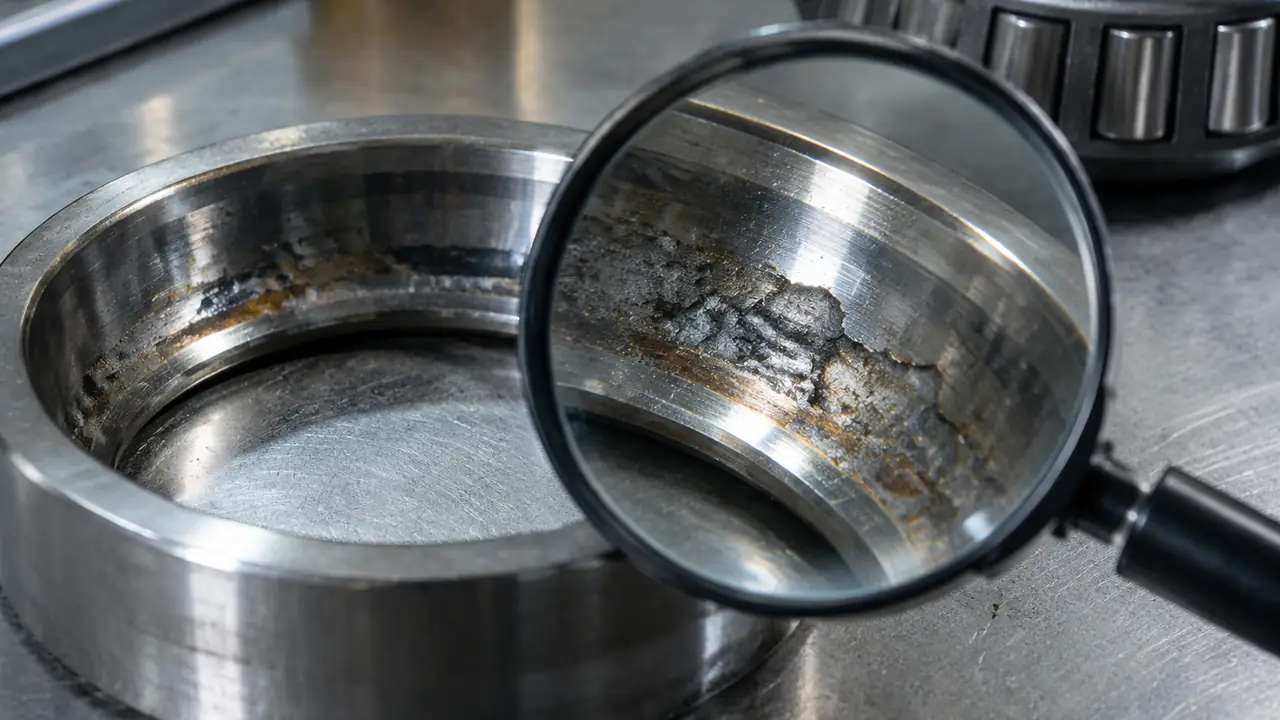
The raceway pattern is the best evidence. In a correctly loaded radial bearing, the wear track lies in the centre of the raceway across the load zone. With tilt, the track shifts towards one shoulder on the inner ring and the opposite shoulder on the outer ring, giving a diagonal pattern. In cylindrical and tapered rollers, burnishing and wear appear at one end of the roller. In ball bearings, a wider track on one side of the ring and a cage pocket worn on one face are typical. Heat discolouration and grease dark on one side add to the picture. The patterns are compared with other damage in reading spalling and fatigue damage.
How misalignment shortens life
The effect on life is steeper than most people expect. The life formula in ISO 281 uses a power of the load, so even a modest increase in the effective load on part of the raceway cuts life sharply. A tilt that doubles the stress on one edge of a roller can reduce life there to a small fraction of the calculated value, because the local stress rather than the average stress decides where fatigue starts. At the same time, tilt increases friction, so the bearing runs warmer, the grease ages faster and the film becomes thinner, and these effects compound.
Cage and seal damage follow as secondary effects. A tilted ring pushes the cage against the pockets unevenly and can overload it at speed. Contact seals rub on one side and wear unevenly, letting contamination in. By the time noise appears, the damage is often well advanced, and the root cause may be masked by secondary failures such as seal wear and grease degradation.
Practical tolerances and checks
- Check shoulder squareness and seat roundness at the shaft and the housing with a dial gauge or measuring machine.
- Measure shaft runout at the bearing seats while rotating between centres.
- Align housings before tightening, using a straight edge, laser alignment or a mandrel through both bores.
- Check coupling alignment with the machine at operating temperature if possible.
- Use mounting tools that push on the correct ring and keep the bearing square to the shaft.
- For long shafts, base plates or housings that cannot be kept in line, specify a self-aligning bearing or a spherical seat.
Choosing designs that forgive
When misalignment is unavoidable, such as in long conveyor shafts, heavy fans or fabricated frames, pick a design that tolerates it. Spherical roller bearings carry heavy loads with misalignment; self-aligning ball bearings handle lighter loads at speed; housed units with spherical outer rings and a rocking seat accept mounting errors on farm and conveyor frames. The trade-off is lower speed capability or load capacity compared with rigid designs, set out in spherical roller vs self-aligning ball bearings. The housed unit option is on the pillow block bearing page.
For orders, state the expected misalignment, shaft length, load and speed, so that the partner plant can propose a suitable series and internal clearance. Lead times for stock and non-standard types follow the reference ranges in MOQ and lead time, confirmed in writing for each program. The wider list of failure causes is in bearing failure causes.