
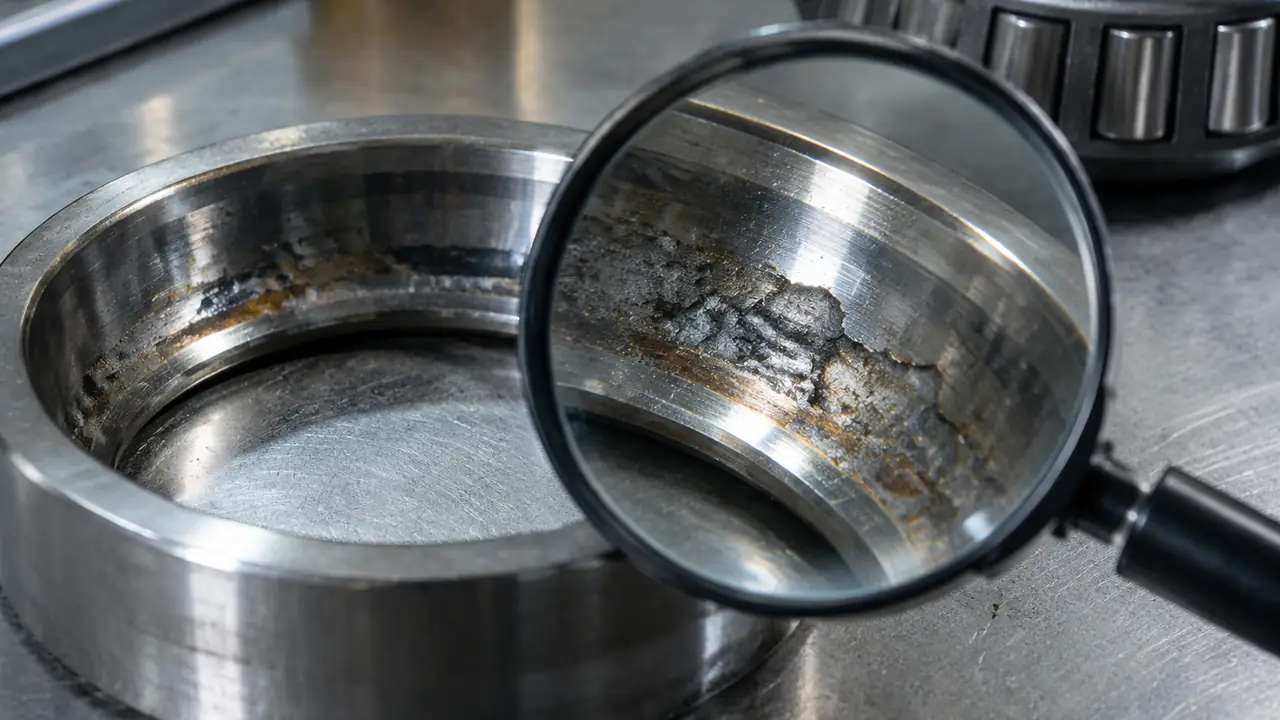
What spalling is
Every rolling bearing carries load through very small contact areas. Under a ball or roller, the steel is stressed to a depth of a fraction of a millimetre, and each passing element repeats that stress cycle. After enough cycles, microscopic cracks form in the stressed zone, grow towards the surface and let a small flake of material break away. The resulting crater is called a spall. In the classification of ISO 15243 this is the fatigue family of failure modes.
Spalling is gradual. The first spall is small, but once the surface is broken, the rolling elements hammer the edge of the crater on every pass, vibration rises, debris contaminates the grease and the damage spreads. A bearing with a small spall may run for hours, days or weeks, depending on load and speed, which is why monitoring vibration is useful. Eventually the raceway is destroyed, the cage may break and the bearing locks or overheats.
Normal fatigue and early fatigue
Designers accept fatigue as the natural limit of a well-run bearing. The ISO 281 rating life, explained in the L10 calculation note, is a statistical statement: a group of identical bearings run under the same conditions will start to spall over a spread of lifetimes, and a defined proportion will have failed by the rated life. A bearing spalling at about its calculated life under stated conditions is a normal end.
Early fatigue is different. It points to conditions that were worse than the calculation assumed. The most common are higher load than expected, shock, a lubricant film that was too thin for the speed and temperature, contamination that dented the raceway, tight fits that reduced clearance, and misalignment that overloaded one edge. Poor steel cleanliness or heat treatment can also reduce life; those cases tend to appear as scattered early failures across different machines in one batch.
Reading the pattern
| What you see | What it suggests | What to check |
|---|---|---|
| Spall in the load zone of one ring only, widening gradually | Normal fatigue or moderate overload | Load versus rated load; running hours |
| Spalls spaced at ball or roller pitch on a ring | Dents from impact or mounting force | Mounting method, transport, shock events |
| Spalling starting at small pits around the track | Debris indentation then fatigue | Seals, grease and housing cleanliness |
| Band of spalls on one side of the track | Misalignment or tilt | Housing alignment, shaft deflection |
| Spalling on both rings and rolling elements | Overall overload or very thin lubricant film | Lubricant viscosity at temperature, load |
| Spalls at 180 degrees apart on outer ring | Out-of-round housing squeezing the ring | Housing bore roundness and fit |
| Spalls at the edge of a roller track | Edge loading, tilt or axial overload | Axial location, shoulder squareness |
Surface-initiated and subsurface fatigue
Classic fatigue starts below the surface where shear stress peaks, in a clean, well-lubricated bearing. Modern clean bearing steel and good lubrication have made this form rarer in practice. Many real-world spalls start at the surface instead, at points where the lubricant film is too thin to separate the rolling surfaces fully. Asperities touch, micro-cracks form, and the crack grows into a spall. This is why viscosity and grease selection matter so much; see bearing grease selection.
A related feature is smearing, in which rolling elements skid and weld a thin layer of material onto the raceway. It happens when the bearing is lightly loaded and accelerated quickly, such as on a fast-starting machine with a large cage mass, or when lubricant is too stiff in the cold. It is not fatigue itself, but a smeared surface is a good place for fatigue to begin.
Why the lubricant film decides so much
The ratio between the actual oil viscosity at operating temperature and the viscosity needed for the bearing size and speed is the key to life in practice. When the ratio is high, a continuous film separates the surfaces and fatigue life can exceed the basic calculation. When it is low, the surfaces touch, and life falls sharply. Heat lowers viscosity, so a bearing that runs hotter than planned loses film strength. That is why overheating and fatigue are linked, and why the checks in bearing overheating belong in any fatigue investigation. Grease bleeds base oil into the contact, so the base oil viscosity and the age of the grease determine the film in service.
Cleanliness has a similar effect. Hard particles that pass through the contact leave dents, and each dent raises local stress at its rim. A bearing in a clean sealed housing may exceed its calculated life by a large margin, while the same bearing in a dusty site may fail in a fraction of it. Buyers specifying for harsh sites should therefore look at seal design and housing protection together with the bearing series.
What not to conclude
Do not assume that a spalled bearing was a poor product. The pattern often says otherwise. If the spalls sit at ball pitch, ask about the mounting. If they are on one side of the track, ask about alignment. If a batch fails at roughly the same hours in the same duty, the application may be demanding more than the bearing size can give, and a larger series, a roller design or a different lubricant is the answer. The comparison of series is in the size chart, and the choice between ball and roller is in ball vs roller bearings.
Supplier-side causes
Fatigue can also be influenced by factors that the supplier controls: steel cleanliness, heat treatment depth and hardness, raceway finish and geometry, and internal clearance. For imported bearings these are the items that a buyer can address in advance through batch records, hardness checks and a defined inspection plan. The desk agrees such items with partner plants for each program and confirms them in writing; the list of checks is in testing and inspection, and the steel grade background is on the bearing steel page. The wider failure picture is in bearing failure causes.
Practical steps after a spall is found
- Replace the bearing and also inspect the shaft and housing seats, seals and the lubrication route.
- Compare the pattern with the table above and record load, speed and temperature at the time.
- If the damage is near the calculated life, consider whether a longer-life series or a roller design is better for future builds.
- If the damage is early, fix the root cause before ordering the same bearing again.
- Keep a note of the batch number of the failed bearing and the replacement.