
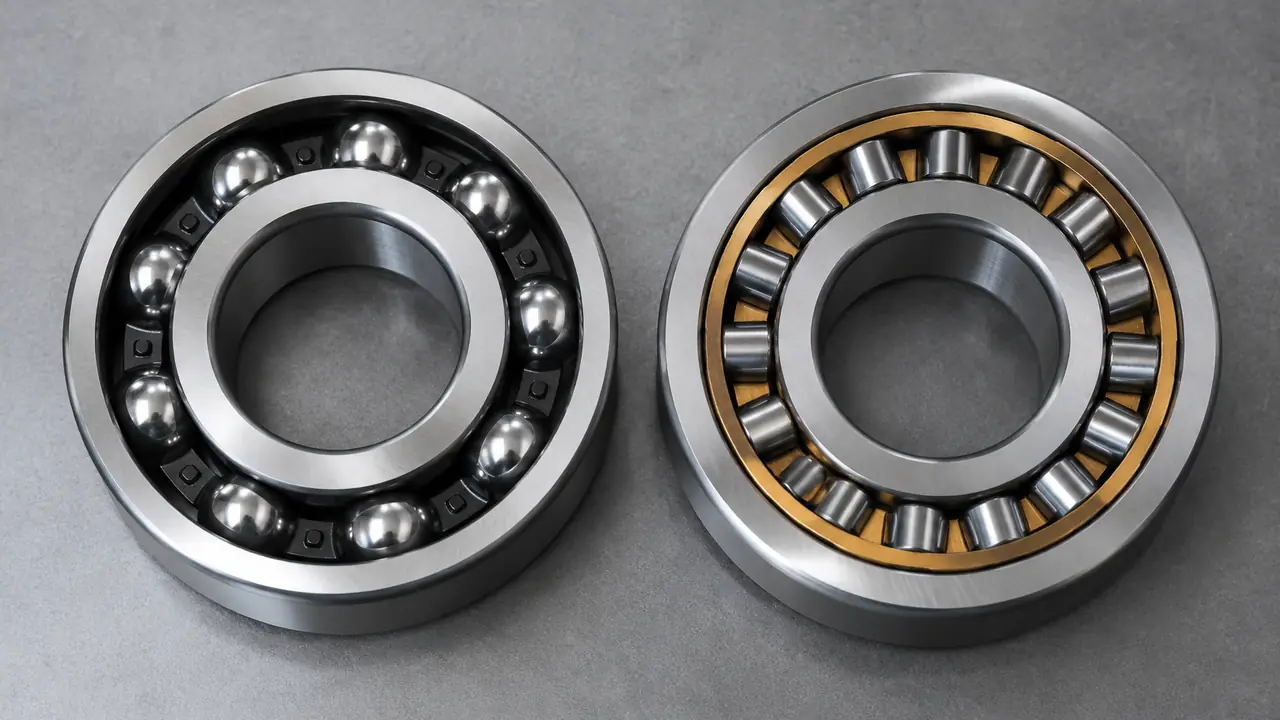
Point contact against line contact
A ball in a groove touches each ring at a single point, which under load deforms into a small oval patch. A roller touches each ring along a line, which deforms into a long, narrow rectangle. The roller patch is much larger for the same envelope, so the same load produces lower contact stress, and the bearing can carry more. The ball patch is smaller, so there is less rolling resistance and less heat at speed.
Everything else in the comparison comes from this. Rollers are stiffer and carry heavier and shock loads; balls are quieter, faster and more tolerant of light load. In both families the load capacity and speed limit for a specific designation are published by the supplier, so this article stays with relative comparisons and leaves the numbers to the datasheet.
Side-by-side comparison
| Criterion | Ball bearings | Roller bearings |
|---|---|---|
| Load direction | Radial, moderate axial (deep groove); combined (angular contact); axial only (thrust) | Radial (cylindrical); combined (tapered); heavy axial (thrust roller); radial plus misalignment (spherical) |
| Load capacity | Light to medium for the size | Medium to heavy for the same size; handles shock better |
| Speed | Higher, low heat generation | Lower at the same size; rises with precision designs |
| Misalignment tolerance | Low, except self-aligning ball types | Very low for cylindrical and tapered; high for spherical roller |
| Friction and noise | Lower torque, quieter | Higher torque, more audible under light load |
| Maintenance | Often sealed and lubricated for life | Usually open and relubricated, or oil-fed |
| Typical applications | Motors, fans, appliances, pumps, light gearboxes | Wheel hubs, gearboxes, rolling mills, crushers, heavy conveyors |
| Relative cost factors | Lower unit cost, high volumes, wide stock | Higher unit cost, tighter tolerances, smaller stock range |
Load: where rollers win
If the shaft carries a heavy or shock load, a roller bearing is the natural choice. A cylindrical roller bearing carries high radial load in a compact section. A tapered roller bearing carries heavy radial and axial load together, which is why vehicle wheel hubs and gear reducers rely on them. A spherical roller bearing adds tolerance of misalignment for the heaviest duty. For the same bore and outside diameter, a roller bearing is stiffer and shows less deflection.
The corollary is that roller bearings need load to run properly. If the load is very light, the rollers can skid instead of roll, which scuffs the raceway. A ball bearing is more forgiving of light, variable or unknown load.
Speed and noise: where balls win
Ball bearings are the standard answer for fast shafts, light loads and low noise. Electric motors, fans, blowers and household appliances use deep groove ball bearings because they run cool, start easily and are available in a wide range of seals and noise grades. For very high speed, precision angular contact balls and hybrid ceramic bearings extend the range, as covered in the high-speed bearing line.
Noise is where buyers notice the difference first. A ball bearing with a good raceway finish hums softly; a roller bearing under light load can growl. For consumer equipment where noise is a quality criterion, the vibration grade (Z1 to Z3) is agreed with the supplier for each order.
Axial load and the middle ground
The choice is not always one or the other. Deep groove ball bearings carry modest axial load in both directions and often suit a shaft that sees a little of both. When the axial component is large, there are two paths: an angular contact ball bearing for higher speed and precision, or a tapered roller bearing for higher load and stiffness. The comparison of those two is in deep groove vs angular contact, and for the roller side see tapered vs cylindrical roller bearings.
Cost, stock and supply
Ball bearings are made in the greatest numbers, with the widest standard range of sizes, so they are easier to source quickly and at the lowest relative unit cost. Roller bearings require precisely ground rollers and, for tapered types, matched cone and cup sets, so they cost more per unit and are usually held in a narrower stock range. In both cases, steel grade, tolerance class, cage and grease change the supply picture more than the type itself. For reference MOQ and lead time ranges, see MOQ and lead time; ranges are confirmed in writing for each program.
One more point for importers: the cost of the wrong choice is larger than the price difference between types. A ball bearing that is overloaded fails early and drives warranty cost; a roller bearing used where a ball bearing would have done adds weight, torque and noise for nothing.
Mounting and handling differences
The two families also differ in how they are fitted. Most ball bearings are non-separable: rings and balls are held together by the cage and are pressed on as one unit, which suits simple assembly lines. Cylindrical and tapered roller bearings are separable, so the inner and outer assemblies can be mounted independently with interference fits on both rings. That helps on heavy shafts and in housings that must be opened for maintenance, but it also means the mounting has to be done carefully, with the correct setting or preload for tapered types.
Roller bearings are also less forgiving of shaft and housing form errors. A slightly out-of-round seat that a ball bearing tolerates can concentrate load on one end of a roller. If your supplier chain machines the housings in several places, include the seat tolerance in the specification and see the fits explained in the tolerance and clearance guide.
How to decide
- Write down the load pattern: radial, axial or combined, and whether it includes shock.
- Check the speed relative to the bearing size. High speed with light load points to balls.
- If load is heavy, shock is present, or stiffness matters, move to rollers; pick cylindrical for radial, tapered for combined.
- If the shaft will flex or housings will not line up, look at spherical roller or self-aligning ball bearings.
- Check space: a needle roller bearing is the thinnest option when radial room is tight.
- Confirm the choice against the datasheet ratings for the exact designation, then request samples.
When the answer is unclear, send the application details through the quote form and ask the desk to shortlist one ball and one roller option for comparison.