
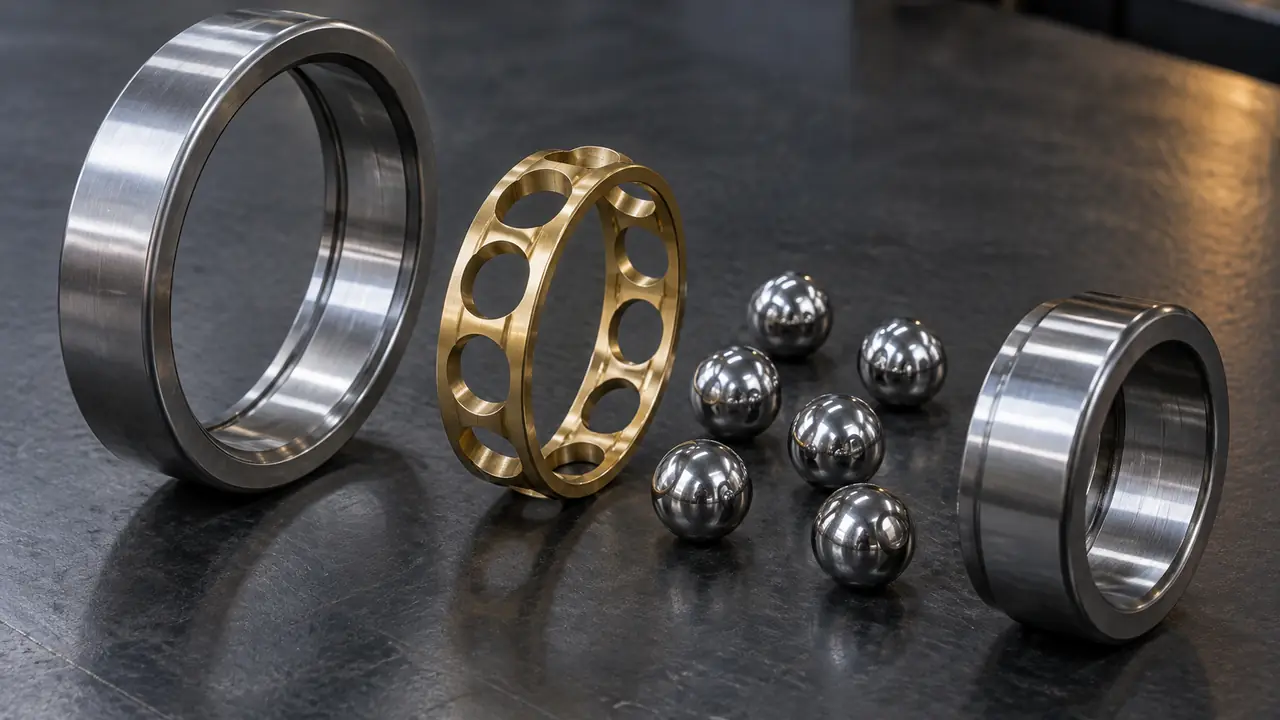
Point contact versus line contact
A ball touches its raceway at a single point that spreads into a small oval under load. A roller touches along a line that spreads into a narrow rectangle. The load is shared over a longer contact length, so the pressure at any spot is lower. For the same bore, outside diameter and width, a roller bearing therefore carries more radial load than a ball bearing, and it is stiffer, deflecting less under that load.
The price of line contact is friction and sensitivity. Rollers generate more drag than balls, so limiting speeds are lower in similar sizes, and they are less tolerant of shaft bending or poor alignment. Roller bearings also prefer a minimum load: running them unloaded can make rollers skid. These characteristics decide where roller bearings are used, and they explain why the usual selection rule is "roller for load, ball for speed". The comparison in more detail sits in ball vs roller bearings.
Four roller shapes, four jobs
| Roller shape | Bearing line | Main strength | Typical place |
|---|---|---|---|
| Cylinder | Cylindrical roller | High radial load, high speed for a roller type | Gearboxes, large motors, pumps |
| Cone (tapered) | Tapered roller | Radial and one-way axial load together | Wheel hubs, axles, reducers |
| Barrel (spherical) | Spherical roller | Heavy load with misalignment | Mining, paper machines, vibrating screens |
| Thin needle | Needle roller | High load in a small radial section | Transmissions, gear pumps, rocker arms |
A fifth family, thrust roller bearings, arranges cylinders or barrels in a flat plane to carry heavy axial loads. These are discussed in the thrust bearing note.
How cylindrical and tapered types differ in practice
Cylindrical roller bearings in NU, NJ, NUP and N configurations differ in how the rings are shouldered. An NU bearing has no shoulders on the inner ring and lets the shaft float axially, which is useful when the shaft expands with heat. An NJ or NUP bearing adds shoulders so it can guide the shaft in one or both directions. Because rollers can slide axially along the raceway, the inner ring and the roller set can usually be separated for mounting.
Tapered roller bearings have conical rollers running between a cone (inner ring with rollers and cage) and a cup (outer ring). The geometry of cone and cup makes the load path angled, so the bearing takes combined radial and axial load but only in one axial direction. They are therefore mounted in opposed pairs and adjusted to a specific end play or preload. Sizes follow ISO 355 for metric series, and inch series exist for automotive and agricultural parts, which is why sourcing teams must confirm which system a part number belongs to.
Materials and heat treatment
Roller bearings use the same family of steels as ball bearings, mainly high-carbon chromium steel such as GCr15 (comparable to AISI 52100 and 100Cr6). Larger sections are often case-carburised steel, because a hard surface layer over a tougher core suits shock load and heavy rings. The rollers themselves are ground to tight diameter and profile tolerances. A slightly crowned roller profile avoids stress peaks at the roller ends, and manufacturers mention this on datasheets as a "modified line contact" or logarithmic profile. The steel and component pages, bearing steel and bearing roller, cover the supply side.
Cages, clearance and lubrication
Roller bearings use cages for the same reason ball bearings do, but the job is harder. The cage must hold each roller square to the raceway; a roller that tilts under load skews, and skewing creates heat and axial thrust on the cage pockets. Pressed steel cages are common in medium sizes, machined brass cages are used for shock load and vibration, and polyamide cages appear in smaller cylindrical and tapered types where weight and noise matter. The bearing cage page covers cage options in more detail.
Internal clearance in a cylindrical or spherical roller bearing is set in the same groups used for ball bearings, CN, C3 and C4, but the numeric limits differ by type and size. For tapered roller bearings clearance is not a fixed property of the bearing at all. It is set during mounting by adjusting the cone against the cup, which is why wheel hub and gear reducer assembly instructions give an end-play or preload figure.
Lubrication matters more as load rises. Line contact runs at high contact pressure, so oil or grease with the right viscosity and extreme-pressure additives helps keep a film in place. Grease fill, relubrication interval and oil level should follow the supplier's recommendation for the exact series, and the basics are in the lubrication guide.
Where roller bearings are the right answer
- Gearboxes and reducers. Helical gears create both radial and axial load; tapered or cylindrical roller bearings share the work.
- Wheel hubs and axles. Tapered pairs carry vehicle weight and cornering load.
- Heavy conveyors and crushers. Spherical roller bearings accept shock and misalignment.
- Rolling mills and large motors. Cylindrical roller bearings take very high radial load at moderate speed.
They are a poor choice in light-duty fans or small appliances, where the extra friction, noise and cost bring no benefit.
Sourcing notes for roller bearings
Roller bearings are more demanding to make than deep groove ball bearings, so supplier selection matters more. The desk draws on partner plants in the large-bearing clusters of northern and central China; industry analyses suggest that Wafangdian in Liaoning and Luoyang in Henan are the best known for heavy and precision types. Cluster details are on the industry clusters page.
For a quotation, state the designation, the roller family, tolerance class, internal clearance group and, for tapered pairs, whether cones and cups are to be matched sets. Typical reference MOQs for standard stock designations run from about 100 to 500 pieces per designation, with custom marking and non-standard parts needing higher quantities; the figures are confirmed in writing per program. Use the quote form to start, and ask for dimensional and hardness records for the first batch.