
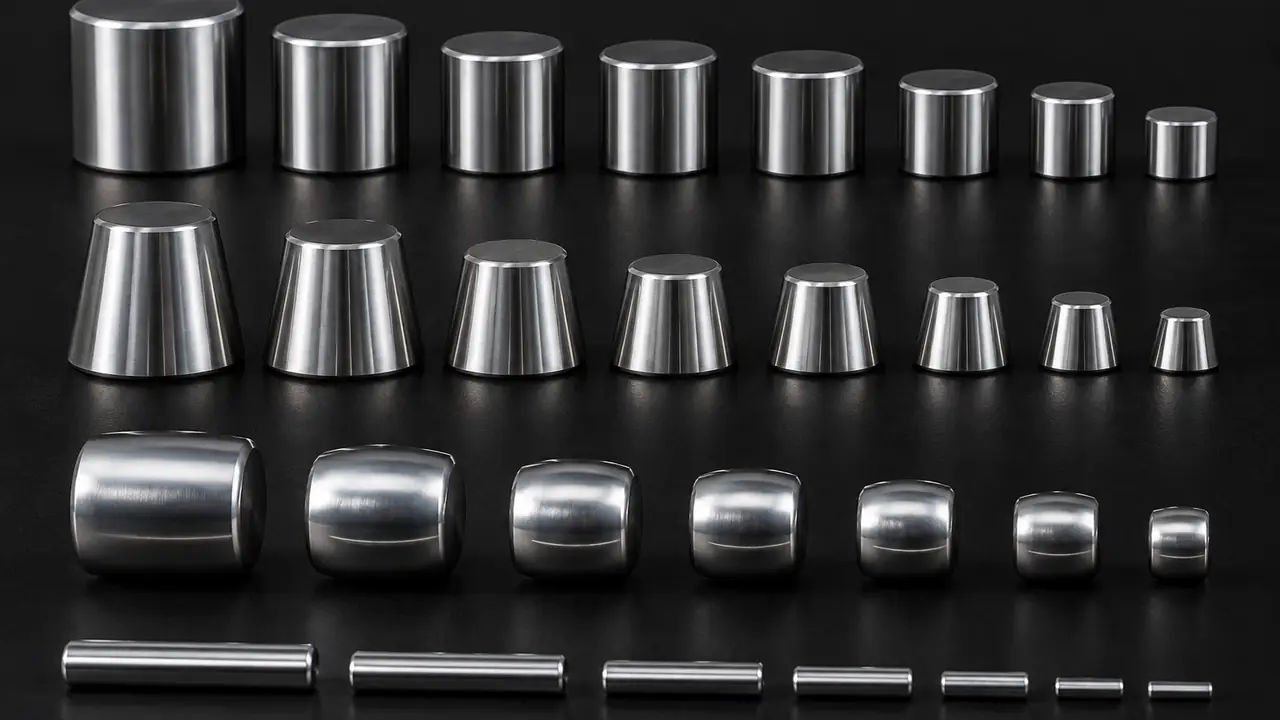
Why rollers, and what kinds exist
A ball touches the raceway at a point; a roller touches along a line. That larger contact area lets roller bearings carry heavier loads for the same size, which is why rollers are used in gearboxes, wheel hubs, mining and heavy machinery. The price of line contact is greater sensitivity to misalignment and to roller accuracy, so roller making is a precision job.
| Roller type | Shape | Used in |
|---|---|---|
| Cylindrical | Straight cylinder, slightly crowned | Cylindrical roller bearings (NU, NJ, N) |
| Tapered | Truncated cone | Tapered roller bearings, wheel hubs, gearboxes |
| Spherical (barrel) | Symmetric or asymmetric barrel | Spherical roller bearings, heavy and misaligned duty |
| Needle | Long, thin cylinder, length many times diameter | Needle roller bearings, compact housings |
Thrust bearings use their own roller forms, such as short cylindrical rollers, covered under thrust roller bearings.
Profile: why rollers are not perfectly straight
A perfectly straight roller pressed against a raceway concentrates stress at its ends, where the contact stops abruptly. Under load and slight misalignment this edge stress can start premature fatigue. To prevent it, roller bodies are given a controlled profile that relieves the ends.
- Crowning. A slight curve is ground along the length so the centre carries most of the load and the ends are relieved. Simple and common.
- Logarithmic profile. A curve that follows a logarithmic form spreads contact stress more evenly along the roller length across a wide range of loads, avoiding edge peaks. It is used in higher-performance cylindrical and tapered bearings.
- Full or partial crown with flat centre. A flat centre with relieved ends, a compromise between the two.
The amount of crown is tiny, a few micrometres in a large roller, which is why profile inspection needs special equipment. The right profile for a given bearing comes from the design; ask the plant to state it on the drawing rather than assume.
Grade and sorting
Roller size varies a little in any production lot. If rollers of different diameters share one bearing, the largest one carries more load and the bearing is noisy and short-lived. Rollers are therefore ground to a grade and sorted into narrow diameter groups so that each bearing is built from rollers within a tight diameter range. Related rollers should also match in length and profile. Roller grades are defined by the plant or standard, and the diameter variation within a bearing set is one of the key points on the drawing.
For tapered bearings, roller size also interacts with the cone and cup raceways, which together set the preload or end play. See tolerance and clearance.
Where rollers fit in the supply chain
Rollers are made by specialist plants, often close to the bearing clusters they supply, and sold both to bearing makers and to repairers. Large tapered and spherical rollers are tied to the heavy-bearing clusters, while small cylindrical and needle rollers are made in volume by plants serving the compact bearing trade. Not every plant covers every type, and a plant that grinds good needle rollers may not hold the tooling for large crowned tapered rollers. The desk shortlists by roller type, size range and profile capability, and asks for a sample lot with a profile and diameter report before a volume order. Background on regional capability is on the clusters.
How rollers are made and checked
- Steel wire or bar is cold headed or cut to blanks, as described in bearing steel.
- Blanks are heat-treated to the agreed hardness; through-hardened chrome steel is typically about 58-65 HRC.
- Diameter, ends and profile are ground and finished.
- Rollers are sorted by diameter and length, and surface-inspected.
- Lots are washed, oiled and packed with lot identification.
Typical lot checks cover diameter and diameter variation, length, profile, roughness, hardness and visible defects. The first lot of a new program is checked more closely. See testing and inspection.
Ordering rollers
Rollers are quoted from a drawing or a bearing designation and counted in thousands. Typical reference ranges: stock samples in 3-7 working days, custom samples in 15-30 days and batch lead times of 25-45 days, subject to written confirmation for each program. Provide the roller type, diameter, length, end form, profile, material and annual quantity through the quote form. To compare with other parts, return to the components hub, or read about bearing cages that hold rollers in place.