
What axial load is
Load on a shaft can be split into two directions. Radial load acts across the shaft, like the weight of a pulley. Axial load, also called thrust, acts along the shaft axis, trying to push it endways. A vertical pump shaft carries the weight of its impeller and the water column as axial load. A helical gear pushes sideways along its shaft. A crane hook swivel, a screw press and a ship propeller all create thrust.
Radial bearings such as standard deep groove types cope with a modest amount of axial load but are not designed around it. When thrust is large or purely axial, a thrust bearing is used, because its raceways are shaped so the load passes straight through along the axis.
How a thrust bearing is built
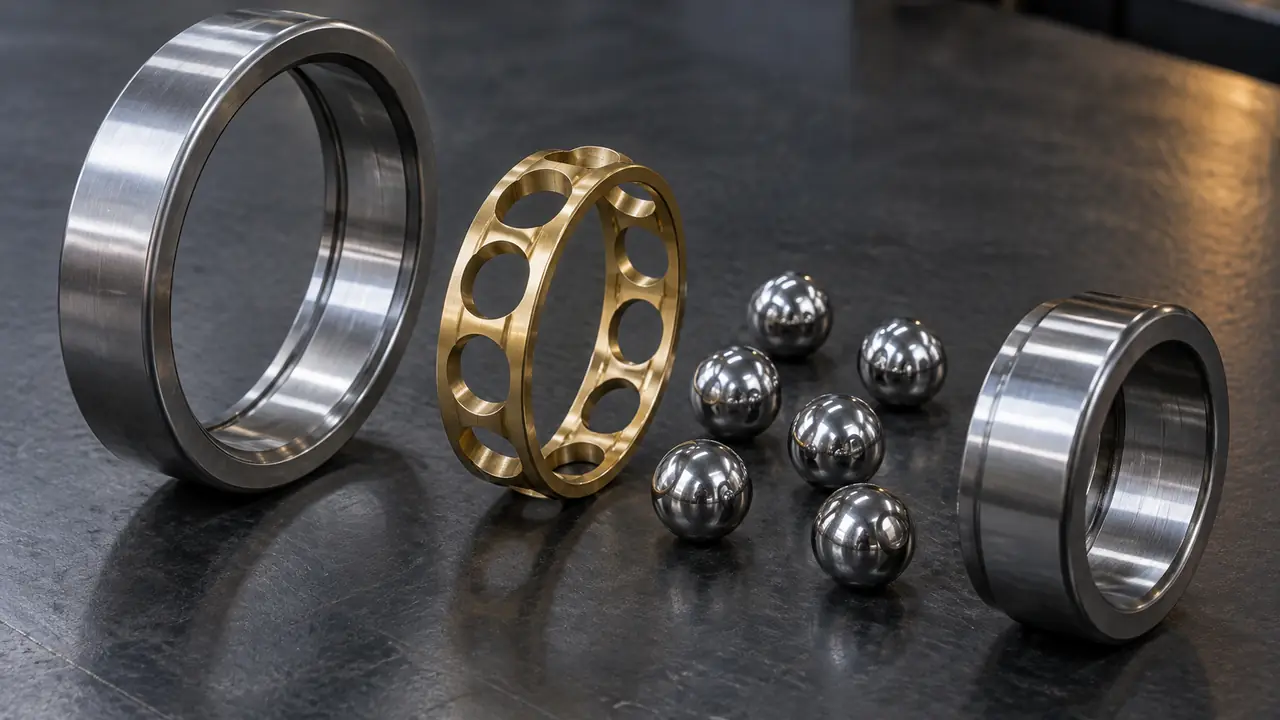
Instead of an inner and outer ring, a thrust bearing has two flat or slightly curved washers, one fixed to the shaft and one to the housing. Rolling elements sit between them in a cage, and the load passes from one washer through the elements to the other. The washer on the shaft is called the shaft washer, and the one in the housing the housing washer. A heavily loaded set may also have a third, central washer so that thrust can be carried in both directions.
Because the washers are separate, the bearing is easy to mount, but it cannot hold itself in position sideways. A thrust bearing therefore needs a radial bearing next to it, or a locating feature, to keep the shaft on centre. Misalignment between the two washers also hurts, so the seat faces in the housing and on the shaft shoulder must be square to the shaft axis.
Three common designs
| Design | Rolling element | Best for | Limits |
|---|---|---|---|
| Thrust ball | Balls in grooved washers | Light to medium axial load, moderate speed | No radial load; low speed relative to radial bearings |
| Cylindrical thrust roller | Short cylinders | Heavy axial load, stiff support | Needs accurate seats; lower speed |
| Spherical thrust roller | Barrel rollers | Heavy axial plus some radial load and misalignment | Needs oil lubrication in most sizes |
Typical series for thrust ball bearings are 511, 512 and 513, which differ in height and load capacity for the same bore; thrust cylindrical roller bearings appear as 811 and 812, and spherical types as 293. The dimensions are standardised and are shown on the size chart, where you can confirm the nominal figures against the supplier's datasheet. Needle thrust bearings, with very thin sections, are an option for tight spaces.
Why speed is limited
In a thrust bearing the rolling elements are pressed into a plane, and centrifugal force pushes them outward, against the cage and washer edges. The result is heat and sliding at the contact. For this reason thrust bearings have lower limiting speeds than radial bearings of similar size, and they suit slow, heavily loaded duty such as turntables, screw jacks and pump thrust positions. Where high speed and axial load occur together, designers usually choose an angular contact ball bearing or a tapered roller pair rather than a pure thrust type.
Single-direction thrust bearings are marked with the housing washer on the load-bearing side, and fitting them upside down turns a working bearing into a failed one within hours. Ask the plant to supply washers that are easy to identify and packed in clearly marked boxes.
Lubrication and mounting rules
- Keep the faces square. Tilt of even a fraction of a degree loads the elements on one side and shortens life sharply.
- Do not rely on grease alone for heavy duty. Oil bath or circulation is common for large roller thrust bearings.
- Preload when the load is light. Thrust ball bearings with little load can skid; a light spring preload keeps the balls rolling.
- Use a locating radial bearing. A thrust bearing does not centre the shaft and needs a radial bearing nearby.
- Check the washer bore. The housing washer should clear the shaft so it does not pick up radial load by accident.
Typical applications by thrust type
Seeing where each design is used makes the choice easier. Thrust ball bearings are found in vertical pump and fan shafts, in lazy-susan style turntables, in swivel joints and in the steering heads of some light machines. The balls roll in simple grooves, the cost is modest, and the load is usually light to moderate. Cylindrical thrust roller bearings appear in gearboxes, machine-tool feed screws and presses, where a large axial force must be taken with little deflection. Spherical thrust roller bearings serve large extruders, vertical mills and marine drives, where heavy axial load comes with some shaft tilt.
Where the available height is small, thrust needle roller bearings with a thin washer or a bare cage-and-roller assembly can run directly on hardened surfaces of the neighbouring parts. In that case the mating faces must be hardened and ground to a bearing-quality finish, or they will wear quickly. This is a design point to settle with the supplier before the first order, and the desk will pass drawings to the partner plant for a written answer.
Finally, remember that some designations look similar. A 511 series thrust ball bearing and a 512 series share a bore but differ in height and washer diameter, so they are not interchangeable, and the washer types with a flat seat differ from those with a spherical seat washer. Matching the series number is the first check in any enquiry.
Where the buyer fits in
Thrust bearings are often bought in small volumes for pumps, jacks, gearboxes and rotating tables. Because the shaft washer, housing washer and cage assembly may be supplied separately, always confirm what is in the box. MRO distributors often hold the common sizes in stock, while OEM customers order the same designation as a program.
Typical reference MOQs for standard stock designations are about 100 to 500 pieces per designation, with lead times given on the MOQ and lead time page; everything is confirmed in writing for each program. Tell the desk through the quote form which direction the load acts, whether the application is vertical, and what speed the shaft runs at.