
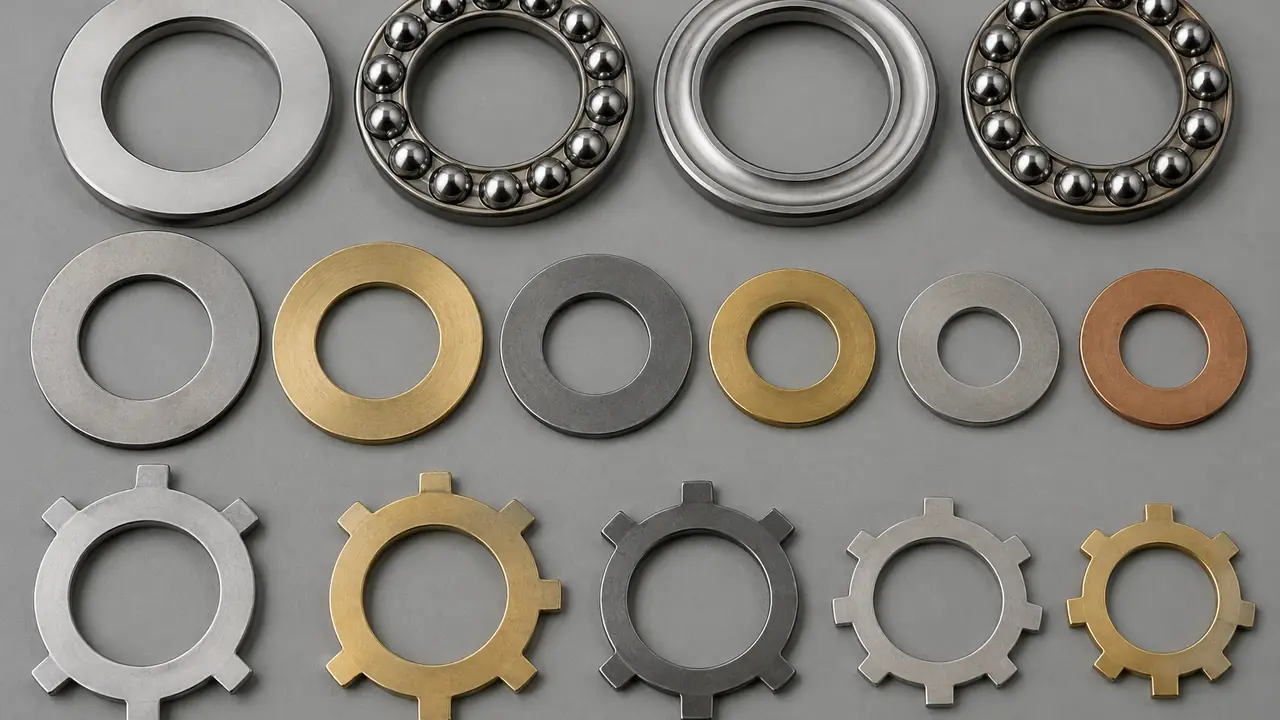
Three kinds of washer in bearing work
The word washer covers three different parts in bearing supply, and they are bought for different reasons. The first is the ring washer of a thrust bearing: a thrust ball bearing is built from a shaft washer that sits on the shaft, a housing washer that sits in the housing, and a set of balls in a cage between them. The second is the flat thrust washer used on its own as a bearing surface, usually steel or bronze, where the load is axial, speed is low and a plain sliding face is acceptable. The third is the lock washer, a tabbed or toothed ring that locks a nut on a shaft so it cannot loosen under vibration.
Washers are inexpensive but they carry the axial load of the machine, and a poor washer can wear the shaft shoulder or housing seat. They are supplied by the same Chinese parts clusters as other bearing components, and the desk coordinates them either with a complete bearing or as loose parts for assembly or repair.
Thrust ring washers: shaft and housing
In a thrust ball bearing the raceway is machined into a flat ring. The washer that fits the shaft has a bore sized to the shaft, with a slight clearance; the washer that fits the housing has a larger bore so that it floats radially and the shaft locates it. Some housing washers have a spherical seat, which works with a matching seat washer to compensate for small misalignment between shaft and housing face. Both are made from through-hardened bearing steel, ground on the faces to control flatness and parallelism, which is what lets the balls roll evenly.
Because the housing washer is allowed to move radially, a thrust bearing cannot locate a shaft radially on its own. A separate radial bearing, such as a deep groove ball bearing, normally takes the radial load. A thrust washer set also needs a minimum axial load to keep the balls rolling, and the supplier datasheet states the guidance.
Flat thrust washers
A flat thrust washer is a simple annular plate that slides against a shoulder, replacing a rolling bearing in low-speed, high-load or cost-sensitive positions. Common materials are listed here.
| Material | Behaviour | Typical use |
|---|---|---|
| Hardened steel | Wear-resistant and strong, needs oil or grease | Gearbox shoulders, spacers, transmissions |
| Mild steel | Economical, limited wear life | Light-duty spacing, agricultural parts |
| Bronze | Good sliding against steel, tolerates marginal lubrication | Gear and cam thrust faces, slow rotation |
| Polymer or composite | Self-lubricating, quiet | Light load, dry running, appliances |
Flat washers can have lubrication grooves or pockets cut into the face. A groove pattern helps oil spread and carry debris away. Sliding washers should be paired with a harder opposing face, and the surface finish of that face should be agreed with the supplier. For circular sliding parts of similar design, see bushings and plain bearings.
Lock washers and nut locking
A lock washer (MB series) has an inner tab that sits in a keyway on the shaft threads, and outer tabs that are bent into a slot of the lock nut. It is used together with a KM lock nut on shaft ends and adapter sleeves. The pairing of nut and washer, and the thread size, are covered under bearing accessories; the washer series is chosen to match the nut size. Spring washers and tab washers of other types are also used, but the MB type is the standard in bearing mounting.
Specifying washers
- For a thrust ring washer, give the full thrust bearing designation or the series and the bore and outside diameter.
- For a flat thrust washer, give inside diameter, outside diameter, thickness, material, groove pattern and surface finish.
- For a lock washer, give the MB series number matching the KM nut and the shaft thread.
- State heat treatment and hardness targets where wear matters, plus any rust-protection requirement.
- Ask for a drawing or sample approval before volume, then agree on inspection of flatness and thickness.
Sourcing and checks
Washers are stamped, turned or ground depending on tolerance, and the desk selects a partner plant on that basis. Before shipment the check covers dimensions and thickness, flatness of the faces, hardness on steel washers, material certificate for bronze, surface condition and anti-rust protection. Components commonly ship in lots counted in thousands; samples from stock take 3-7 working days. All reference ranges are confirmed in writing for each program. Send your drawing or list through the quote form.