
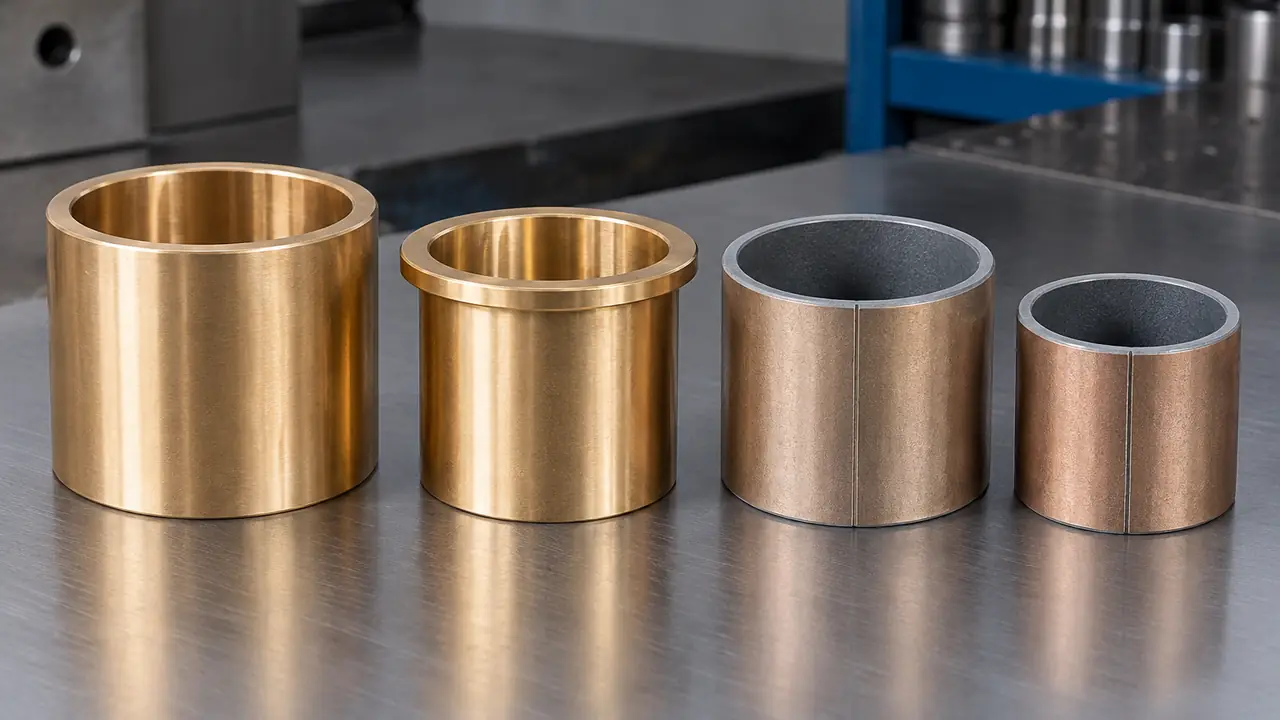
What a plain bearing is
A plain bearing, also called a sleeve bearing, bush or bushing, supports a shaft by sliding contact instead of rolling. It is a simple cylinder pressed into a housing, sometimes with a flange or a pair of thrust faces, and the shaft turns or oscillates inside it. Without balls, rollers or cages, the part is thin, compact, quiet and cheap to fit. It takes dirt, shock and standing load better than most rolling bearings, but it cannot match their low friction at high speed.
The right plain bearing depends on the sliding pair, the motion and the lubrication. The desk sources the main families from partner plants, matched to the duty.
Material families
| Family | How it works | Strengths | Typical use |
|---|---|---|---|
| Bronze (solid) | Cast or wrought alloy, greased by hand or by oil groove | Strong, tolerates shock and edge load | Linkages, presses, heavy pivots |
| Sintered oil-impregnated | Porous metal holds oil that seeps out as the shaft turns | Self-lubricating, quiet, low cost in volume | Small motors, appliances, office equipment |
| PTFE composite | Steel back with a porous bronze layer and a PTFE-based sliding layer | Maintenance-free, low friction, thin wall | Hinges, pivots, automotive, agricultural joints |
| Polymer | Engineering plastic such as PA, POM or PTFE-filled grades | Corrosion-free, quiet, runs dry | Food equipment, light machinery, wet sites |
Within each family, grades vary. A sintered bush can be bronze- or iron-based and impregnated with different oils; a polymer bush can be filled with fibre or a solid lubricant. State the application and the supplier will recommend a grade from the datasheet.
PV limits: the concept
Plain bearing life is governed by two linked quantities: the bearing pressure on the projected area, and the sliding speed at the surface. Their product, usually written PV, is a measure of the heat generated at the sliding interface. Every material has a limit on pressure, a limit on speed and a limit on their combination; push any one past its limit and the surface overheats, wears quickly or seizes. Because the limits depend on the lubrication, the shaft material and finish, the temperature and whether the motion is continuous or oscillating, a number from one datasheet cannot be carried over to another condition.
Rather than quoting figures here, the desk takes the application load, the speed or swing angle, the temperature and the duty cycle, and asks the partner plant to check them against the material's PV data. A low-speed, high-load pivot and a fast, light-load rotation can need entirely different materials even on the same shaft size.
When to choose plain over rolling
- Space is tight. A sleeve is thin-walled, and a plain bush fits where a rolling bearing will not.
- Motion is slow or oscillating. Rolling bearings can suffer false brinelling at small swing angles; sliding contact handles it better.
- Dirt or dust is unavoidable. Grit that wrecks a rolling bearing can be embedded in a soft liner.
- Shock or standing load is high. Surface contact spreads the load.
- Noise must be low. Sliding is quiet, as there are no rolling elements.
- Maintenance is impractical. A composite or sintered bush can run without greasing.
Choose a rolling bearing instead when speed is high, friction must be minimal, or accurate rotation matters - see ball bearings and roller bearings. Heavy oscillating loads with misalignment are better served by spherical plain bearings.
Inspection before shipment
For bushings the agreed checks are bore, outside diameter and length against the ordered tolerance, wall thickness, flange squareness, surface finish, material identification and oil content on sintered parts, and packaging that prevents damage to the sliding layer. Reports go out with the lot; see testing and inspection.
Shaft and housing
The shaft is part of the bearing. A hardened, ground shaft with a fine surface finish extends the life of most materials, and a soft or rough shaft shortens it. The housing bore tolerance and the interference fit of the press-fit sleeve set the final running clearance, so check the datasheet recommendations before machining. For the clearance concept in rolling bearings, compare the tolerance and clearance page.
Ordering notes
Provide the bore, outside diameter, length, material family, flange or thrust washer requirement and the lubrication method. Standard sizes commonly start from 100-500 pieces; non-standard sizes or special materials are assessed from the drawing. Stock samples ship in 3-7 working days and batch production commonly takes 25-45 days, as typical reference ranges confirmed in writing. Send the list through the quote form. More on the specialty bearings hub.