
| Designation | Type | d bore | D outside | B width |
|---|---|---|---|---|
| GE6E | Spherical plain | 6 | 14 | 6 |
| GE8E | Spherical plain | 8 | 16 | 8 |
| GE10E | Spherical plain | 10 | 19 | 9 |
| GE12E | Spherical plain | 12 | 22 | 10 |
| GE15ES | Spherical plain | 15 | 26 | 12 |
| GE20ES | Spherical plain | 20 | 35 | 16 |
| GE25ES | Spherical plain | 25 | 42 | 20 |
| GE30ES | Spherical plain | 30 | 47 | 22 |
| GE40ES | Spherical plain | 40 | 62 | 28 |
| GE50ES | Spherical plain | 50 | 75 | 35 |
Nominal ISO boundary dimensions for reference. Confirm against your drawing and the supplier datasheet.
What a spherical plain bearing does
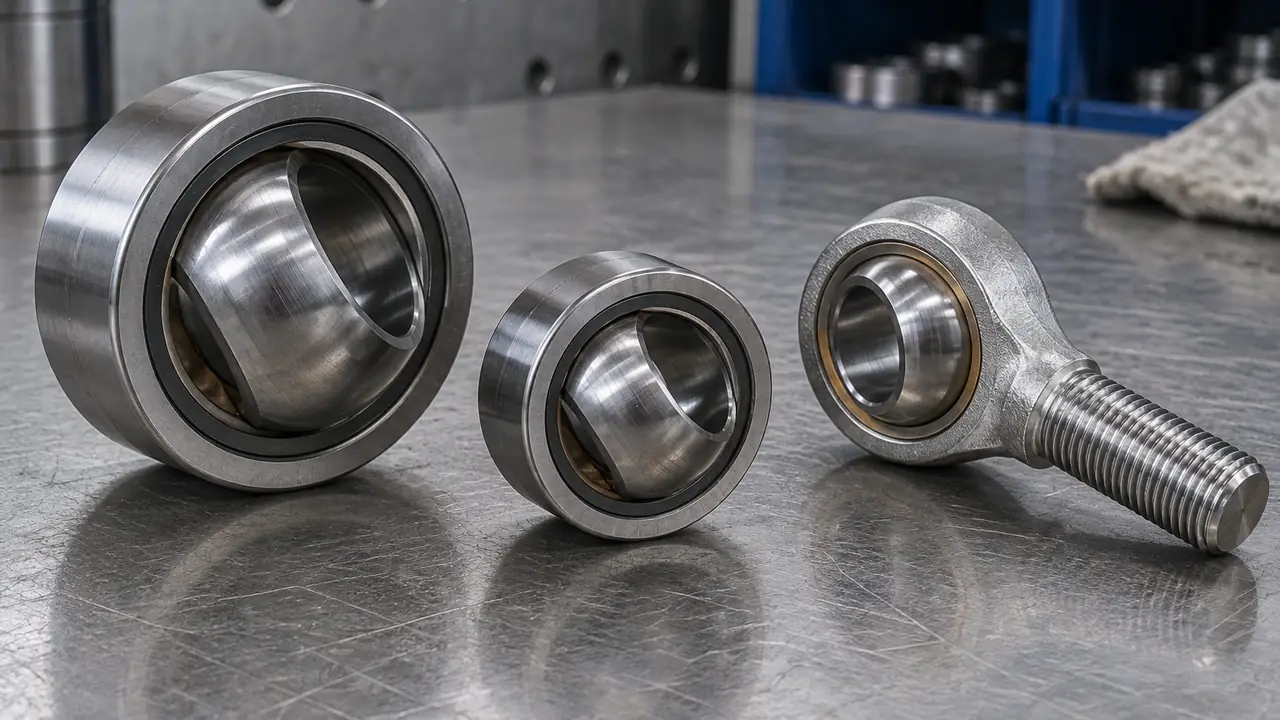
A spherical plain bearing has an inner ring with a convex spherical outside surface and an outer ring with a matching concave surface. The two slide against each other rather than rolling, which allows the bearing to swivel and tilt and to take up misalignment between the shaft and the housing. Because the contact is a wide surface instead of point or line contact, the bearing carries heavy radial load, often with shock, at slow speeds. That profile suits hydraulic cylinder clevises, construction machinery pivots, steering and suspension linkages, packaging machines and agricultural implements.
These bearings are meant for oscillating motion and slow rotation. They are not a substitute for a ball or roller bearing on a fast-turning shaft. If a joint swings through a few degrees under high load, a spherical plain bearing is usually the right choice.
GE series and dimensions
Radial spherical plain bearings follow the dimension series of ISO 12240. The GE designation gives the bore in millimetres; the suffix describes the lubrication and construction: E and ES are steel-on-steel with lubrication groove and hole, DO is the two-piece outer ring version for steel-on-steel use, and PTFE-lined variants use a liner in place of the groove. Nominal boundary dimensions for some common sizes are below.
| Designation | Bore (mm) | Outside dia. (mm) | Width (mm) |
|---|---|---|---|
| GE6E | 6 | 14 | 6 |
| GE10E | 10 | 19 | 9 |
| GE15ES | 15 | 26 | 12 |
| GE20ES | 20 | 35 | 16 |
| GE30ES | 30 | 47 | 22 |
| GE50ES | 50 | 75 | 35 |
Confirm every dimension against the drawing and supplier datasheet. Load ratings, tilt angle and permissible sliding speed depend on the construction and are stated on the datasheet; they are not repeated here.
Steel-on-steel versus maintenance-free
The key choice is how the sliding surfaces are lubricated.
| Type | Sliding pair | Lubrication | Typical use |
|---|---|---|---|
| Steel-on-steel | Hardened steel ball and steel ring | Relubricate through the groove and hole | Heavy shock load, dirty sites where grease is routine |
| Maintenance-free | Steel ball on a PTFE-based liner | None in normal service | Hard-to-reach joints, clean environments, fixed duty |
Steel-on-steel bearings tolerate heavy shock but need regular greasing; if the schedule is missed, wear and seizure follow. Maintenance-free types remove the greasing task but accept lower shock capacity, and the liner has a wear limit that depends on load, motion and contamination. Ask the supplier for the load and life guidance for the specific liner. See the relubrication intervals article for the general logic of relubrication. In practice, a steel-on-steel joint that works outdoors is greased often enough to push a little fresh grease out of the seal, which also flushes out grit before it reaches the sliding surface.
Rod ends: SI and SA
A rod end puts a spherical plain bearing in a housing with a threaded shank or a threaded bore, so a link can be assembled without machining. The male version, SI, has an external thread; the female version, SA, has an internal thread. Right-hand and left-hand threads are paired in turnbuckle-style linkages that adjust length. Rod ends are found on hydraulic and pneumatic cylinders, control linkages, stabiliser links and light machinery.
- Thread and size. State the thread (metric or UNF), the pitch and the hand.
- Housing material. Steel with zinc plating is common; stainless is available for washdown or marine use.
- Liner. Steel-on-steel with a grease fitting, or PTFE-lined for maintenance-free service.
- Mounting. Check the shank length and the angle of swing against the linkage geometry.
Applications and fit
Hydraulic cylinder eyes and clevises, loader arms, excavator buckets, truck tailgates, agricultural hitches and automation pivots all suit spherical plain bearings. The housing bore is usually a close fit and the ring is retained by a snap ring or staking; the shaft fit depends on the loading, so consult the datasheet. Keep dirt out with a seal or a boot on exposed joints.
Where the motion is faster or continuous, switch to a self-aligning ball bearing or a spherical roller bearing. For compact sliding joints with simple sleeves, see plain bearings.
Ordering notes
Send the bore, the series or rod end type, the liner type and the thread through the quote form. Standard designations commonly start from 100-500 pieces; non-standard sizes or special materials are assessed from the drawing. Stock samples ship in 3-7 working days, batch production commonly takes 25-45 days, as typical reference ranges confirmed in writing. More lines on the specialty bearings page.