
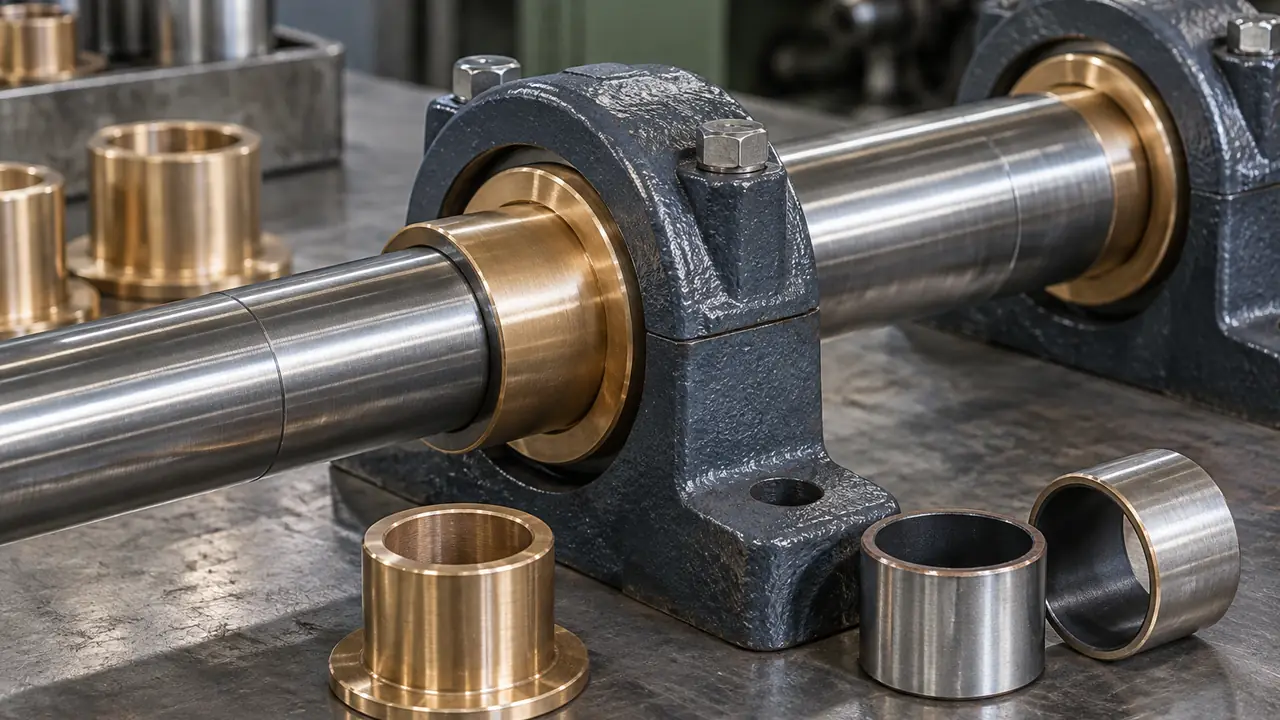
What a bushing is and where it fits
A bushing, also called a sleeve bearing or plain bearing sleeve, is a cylinder pressed into a housing that supports a rotating or oscillating shaft with a sliding surface. It has no balls or rollers, so it is thin, compact, quiet and tolerant of shock, dirt and slow movement. Bushings suit hinges, linkages, pivots, agricultural and construction equipment, pumps, small motors, appliances and slow gear trains where a rolling bearing would be too bulky or too expensive. They are not suited to very high speeds under heavy load without good lubrication, where rolling bearings or hydrodynamic bearings are better.
In the bearing world the bushing sits in the same family as the plain bearing, the spherical plain bearing and the thrust washer. The desk sources bushings from specialist makers in several Chinese provinces, matched to the load, speed and lubrication method.
Material families compared
| Material | How it works | Strengths | Watch for |
|---|---|---|---|
| Solid bronze | Cast or machined alloy bore, often with grease grooves | High load, shock tolerant, repairable | Needs regular lubrication |
| Sintered (oil-impregnated) | Porous metal holds oil that bleeds out in use | Maintenance-free, low cost, quiet | Limited load; oil can run dry |
| Wrapped bimetal | Steel back rolled with a bronze or sliding layer, often with lubricant pockets | Strong back, economical, stable fit | Thin layer limits wear life |
| PTFE composite | Steel back, porous bronze layer, PTFE-based liner | Dry running, low friction, no grease | Check load and shaft hardness |
| Polymer | Moulded engineering plastic, often glass or carbon filled | Light, corrosion-resistant, quiet | Temperature and load limits; swelling |
Exact load, speed and temperature limits come from the supplier datasheet for each material; this site does not publish generic values.
Forms: sleeve, flanged and thrust
- Sleeve (cylindrical). The standard form for radial load. Defined by inside diameter, outside diameter and length. The outside is pressed into a bored housing.
- Flanged. A sleeve with a collar on one end. The flange takes light axial load and locates the bushing in the housing, so it often replaces a sleeve plus a washer.
- Thrust. A flat ring, with or without tabs and grooves, for axial load against a shoulder. It acts like a flat thrust washer made of a bushing material.
Special forms include split bushings for assembly where the shaft cannot be threaded through, slotted sleeves, and bushings with spherical outside diameters. Non-standard shapes are assessed from the drawing.
Fits and running clearance
A bushing carries load only if it is held firmly in the housing and the shaft runs with a controlled clearance inside it. Two fits are involved.
- Outside fit. The bushing is pressed into the housing with an interference fit so that it does not rotate or walk. Housing bores are commonly toleranced H7 for press-fit sleeves.
- Bore after pressing. The pressing closes the bore slightly, and the final inside diameter is the number that sets running clearance. The supplier datasheet states the bore before and after fitting; check which is quoted on the drawing.
- Running clearance. The shaft runs with a small clearance inside the bore, enough for an oil or sliding film and for thermal growth, but not so large that the shaft knocks. Hotter or dirtier duty needs a larger clearance than a clean, precise one.
- Shaft finish and hardness. The shaft should be harder than the bushing and have a fine surface finish; a rough shaft wears the bushing quickly, especially with PTFE and polymer liners.
The same clearance idea applies in rolling bearings, explained in tolerance and clearance, but plain bushings are less forgiving of misalignment, so keep shaft and bore on one axis. Where that is hard, a self-aligning type such as the spherical plain bearing is the better choice.
Choosing and ordering
Choose by lubrication method first. If the shaft can be greased, solid bronze or bimetal is robust. If lubrication is impossible or intermittent, use a sintered, PTFE composite or polymer bushing. Then check load, speed, temperature and exposure to water and chemicals, because composites and polymers differ widely in these. Send the dimensions, material, lubrication and a note on the operating conditions via the quote form.
Before shipment the desk checks dimensions and wall thickness, concentricity, material, liner adhesion on composites, surface finish and packing against rust or contamination. Typical reference ranges: stock sizes quoted from hundreds of pieces, non-standard from drawing, samples in 3-7 working days from stock. All are confirmed in writing for each program.