
| Designation | Type | d bore | D outside | B width |
|---|---|---|---|---|
| LM6UU | Linear | 6 | 12 | 19 |
| LM8UU | Linear | 8 | 15 | 24 |
| LM10UU | Linear | 10 | 19 | 29 |
| LM12UU | Linear | 12 | 21 | 30 |
| LM16UU | Linear | 16 | 28 | 37 |
| LM20UU | Linear | 20 | 32 | 42 |
| LM25UU | Linear | 25 | 40 | 59 |
| LM30UU | Linear | 30 | 45 | 64 |
| LM40UU | Linear | 40 | 60 | 80 |
Nominal ISO boundary dimensions for reference. Confirm against your drawing and the supplier datasheet.
What a linear bearing does
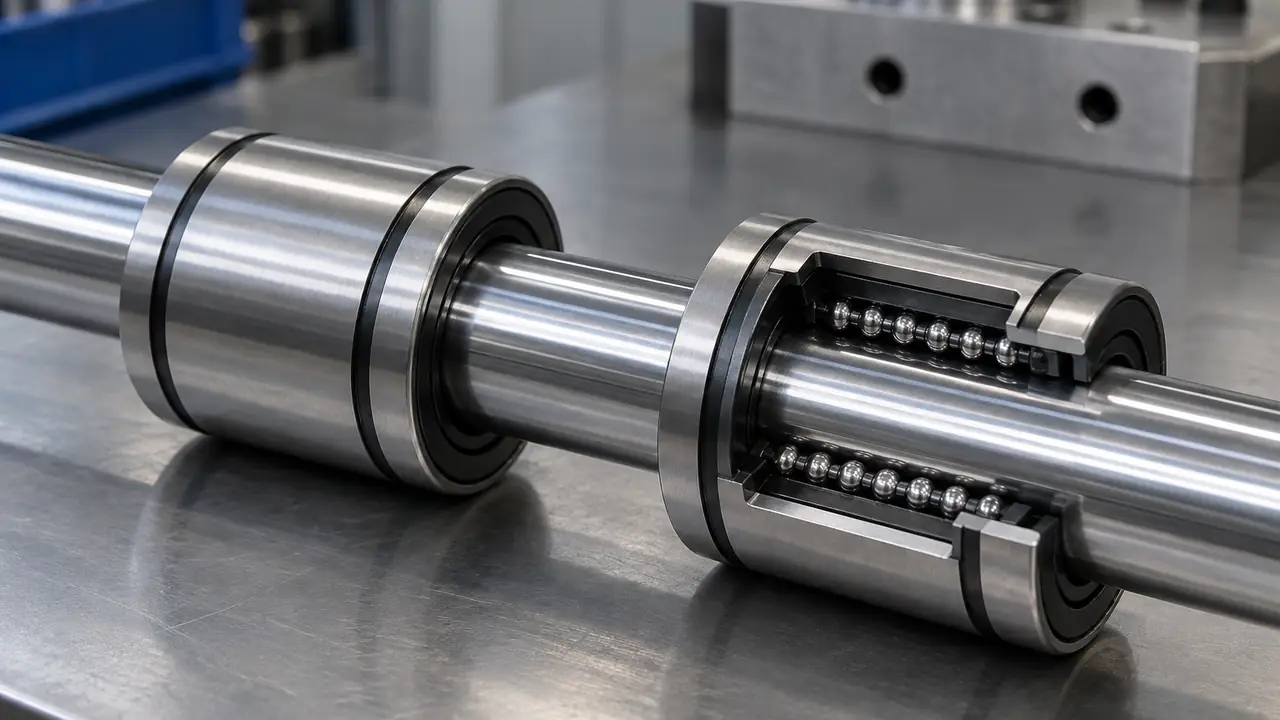
A linear ball bearing is a sleeve, usually a steel outer shell with rows of recirculating balls inside, that slides along a round shaft. The balls roll between the shaft and the sleeve, carry the load, and return through channels in a cage, so travel length is limited only by the length of the shaft. Compared with a plain bushing sliding on the same rod, friction is far lower and motion is smoother, which is why the type is common in 3D printers, laser engravers, packaging machines, pick-and-place heads and small automation slides.
The bearing carries load at right angles to the shaft. It does not stop the carriage from rotating around the shaft, so most designs use two parallel shafts or one shaft plus a second guide. It also has limited tolerance for moment load, which is where profile rail guides take over. For long travel under moderate load on a budget, the shaft-and-bushing system is hard to beat.
Designation and common sizes
The LM-UU designation names the bore in millimetres: LM8UU fits an 8 mm shaft. The UU suffix means a seal at each end. The nominal outside diameter and length follow the common metric series.
| Designation | Shaft (mm) | Outside dia. (mm) | Length (mm) |
|---|---|---|---|
| LM6UU | 6 | 12 | 19 |
| LM8UU | 8 | 15 | 24 |
| LM12UU | 12 | 21 | 30 |
| LM16UU | 16 | 28 | 37 |
| LM20UU | 20 | 32 | 42 |
| LM40UU | 40 | 60 | 80 |
These are nominal boundary dimensions for reference. Confirm against the drawing and the supplier datasheet before ordering; load ratings come from that datasheet and are not repeated here.
Closed, open, adjustable and flanged types
- Closed (LM-UU). The standard bushing, pressed into a bored housing. Best rigidity and load share.
- Open (LM-OP). A slot along the sleeve lets the bearing run on a shaft that is supported along its length, so long shafts do not sag under load.
- Adjustable. A split sleeve in a slightly oversized housing lets you remove clearance; useful when a carriage rattles.
- Flanged (LM-FL). A flange on the sleeve bolts straight to the carriage, so no precision bore is needed. Round, square and oval flange shapes are common.
- Long and tandem (LME). Longer sleeves spread load and resist tilt on a single carriage.
Seals (UU) keep out chips and dust but add a little drag; open ends suit clean, lubricated systems. Cages are pressed steel or polymer, and standard material is high-carbon chromium steel GCr15, comparable to AISI 52100 and 100Cr6. Stainless versions are available for washdown machinery, see stainless steel bearings.
Shaft hardness and tolerance
The shaft is half of the bearing. Balls roll directly on it, so an unhardened shaft pits and wears quickly. Specify a hardened and ground round shaft with a fine surface finish and good straightness; the supplier datasheet states the recommended hardness and tolerance zone for each bore. The housing bore also needs the tolerance recommended for the bushing type. Where the shaft and bore are both in the specification, smoothness and life follow; where the shaft is a bright drawn rod from the hardware store, they usually do not.
Lubricate with light grease or oil, and keep the shaft free of chips. For more on lubricant choices see the lubrication guide.
Linear bearing versus profile rail guides
| Consideration | Ball bushing on shaft | Profile rail guide |
|---|---|---|
| Load and moment | Moderate radial; limited moment | High in all directions |
| Stiffness | Lower | Higher |
| Cost of system | Lower | Higher |
| Mounting | Shaft supports and housings or flange | Flat, accurate mounting surface |
| Contamination | Seals help; shaft exposed | Wipers and covers available |
If a design needs light, long-travel motion with simple supports, bushings and shafts are usually the right pick. If it needs rigid, repeatable positioning under overhung loads, move to a rail guide.
Inspection before shipment
The inspection plan is agreed for each lot. For ball bushings the usual checkpoints are bore and outside diameter against the ordered tolerance, sleeve length, smoothness of travel on a gauge shaft, seal fit, rust protection and marking against the approved sample. Reports travel with the lot; see testing and inspection.
Ordering notes
Send the shaft diameter, the type (closed, open, flanged), the seal requirement and the quantity through the quote form. Standard designations commonly start from 100-500 pieces; private-label marking and boxes start around 1,000-5,000 pieces. Stock samples ship in 3-7 working days, batch production in 25-45 days, all as typical reference ranges confirmed in writing. See also specialty bearings.