
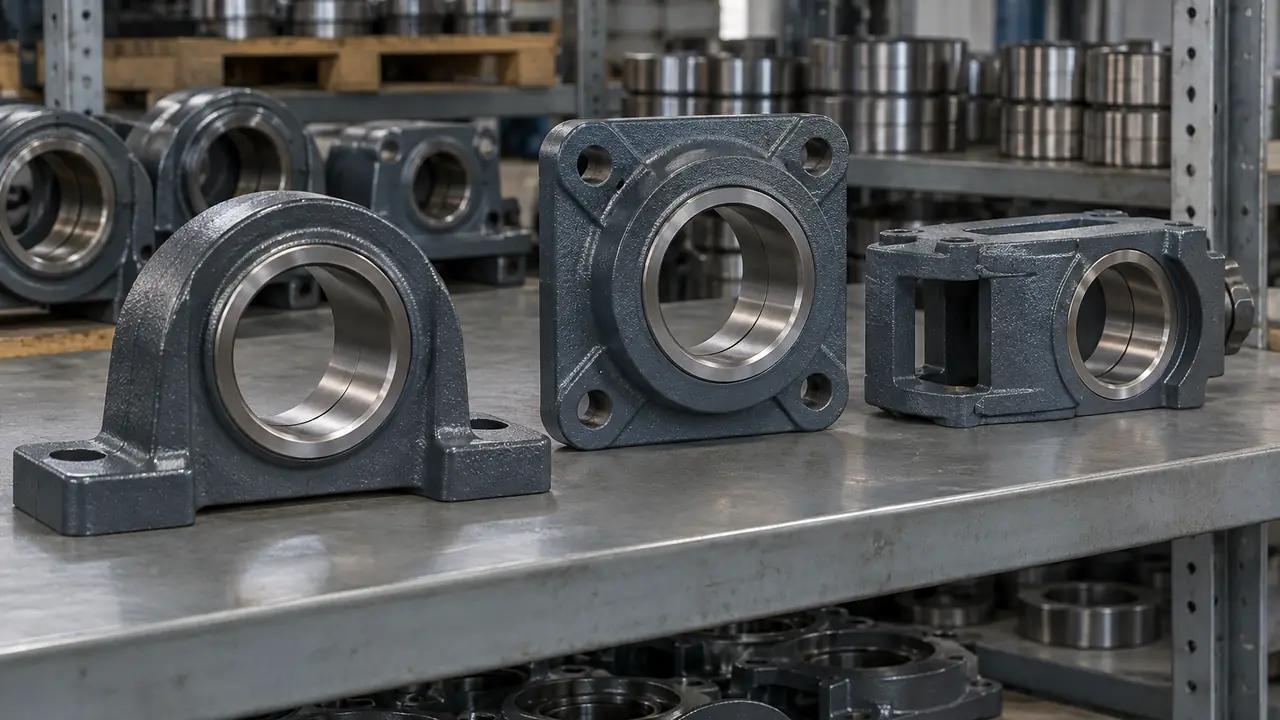
What a bearing housing does
A bearing housing is the support that locates a bearing, protects it from contamination, holds lubricant and transfers shaft load to the machine frame. Some housings are part of a gearbox or motor casting and are machined in place. The housings discussed here are the stand-alone units bought separately and bolted to a frame: they are used on conveyors, agricultural machines, fans, pumps, mixers, textile and food machinery. They come empty, ready to take a bearing, or as complete units where the housing is supplied with a matching insert bearing, as in the pillow block bearing line.
Housings are cast and machined in the same industrial regions as bearings, and a large share of unit production uses ductile and grey iron foundries. The desk coordinates both the housing and the bearing so that fit, bore and seals arrive consistent, rather than having two suppliers each assume the other's tolerance.
Housing types
| Type | Common code | Mounting | Typical use |
|---|---|---|---|
| Pillow block | P (UCP, SN-type base) | Foot with two bolts on a flat base | Shaft supports, conveyors, fans |
| Flange, 2-bolt | FL | Oval flange against a wall face | Light units on flat frames |
| Flange, 3-bolt | FC or triangular | Three bolts on a round pattern | Compact spaces, small machines |
| Flange, 4-bolt | F (square) | Square flange, four bolts | Heavier duty and better rigidity |
| Take-up | T | Slides in a slot for belt or chain tension | Conveyor tail shafts, belt tension |
| Split plummer block | SN-type | Two-piece cap and base, bolts through foot | Heavy machinery, shafts that cannot be threaded |
The split plummer block is described generically here: the housing is cut along the shaft centreline, with a cap and a base joined by bolts. That makes mounting on long or fixed shafts easy, with an adapter sleeve or a tapered bore bearing, and it allows inspection without removing the shaft. It is the common choice for a spherical roller bearing on a large shaft.
Materials
- HT200 grey cast iron. The standard material in China for general housings. Good vibration damping, easy to cast and machine, and economical. It is brittle under shock, so impact loads call for a tougher material.
- Ductile (nodular) iron. Higher strength and toughness than grey iron, at moderate extra cost. Chosen for heavy loads, shock and vibration.
- Pressed (stamped) steel. Lightweight and cheap, used for light conveyors, agricultural and appliance duty. Rigidity is lower than cast iron.
- Stainless steel and thermoplastic. Used for washdown, food and marine environments. Pair with stainless bearings and food-grade grease.
Surface treatment is separate from the base material: paint for general use, zinc or epoxy for outdoors, and stainless needs no coating. Ask for the finish on the quote so that it is not assumed.
Seals and lubrication
Housing seals keep grease in and dirt out. Plain felt or lip seals are standard on pillow blocks. Labyrinth and multi-lip seals add protection against dust and water spray in agricultural and washdown duty; see bearing seals. Larger split housings may use removable end covers and a seal ring on each side, often with a grease nipple on top for relubrication. Choose the grease from the temperature and speed of the application, as explained on the grease page and in the lubrication guide.
Choosing by application
For a conveyor head or tail shaft, take-up housings let you tension the belt, and ductile iron is worth the small premium where start-stop shock is common. For a fan or blower, a pillow block or flange unit in grey iron is usually enough, with attention to balance and a tight base. For agricultural machines, pick a housing with a double-lip or labyrinth seal and a grease nipple, since dust and mud are the main enemies. For food lines, stainless or coated housings with smooth outer surfaces let washdown run off. For heavy shafts in mining or paper mills, a split housing with a spherical roller bearing and generous sealing is the usual route.
Fit, alignment and ordering
Insert bearings in pillow blocks have a spherical outer surface that sits in a matching spherical seat, so the unit can align itself to a small shaft deflection or frame error at mounting. A split housing has a cylindrical or spherical seat, depending on the bearing, and its base must be flat and rigid. Specify the bore or the bearing designation, the mounting dimensions (bolt centre distance and height), housing material, finish and seal type. Send these through the quote form.
Before shipment the desk checks casting quality and absence of cracks, bore diameter and seat tolerance, flatness of the base, bolt hole spacing, paint or coating thickness visually, and packing. Typical reference ranges are 100-500 pieces per type, with batch production commonly in the 25-45 day range, all confirmed in writing for each program.