
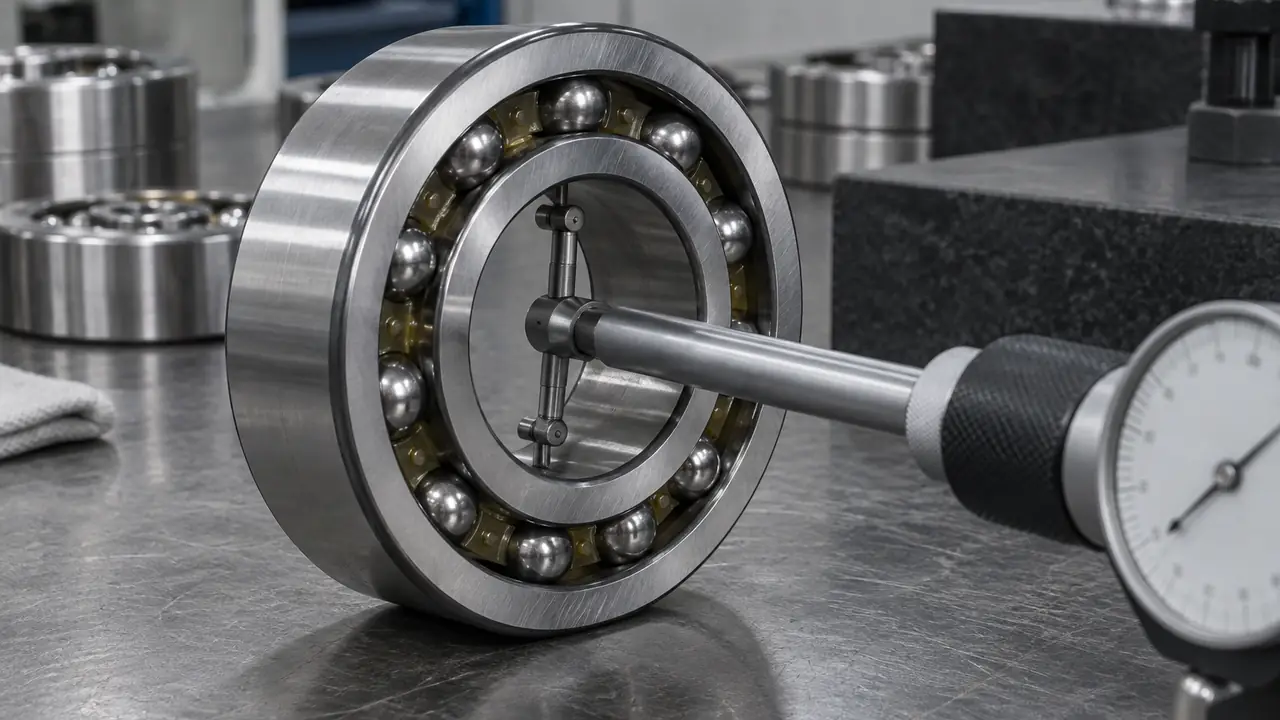
Anatomy of a bearing number
A full designation has up to three parts. Prefixes, where used, describe an assembly or a part of one. The basic designation in the middle identifies the type, the dimension series and the bore. Suffixes on the end describe design variants such as seals, clearance, tolerance and cage. Take 6204-2RS/C3. The first digit 6 marks a deep groove ball bearing; the 2 is the diameter series; the 04 is the bore code, meaning 20 mm; the suffix 2RS means two contact rubber seals; the suffix C3 means radial internal clearance larger than normal.
The basic designation
| Position | What it tells you | Example |
|---|---|---|
| Type | Bearing family: 6 deep groove, 7 angular contact, 1 or 2 self-aligning, NU / N / NJ cylindrical roller, 3 tapered roller, 5 thrust ball | 6204: deep groove |
| Dimension series | Width and diameter series, which fix outside diameter and width for a bore | 62: light series |
| Bore code | 00 = 10 mm, 01 = 12, 02 = 15, 03 = 17; from 04 multiply by 5 | 04: 20 mm bore |
The same bore code in different series gives different housings, so always read the series as well. The size chart shows the resulting dimensions. Bores below 10 mm are normally written out, as in 608.
Suffix families
| Family | Codes | Meaning |
|---|---|---|
| Seals and shields | Z, ZZ; RS, 2RS | One or two metal shields; one or two contact rubber seals. See 2RS vs ZZ |
| Internal clearance | C2, CN, C3, C4 | Smaller than normal, normal, larger, larger still. See C3 explained |
| Tolerance class | P0, P6, P5, P4 | Normal, then increasingly tight accuracy. See tolerance and clearance |
| Cage | J, M, TN9 and similar | Steel, brass, glass-fibre reinforced nylon; codes differ between makers |
| Tapered bore | K | Bore with taper, mounted on a sleeve or tapered shaft. See accessories |
| Snap ring groove | N, NR | N is a groove in the outer ring; NR is the groove with a snap ring fitted |
Combined suffixes are written one after another, sometimes with a slash: 6204-2RS/C3 or 6204-2Z/C3P6. Order is not always standardised, so ask for the meaning to be spelled out on the quotation.
Worked examples
Three short readings show the method. A 30208 is a tapered roller bearing: type 3, series 02, bore code 08 for 40 mm. A NU2210 is a cylindrical roller bearing with a double-flanged outer ring and a flangeless inner ring, in the 22 series, with a 50 mm bore. A 22210 K is a spherical roller bearing with a 50 mm bore and a tapered bore, which means it needs a sleeve, a nut and a washer. In each case the size can be checked in the size chart, while the suffix details come from the supplier datasheet.
Prefixes and special variants
Prefixes are used mainly for parts of an assembly, such as a separate ring in a cylindrical roller bearing or a cone and cup pair in a tapered roller bearing. Special variants for noise, grease, heat treatment or stainless material usually appear as extra letters or digits at the end, and their meaning depends on the maker. A heat-stabilised bearing for high temperature, a low-noise grade, or a stainless version each has a code. If a suffix is not on the table above, treat it as maker-specific and ask for its definition.
Why suffix meanings vary and what the desk does about it
The basic designation and the main suffixes are broadly shared across the industry, because they follow common standards such as ISO 15 for dimensions and ISO 492 for tolerance. Many other suffixes are the maker's own. Two plants may use the same letters for different cage materials or different grease fills. Because of this, Rolvane does not assume that a code means the same thing from plant to plant. For every program the desk lists the full designation, writes out what each suffix means in plain words, and confirms the result in writing with the partner plant and with you. Where a suffix is critical, such as clearance or tolerance, it is checked on a sample.
How to write a clean request
- Give the basic designation, for example 6204.
- State the seal or shield, for example 2RS.
- State the clearance group, for example C3, or CN if normal.
- State the tolerance class, for example P6, or P0 for normal.
- State the cage, grease and any special requirement in words, not only codes.
Send the list through the quote form. Typical reference ranges: 100-500 pieces per standard designation, samples in 3-7 working days from stock, batch production in 25-45 days, always confirmed in writing for each program.