
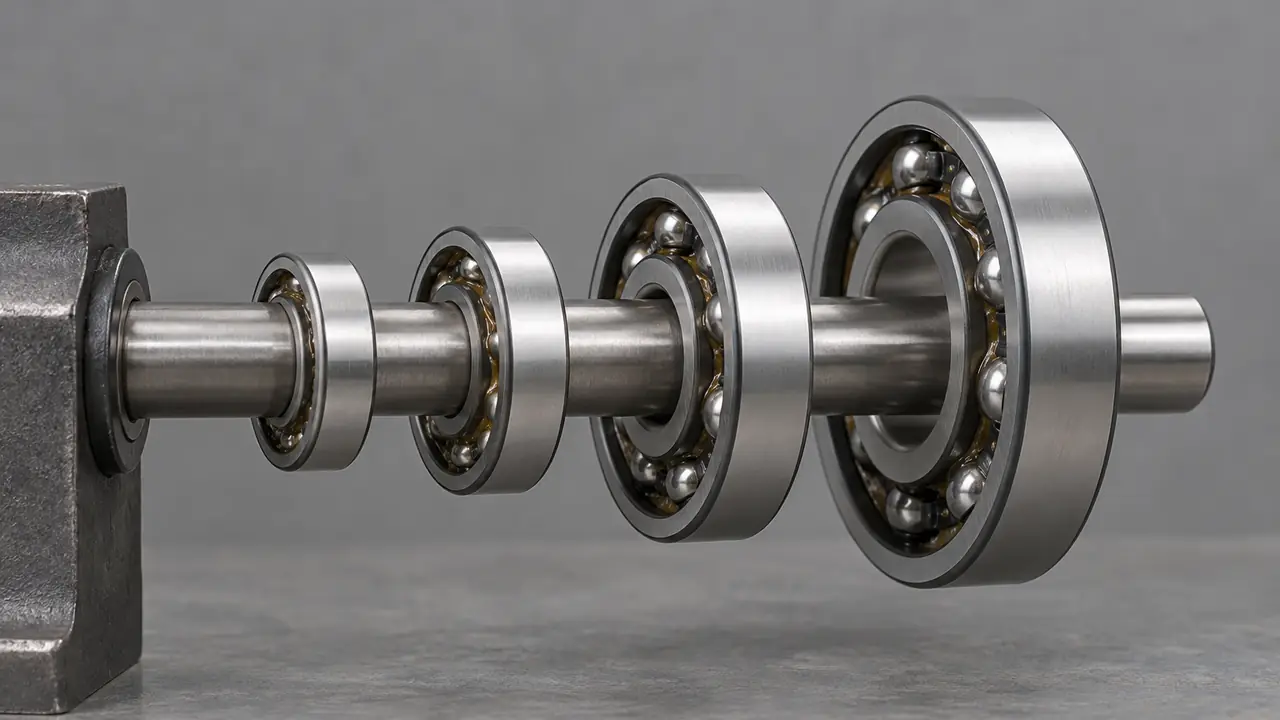
The three blocks of a designation
Take a typical order line: 6204-2RS C3 P6. It splits into three blocks. The basic designation (6204) gives the bearing type, the dimension series and the bore. The suffixes (2RS, C3, P6) describe optional features such as seals, internal clearance and tolerance class. Some special items also carry a prefix, for example to mark a separate ring or a rolling-element set rather than a complete bearing.
The basic designation of standard metric bearings is tightly controlled. Boundary dimensions follow ISO 15 for radial bearings and ISO 355 for metric tapered roller bearings, so the same basic number means the same bore, outside diameter and width wherever it is made. Suffixes are different. Many are common across the industry, but some are plant-specific or catalogue-specific, which is why the desk always asks partner plants to confirm suffix meanings in writing before an order is placed. The full system is described in the designation guide; this note walks through the reading order.
Step 1: the first digits give the type and series
Read from the left. The first digit or letters identify the bearing type, and the next digit or two set the dimension series. The table lists the series most buyers meet, as given in the product pages of this site.
| Type | Typical series prefix | Example |
|---|---|---|
| Deep groove ball | 60, 62, 63, 68, 69 | 6205 |
| Angular contact ball | 70, 72, 73 | 7206 |
| Self-aligning ball | 12, 13, 22, 23 | 1204 |
| Thrust ball | 511, 512, 513 | 51104 |
| Cylindrical roller | NU2, NU3, NJ2 | NU206 |
| Tapered roller | 302, 303, 320, 322 | 30205 |
| Spherical roller | 222, 223, 230 | 22210 |
| Needle roller | HK, NK, NA49 | HK2012 |
The letters in roller bearings carry structural meaning. In cylindrical roller bearings, NU, NJ, NUP and N describe which ring has flanges and therefore how the bearing locates the shaft axially; that topic has its own page on cylindrical roller bearings.
Step 2: the bore code
For most metric bearings the last two digits of the basic number are the bore code. From 04 upward the rule is simple: multiply by five. The first four codes are exceptions that you simply memorise.
| Bore code | Bore (mm, nominal) | Example |
|---|---|---|
| 00 | 10 | 6000 |
| 01 | 12 | 6201 |
| 02 | 15 | 6202 |
| 03 | 17 | 6203 |
| 04 | 20 (4 x 5) | 6204 |
| 05 | 25 (5 x 5) | 22205 |
| 10 | 50 (10 x 5) | 30210 |
Small bearings break the pattern: in 608 the last digit is the bore itself, 8 mm, and in 623 it is 3 mm. Larger or unusual bores are written after a slash, such as 6305/22 for a 22 mm bore. The calculation, including the exceptions, is covered in bearing bore codes.
Step 3: the dimension series sets the outside diameter and width
The same bore can be built in several series. A higher series number means a bigger outside diameter and a wider ring, which usually means a bigger load capacity at the cost of space. The example below holds the bore at 17 mm (bore code 03) and changes only the series. All values are nominal ISO boundary dimensions for deep groove ball bearings; confirm them against the drawing and the supplier datasheet.
| Designation | Series | d x D x B (mm) |
|---|---|---|
| 6803 | 68, ultra-thin | 17 x 26 x 5 |
| 6903 | 69, extra-thin | 17 x 30 x 7 |
| 6003 | 60, extra-light | 17 x 35 x 10 |
| 6203 | 62, light | 17 x 40 x 12 |
| 6303 | 63, medium | 17 x 47 x 14 |
Because the bore is the same, all five fit the same 17 mm shaft, but they need different housing bores and different axial space. Never swap series without checking the housing. The 6200 and 6300 pair is compared in 6200 vs 6300 series.
Step 4: suffixes
Suffixes follow the basic number and sometimes a hyphen or space. These are the ones that appear most often on deep groove ball bearing enquiries.
| Suffix | Usual meaning |
|---|---|
| RS, 2RS | Contact rubber seal on one or both sides |
| Z, 2Z, ZZ | Metal shield on one or both sides |
| C3 | Internal clearance larger than normal |
| P6, P5, P4 | Tolerance class tighter than normal (ISO 492 classes 6, 5, 4) |
| Z1, Z2, Z3 | Vibration or noise group, agreed per order |
| N, NR | Snap ring groove, or groove with snap ring |
Seal versus shield is the suffix that causes the most mistakes; see 2RS vs ZZ bearings. Clearance groups are explained in C3 clearance explained, and the full tolerance system is on the tolerance and clearance page. Cage, grease and heat-treatment suffixes are the least standardised; ask for them to be spelled out rather than guessed.
Three worked examples
6203-2RS C3. Deep groove ball bearing (6), light series (62), bore code 03 so 17 mm, nominal 17 x 40 x 12 mm, rubber seals on both sides, clearance larger than normal.
30205. Tapered roller bearing (302 series), bore code 05 so 25 mm. For tapered bearings the width in tables is the total width T, which for 30205 is a nominal 16.25 mm with outside diameter 52 mm.
22210. Spherical roller bearing (222 series), bore code 10 so 50 mm, nominal 50 x 90 x 23 mm. The number alone does not say whether the bearing has a cylindrical or tapered bore; that is added by a suffix such as K.
What a number does not tell you
A designation fixes size and basic design. It does not fix steel cleanliness, heat treatment, raceway finish, cage design, grease or noise level, and those decide how long a bearing runs. Two bearings with the same designation fit the same shaft and housing, but they are not the same product. Ratings such as load capacity and limiting speed come from the supplier datasheet for that exact bearing, not from the number.
When you send an enquiry, give the full designation with suffixes, the quantity per designation and a sentence on the application. If the number on an old part is worn away, measure it instead; the method is in how to measure a bearing. Then send the list through the quote form and the desk will return matched options with typical reference MOQ and lead time, confirmed in writing for each program.