
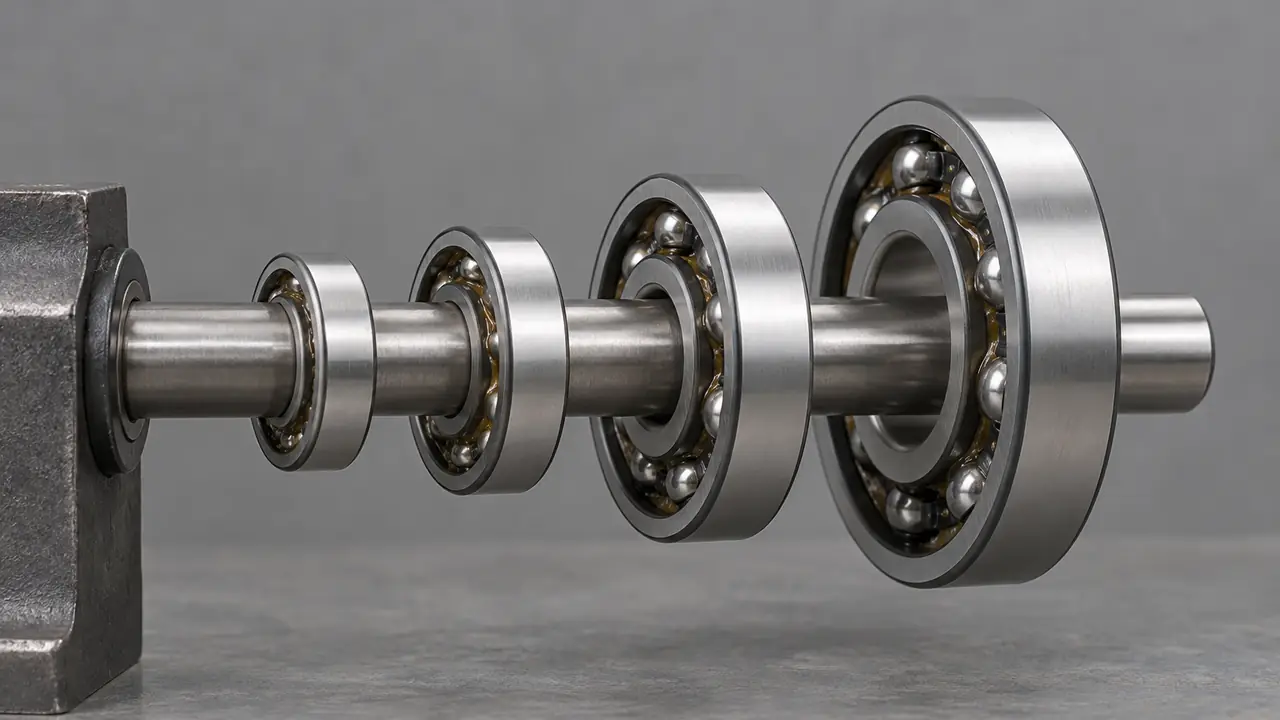
Nominal size of the 6203
The designation reads easily once you know the system. The 6 marks a single-row deep groove ball bearing, the 2 puts it in the light dimension series, and the final 03 is the bore code for 17 mm. The nominal boundary dimensions under ISO 15 are:
| Dimension | Symbol | Nominal value |
|---|---|---|
| Bore | d | 17 mm |
| Outside diameter | D | 40 mm |
| Width | B | 12 mm |
These are nominal values. Real parts are made to a tolerance class, normally the Normal class under ISO 492, and the datasheet or drawing is where the permitted deviation, the corner chamfer size and the shoulder diameters are stated. Confirm them there rather than relying on a catalogue table. Load ratings and limiting speed also belong to the datasheet of the specific bearing; this note does not quote them because they depend on the design, steel and cage.
If you want the complete family of deep groove sizes, the deep groove ball bearing page lists the standard range, and the bearing number guide explains why 6203 reads the way it does.
Where the 6203 sits among 17 mm bearings
A 17 mm shaft can carry five different standard deep groove series. Choosing between them is mostly a question of how much room the housing allows and how much load the shaft sees.
| Designation | Series | d x D x B (mm) | Note |
|---|---|---|---|
| 6803 | Ultra-thin | 17 x 26 x 5 | Very tight radial space |
| 6903 | Extra-thin | 17 x 30 x 7 | Compact assemblies |
| 6003 | Extra-light | 17 x 35 x 10 | Lighter, narrower |
| 6203 | Light | 17 x 40 x 12 | Common general-purpose choice |
| 6303 | Medium | 17 x 47 x 14 | Larger ring section |
The 6203 and the 6303 share a bore but not a housing, and the 6003 is narrower and smaller. A drawing that says 17 x 40 x 12 can only be a 6203-type bearing, which is a handy check when a part number is unreadable. The wider comparison is in 6200 vs 6300 series.
Common 6203 variants
The base number describes only the size and design. Orders add suffixes to describe protection, clearance and accuracy. These are the variants buyers request most often.
| Ordering form | What changes | Typical reason |
|---|---|---|
| 6203 | Open, no seals | Oil lubrication or a sealed housing |
| 6203-ZZ (or 2Z) | Metal shields both sides, greased | Low friction, clean dry sites |
| 6203-2RS | Contact rubber seals both sides, greased | Dust, splash, sites with some moisture |
| 6203 C3 | Clearance larger than normal | Interference fits, warm running, motors |
| 6203-2RS C3 | Both of the above | Very common for motors and pumps |
| 6203 P6 | Tighter tolerance class | Quiet or accurate running |
| 6203 N or NR | Snap ring groove, or groove with ring | Axial location in the housing |
The seal choice trades friction against protection; the two types are compared in 2RS vs ZZ bearings. For clearance, a bearing pressed onto a shaft with an interference fit loses some internal clearance, and a hot shaft expands inside a cooler housing. That is why a C3 variant is often chosen; the logic is in C3 clearance explained.
Typical applications
The 6203 appears wherever a 17 mm shaft carries moderate radial load with some axial load. Based on what the 17 mm bore and the light series suit, typical places include small electric motors, centrifugal pumps, fans and blowers, gearboxes with light duty, conveyor and roller shafts, power tools and household appliances. This is general guidance, not a sizing calculation. For any real design the load, speed and life must be checked against the rating values from the supplier datasheet, using the ISO 281 method.
Housed shaft ends and appliance motors tend to use the sealed, greased versions because there is no lubrication point. Equipment with oil bath or circulating oil usually takes open bearings. When in doubt, describe the operating conditions in the enquiry and let the supplier propose the closure and the grease.
Fit and mounting basics
The shaft seat for a 17 mm bore and the housing seat for a 40 mm outside diameter must be machined to the tolerances recommended for the load and rotation. Which ring rotates matters: the rotating ring normally takes the tighter fit. Typical shaft and housing tolerance letters such as k5 or H7 are explained in shaft and housing fits. Check the shoulder height, too. A shoulder that is too low leaves the ring unsupported, and one that is too high blocks the seal or makes removal difficult.
Checking a 6203 on receipt
Because the 6203 is a high-volume number, it is also one where plants differ most in finish and noise. A short incoming check catches most problems before the bearings reach the line. Measure the bore and outside diameter with a calibrated gauge at two angles, and the width at several points around the ring. Turn each bearing by hand: it should run smoothly, without catching or a gritty feel, and the seals or shields should sit flush without visible damage. Look at the marking, which should show the full designation and the maker code, and check that every carton carries the same lot reference. A sample from each lot kept on file helps if a field problem appears later.
For larger programs the desk can arrange a first-article check and a pre-shipment inspection at the partner plant, using the test items agreed in the order. Which items are measured, and to what limits, is set in writing with the supplier; this site does not state test values. The general method is described in how to measure a bearing.
What to confirm before ordering 6203
- Closure: open, ZZ or 2RS, and whether the seal is rubber of a specified type.
- Internal clearance group: normal or C3.
- Tolerance class and, for quiet equipment, the vibration group.
- Cage and grease if temperature, speed or noise are critical.
- Quantity per designation, marking and packaging.
Standard stock sizes such as the 6203 are typically offered from a reference MOQ of 100-500 pieces per designation, with samples in about 3-7 working days; branded boxes or laser marking raise the reference MOQ. Figures are indicative and confirmed in writing for each program, see MOQ and lead time. To request a quotation for the 6203 or a nearby size, use the quote form.