
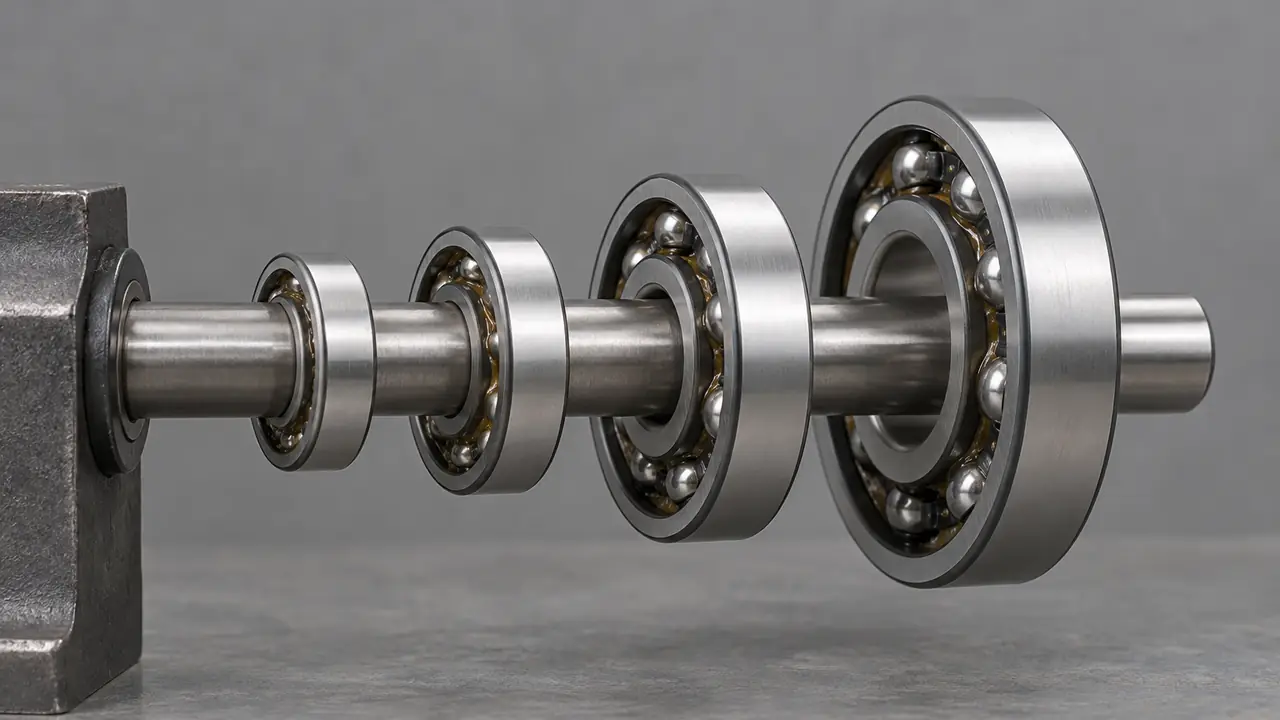
What the second digit changes
In the numbers 6200 and 6300, the 6 identifies a single-row deep groove ball bearing, and the second digit sets the dimension series. The 2 gives the light series and the 3 gives the medium series. The last two digits are the bore code, so 6204 and 6304 both have a 20 mm bore. What changes is the outside diameter and width: the medium series has a thicker ring section, which leaves room for larger balls and a stronger raceway.
That is the whole principle. A 6300 series bearing is not a different design, it is the same design scaled up on the outside. Because the shaft size is identical, the choice between the two lines is a question of housing space, load and life. Both follow ISO 15 boundary dimensions, so the sizes below are the same across qualified plants. They are nominal; confirm them on the supplier drawing.
Side-by-side dimensions
| Bore code | Light, 62 series | Medium, 63 series |
|---|---|---|
| 00 (10 mm) | 6200: 10 x 30 x 9 | 6300: 10 x 35 x 11 |
| 01 (12 mm) | 6201: 12 x 32 x 10 | 6301: 12 x 37 x 12 |
| 02 (15 mm) | 6202: 15 x 35 x 11 | 6302: 15 x 42 x 13 |
| 03 (17 mm) | 6203: 17 x 40 x 12 | 6303: 17 x 47 x 14 |
| 04 (20 mm) | 6204: 20 x 47 x 14 | 6304: 20 x 52 x 15 |
| 05 (25 mm) | 6205: 25 x 52 x 15 | 6305: 25 x 62 x 17 |
| 06 (30 mm) | 6206: 30 x 62 x 16 | 6306: 30 x 72 x 19 |
| 07 (35 mm) | 6207: 35 x 72 x 17 | 6307: 35 x 80 x 21 |
| 08 (40 mm) | 6208: 40 x 80 x 18 | 6308: 40 x 90 x 23 |
The gap widens as the bore grows. At 17 mm the medium series adds 7 mm of outside diameter; at 40 mm it adds 10 mm. The width increase is bigger in relative terms, up from 18 to 23 mm at the 40 mm bore, which matters for axial space in short housings.
Where the sizes overlap
The two series create several coincidences that cause real mistakes. Reading across the table, you will see these pairs:
- 6204 (20 x 47 x 14) and 6303 (17 x 47 x 14) have the same outside diameter and width but different bores. They fit the same housing but not the same shaft.
- 6205 (25 x 52 x 15) and 6304 (20 x 52 x 15) likewise share the housing envelope but not the shaft.
- 6206 (30 x 62) and 6305 (25 x 62) share an outside diameter of 62 mm; the widths are 16 and 17 mm.
These overlaps can be used in design: a medium-series bearing with a smaller bore can sometimes drop into the housing of a light-series one when the shaft is turned down. They are also traps: a bearing with the right housing size and the wrong bore is easy to order by accident, so always verify all three dimensions on a line item. See how to measure a bearing if the part is already installed.
How to choose between them
There is no rule that medium is better. The two lines solve different problems, and the right pick follows from the application.
| Factor | Favours 6200 (light) | Favours 6300 (medium) |
|---|---|---|
| Housing space | Limited radial or axial space | Room for a larger ring |
| Load | Light to moderate | Heavier or more shock |
| Speed | Higher, lower friction | Moderate |
| Shaft diameter | Shaft fixed by the design | Shaft fixed, load pushes up |
| Weight and cost | Lower | Higher |
Load capacity and limiting speed for each bearing come from the supplier datasheet. The comparison above is directional only, and the real decision should use the dynamic load rating C and the equivalent load P in the L10 formula of ISO 281; see bearing life and L10. At a light load both lines may far exceed the required life, and the smaller, cheaper light bearing is then the sensible pick. At a heavy or shocking load, the light bearing may fall short, and the extra section of the medium line pays for itself. The calculation, not habit, should settle which case you are in, and it should be re-run if the load estimate changes.
Housing material also enters the decision. A thin aluminium or plastic housing may not support the bigger outside diameter of a medium bearing, while a heavy cast iron housing has no such concern. Likewise, a short shaft step may leave too little shoulder for the wider ring. Check these geometric limits first, since they can rule out a series before any load calculation begins.
Typical use patterns
The light 62 series is the general-purpose choice for medium electric motors, pumps, fans, appliances and conveyor idlers; the 6203 and 6205 are the most-ordered members of the line (see 6203 and 6205). The medium 63 series appears in heavier duty: gearbox shafts, larger pumps, agricultural machinery, compressors and equipment with shock loads or belt tension. These are general patterns, not specifications, and the same machine may use both lines in different positions.
If neither is enough, the next steps are a roller bearing for radial load, such as a cylindrical roller bearing, or a housed unit that moves the load into a stronger structure. Sizes beyond the 63 series are listed on the deep groove ball bearing page.
Suffixes work the same way
Closure, clearance and tolerance suffixes apply identically to both lines. 6204-2RS C3 and 6304-2RS C3 both carry rubber seals and larger-than-normal clearance. Suffix meanings are explained in bearing numbers decoded. Ask that the quotation repeat the dimensions with the designation, so a one-digit slip between 6204 and 6304 is caught before production.
For ordering, standard stock sizes in both lines are typically available from a reference MOQ of 100-500 pieces per designation, with stock samples in about 3-7 working days. These ranges are indicative and confirmed in writing for each program, as set out on the MOQ and lead time page. Send a mixed list through the quote form and the desk will return matched options for each line.