
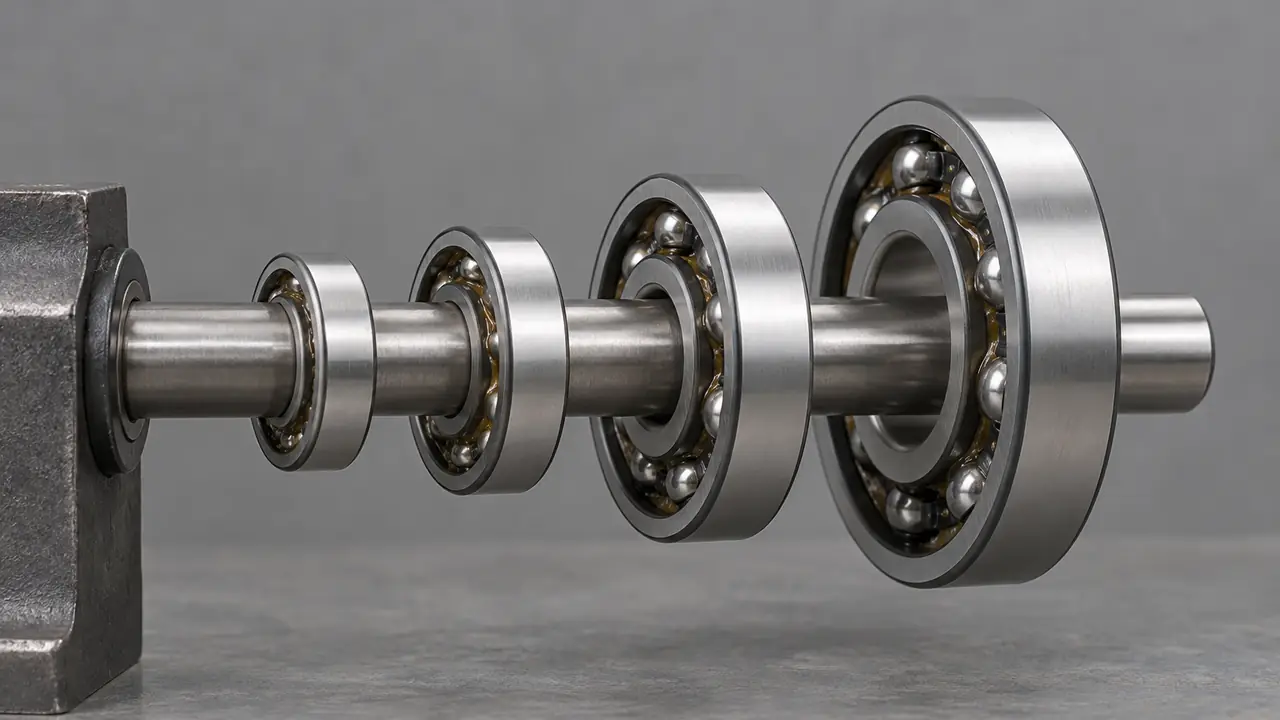
Nominal size of the 6205
Reading the number: 6 for a single-row deep groove ball bearing, 2 for the light dimension series, and 05 for a bore code of 25 mm (5 x 5). The nominal ISO 15 boundary dimensions are listed below.
| Dimension | Symbol | Nominal value |
|---|---|---|
| Bore | d | 25 mm |
| Outside diameter | D | 52 mm |
| Width | B | 15 mm |
Treat these as nominal. Tolerances, corner radius, shoulder diameters and mass are on the drawing or datasheet from the supplier, and that is also where the dynamic and static load ratings and the limiting speed for the specific bearing are given. This site does not publish rating numbers because they vary with design and steel, and quoting a generic figure would mislead.
The 25 mm bore across series
The bore code 05 applies to several series. If a housing or shaft limits you, the five standard deep groove series give these nominal sizes.
| Designation | Series | d x D x B (mm) |
|---|---|---|
| 6805 | Ultra-thin | 25 x 37 x 7 |
| 6905 | Extra-thin | 25 x 42 x 9 |
| 6005 | Extra-light | 25 x 47 x 12 |
| 6205 | Light | 25 x 52 x 15 |
| 6305 | Medium | 25 x 62 x 17 |
The 6005 is lighter and narrower, and the 6305 has a larger ring section. For the full 6000 family see 6000 series bearings; for the pair that most often competes in design reviews, see 6200 vs 6300 series.
Same size envelope, different bearing types
The 52 mm outside diameter and 25 mm bore also appear in other bearing types. This matters when an application has a 25 mm shaft and a 52 mm seat but needs a different load capability. The sizes below are nominal and from the standard tables.
| Designation | Type | Bore x OD x width (mm) |
|---|---|---|
| 6205 | Deep groove ball | 25 x 52 x 15 |
| NU205 | Cylindrical roller | 25 x 52 x 15 |
| 30205 | Tapered roller (total width T) | 25 x 52 x 16.25 |
| 2205 | Self-aligning ball | 25 x 52 x 18 |
| 22205 | Spherical roller | 25 x 52 x 18 |
| UC205 | Insert bearing (inner ring width) | 25 x 52 x 34.1 |
The bore and outside diameter match, but the width differs and so does the load behaviour. Replacing a 6205 with a roller type is a design change, not a like-for-like swap, and it needs a check of the axial location and the loads. Details of each type are on their product pages, for example cylindrical roller bearings.
Seals, shields and open versions
Most 6205 bearings are sold in one of three forms. Open bearings are used with oil or in a housing that supplies grease. Shielded bearings (6205-ZZ or 2Z) have metal shields that keep grease in and large particles out without touching the inner ring, so friction stays low. Sealed bearings (6205-2RS) have contact rubber seals that block fine dust and splash better, at the cost of higher friction and a lower speed capability. The practical differences are covered in 2RS vs ZZ bearings, and the parts themselves are on the seal and shield pages.
Seal material also matters. Standard seals are nitrile rubber; applications with higher temperature or aggressive media may call for fluoro rubber, which should be stated in the enquiry. The seal compound and the temperature limit of the grease come from the supplier datasheet.
Clearance groups: normal, C3 and others
Internal clearance is the total free movement of one ring relative to the other before mounting. Normal clearance is the default. C3 is the group larger than normal, and it is widely specified for the 6205 in electric motors and pumps, where a tight shaft fit and warm running both eat into clearance. C2 is smaller than normal and suits precise, lightly loaded positions. The clearance values in micrometres depend on bore size, so read them from the standards table or the supplier datasheet rather than from memory. The overview is on the tolerance and clearance page, and the groups are explained in bearing internal clearance.
Clearance and tolerance class are separate. A 6205 C3 can be made to the normal class or to P6. Ask for both to be written out, for instance "6205-2RS C3, normal tolerance class, low-noise grease".
Where the 6205 is used
With a 25 mm shaft and a light series, typical applications include medium electric motors, pumps, gearbox auxiliary shafts, fans, agricultural implements and conveyor rollers. This is general guidance based on what the size suits; actual selection should use load, speed and life checks per ISO 281 with the datasheet ratings. For equipment on dusty sites a housed unit with a 25 mm bore may be easier to service; see pillow block bearings.
Mounting and lubrication points
Two habits prevent most early failures on this size. First, press the bearing on through the ring that carries the tighter fit, never through the balls; a shaft press fit applied via the outer ring leaves dents in the raceway that show up later as noise. Second, do not overfill a sealed or open housing with grease. Too much grease raises temperature through churning, particularly at higher speed, and a bearing that runs hot loses clearance and grease life together. For the method and quantities, see the lubrication guide. Sealed 6205 bearings arrive pre-greased, and the grease type is a supplier choice unless you specify it, so name the temperature range and noise expectation in the enquiry.
What to state in the enquiry
- Full designation with suffixes, for example 6205-2RS C3.
- Tolerance class and, for motors or appliances, the vibration group.
- Grease type if temperature or noise is critical; seal material if above ordinary temperatures.
- Quantity per designation, marking and packing method.
Standard 6205 variants are typically supplied from a reference MOQ of 100-500 pieces per designation, with stock samples in about 3-7 working days and bulk stock orders in 7-15 working days. These are indicative ranges confirmed in writing for each program; see MOQ and lead time. Submit the list through the quote form.