
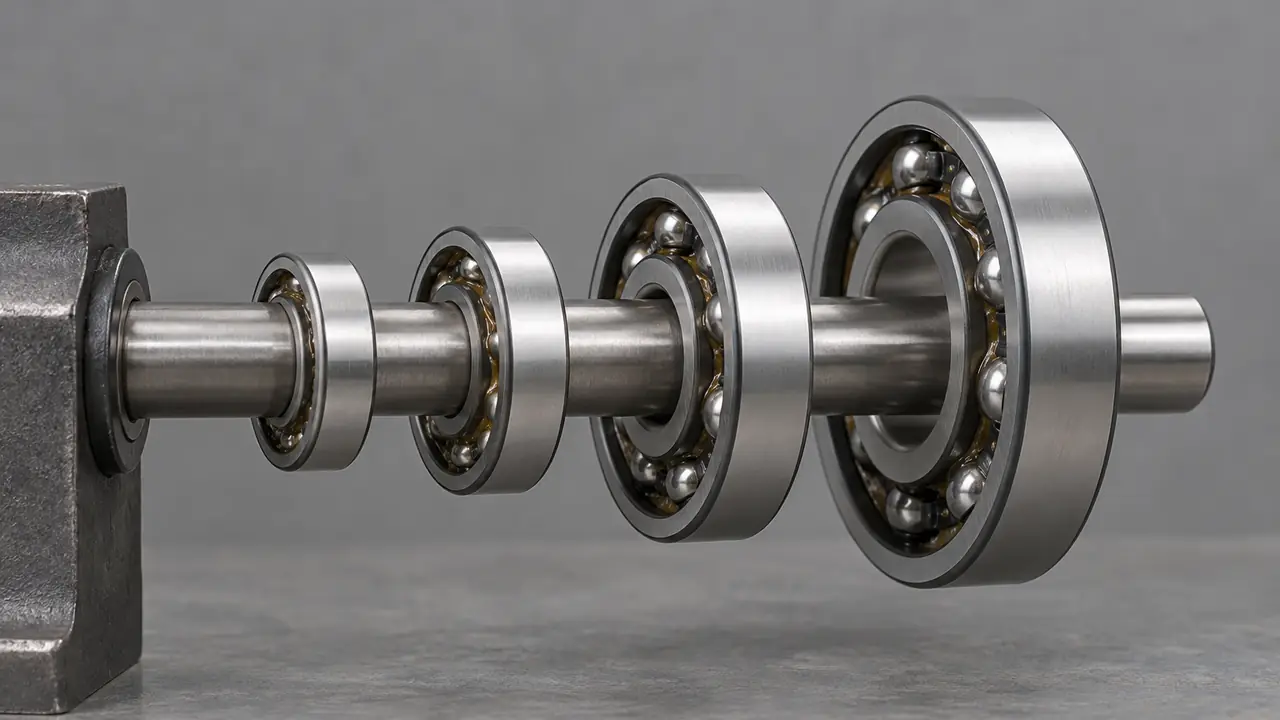
What the 6000 series is
In the metric deep groove range, the first digit 6 means a single-row deep groove ball bearing, and the second digit sets the dimension series. A 0 gives the extra-light line, a 2 the light line and a 3 the medium line. For a fixed bore, a higher second digit means a larger outside diameter, a wider ring and more room for bigger balls. The 6000 series therefore gives the smallest section among the regular lines, short of the thin-section 68 and 69 families.
All 6000 series bearings follow the boundary dimensions of ISO 15. Because the system is common, a 6008 from one plant should match the 6008 from another in bore, outside diameter and width, though not necessarily in noise, steel or grease. The chart below gives nominal values; check them against the supplier drawing before design-in.
6000 series dimension chart
The bore code follows the usual rule: 00, 01, 02 and 03 mean 10, 12, 15 and 17 mm, and from 04 the code times five gives the bore. Dimensions are in millimetres.
| Designation | d | D | B |
|---|---|---|---|
| 6000 | 10 | 26 | 8 |
| 6001 | 12 | 28 | 8 |
| 6002 | 15 | 32 | 9 |
| 6003 | 17 | 35 | 10 |
| 6004 | 20 | 42 | 12 |
| 6005 | 25 | 47 | 12 |
| 6006 | 30 | 55 | 13 |
| 6007 | 35 | 62 | 14 |
| 6008 | 40 | 68 | 15 |
| 6009 | 45 | 75 | 16 |
| 6010 | 50 | 80 | 16 |
| 6011 | 55 | 90 | 18 |
| 6012 | 60 | 95 | 18 |
| 6013 | 65 | 100 | 18 |
| 6014 | 70 | 110 | 20 |
| 6015 | 75 | 115 | 20 |
| 6016 | 80 | 125 | 22 |
The common stock sizes in this range are 6000 to 6010, but larger sizes are available from the partner plants as well. Most of the bearings above can be ordered open, shielded (ZZ) or sealed (2RS), and with C3 clearance or tighter tolerance classes on request. See bearing numbers decoded for suffix meanings.
How it compares with the 6200 and 6300 lines
Choosing a series is mostly a trade between space and capacity. The table sets four bores side by side across the three regular series so the pattern is visible.
| Bore (mm) | 60 series (d x D x B) | 62 series | 63 series |
|---|---|---|---|
| 17 | 6003: 17 x 35 x 10 | 6203: 17 x 40 x 12 | 6303: 17 x 47 x 14 |
| 25 | 6005: 25 x 47 x 12 | 6205: 25 x 52 x 15 | 6305: 25 x 62 x 17 |
| 40 | 6008: 40 x 68 x 15 | 6208: 40 x 80 x 18 | 6308: 40 x 90 x 23 |
| 50 | 6010: 50 x 80 x 16 | 6210: 50 x 90 x 20 | 6310: 50 x 110 x 27 |
At the same bore, the 6000 line has the smallest balls and the least load capacity, while the 6300 line has the most. The rating values come from the supplier datasheet for each bearing and should be compared there, not inferred from the table. For a closer look at the other two lines, read 6200 vs 6300 series.
When the 6000 series is the right choice
Pick the 6000 series when the shaft diameter is fixed, the housing space is limited and the load is moderate. It is common in compact electric motors, small gearboxes, appliances, power tools, textile and packaging machinery, office equipment and many light-duty rotating assemblies. It also suits high-speed running of lightly loaded shafts, because the lower ball mass and smaller section reduce inertia and friction. Limiting speed values are not given in generic tables; they are on the supplier datasheet and depend on the closure, grease and cage.
It is less suitable where shock loads, heavy radial loads or large misalignment are expected. In those cases move to the 6200 or 6300 line, or to a roller type. A quick way to decide is to compare the L10 life per ISO 281 at your load, using datasheet ratings; the method is outlined in bearing life and L10.
Where the thin series fit in
Below the 6000 line, two thinner families exist for tight radial space. The 69 series (extra-thin) and the 68 series (ultra-thin) keep the same bore but cut the ring section further. At a 25 mm bore, for example, the 6905 is 25 x 42 x 9 and the 6805 is 25 x 37 x 7, against 25 x 47 x 12 for the 6005. The thinner the section, the smaller the balls and the lower the load capacity, so these series suit lightly loaded joints, instruments and compact drives rather than general power transmission. They are often chosen when a design starts from a hollow shaft or a thin housing and the bearing has to fit what is left. If you are unsure which series your part uses, measure the three dimensions and match them against the chart on this page or the size chart.
Practical tips when ordering from the 60 line
- Write the dimensions beside the number. 6005, 6205 and 6305 differ only in the second digit. Add the size, such as 25 x 47 x 12, to every line.
- Confirm the closure. The 6000 series is often sold sealed, but not always. ZZ shields and 2RS seals change friction and protection.
- State the clearance. The thin ring sections lose clearance quickly with a tight press fit, which is why C3 is often added for motor work.
- Check the shoulder diameters. With a small section, the shaft and housing shoulders must support the ring but clear the seal; read them from the drawing.
For MOQ and lead time, partner plants typically work to a reference of 100-500 pieces per designation for standard stock, with stock samples in about 3-7 working days; see MOQ and lead time. All figures are indicative and confirmed in writing for each program.
Ordering across a range
Buyers who stock the 6000 line for distribution or maintenance usually do not need every size. A short list of the most used bores, with one or two closure variants each, covers most requests, and the rest can be quoted on demand. The desk can propose a stock list from your sales history and the sizes in the deep groove range, and it can arrange boxing and labelling for your own channel; see the quote form to start.