
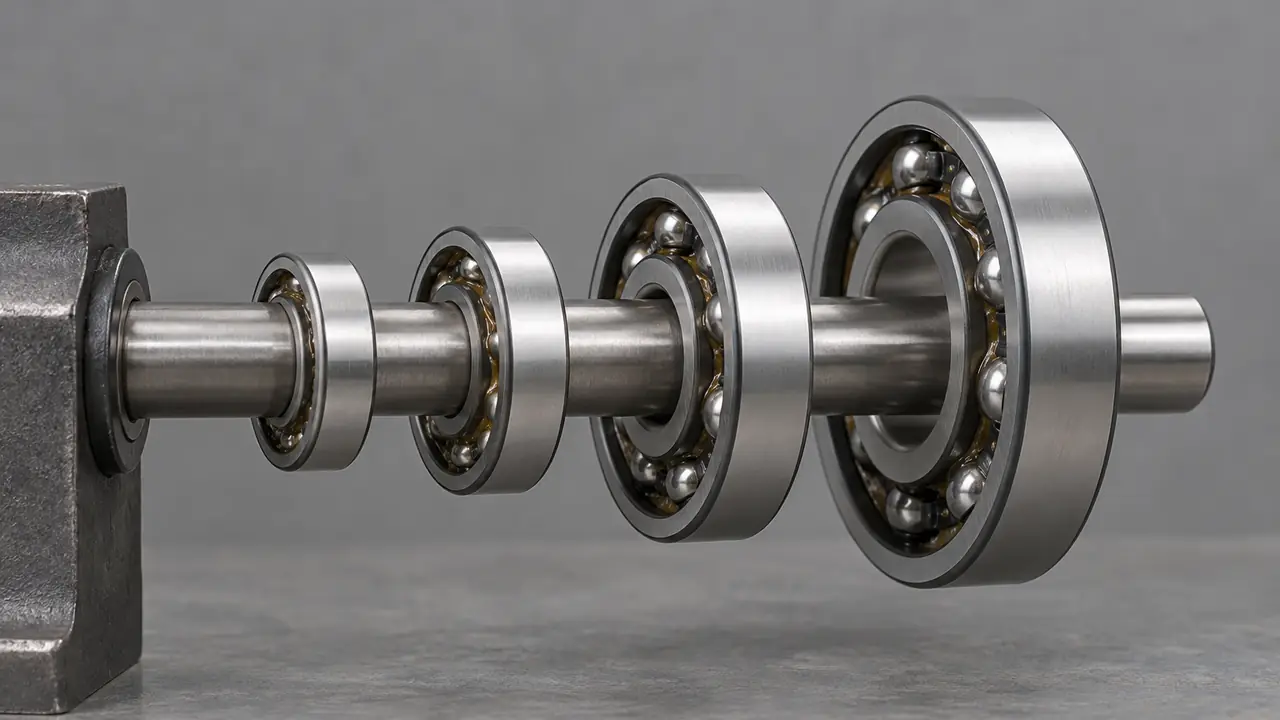
The basic rule: multiply by five
For most metric rolling bearings with a bore from 20 mm to 480 mm, the last two digits of the basic designation are the bore code, and the bore in millimetres is the code multiplied by five. So 6204 has code 04 and a 20 mm bore. A 6210 has code 10 and a 50 mm bore. A 22220 has code 20 and a 100 mm bore. The same rule holds across ball, tapered roller, spherical roller and cylindrical roller bearings, which makes it the single most useful habit for reading a number.
The result is a nominal bore under ISO 15 and its sister standards. The actual bore is a few micrometres off nominal, within the tolerance class of the bearing, and that tolerance is on the supplier drawing. The calculation tells you which bearing to look for, not how it will fit the shaft; fits are a separate step, covered in shaft and housing fits.
The four exceptions below 20 mm
Under 20 mm the pattern breaks. Four codes are assigned to fixed bores that you simply memorise.
| Bore code | Bore (mm) | Example | Nominal d x D x B (mm) |
|---|---|---|---|
| 00 | 10 | 6200 | 10 x 30 x 9 |
| 01 | 12 | 6201 | 12 x 32 x 10 |
| 02 | 15 | 6202 | 15 x 35 x 11 |
| 03 | 17 | 6203 | 17 x 40 x 12 |
From code 04 the multiply-by-five rule applies. This is why 6204 is 20 mm, 6205 is 25 mm and 6206 is 30 mm. A common slip is to apply the rule to 03 and read 15 mm instead of 17 mm; checking the table catches it.
A quick-reference table
| Code | Bore (mm) | Code | Bore (mm) |
|---|---|---|---|
| 04 | 20 | 12 | 60 |
| 05 | 25 | 14 | 70 |
| 06 | 30 | 16 | 80 |
| 07 | 35 | 18 | 90 |
| 08 | 40 | 20 | 100 |
| 09 | 45 | 22 | 110 |
| 10 | 50 | 24 | 120 |
| 11 | 55 | 26 | 130 |
Because the code only gives the bore, the series digits still decide the outside diameter and width. The same bore of 25 mm exists as 6005, 6205 and 6305 with different outside diameters, as shown in 6205 bearing dimensions.
Slash codes and small bores
Not every bore is a multiple of five, and not every bearing has a two-digit code. Two conventions cover the rest.
- Slash notation. Bores that are not divisible by five, or are very large, are written after a slash. A 6305/22 has a 22 mm bore, a 62/28 has a 28 mm bore and a 62/32 has a 32 mm bore. At 500 mm and above the bore in millimetres is written directly after the slash, for instance 230/500 for a 500 mm bore.
- Single digit bores. Bearings below 10 mm bore use the bore in millimetres directly, with no code. 608 is 8 mm, 625 is 5 mm and 623 is 3 mm. In the 68 and 69 families the same rule applies: 688 is 8 mm and 693 is 3 mm.
Some bearings with fractions use a slash as well: for example, a 2.5 mm bore is written 62/2.5. Small sizes are discussed further on the miniature bearing page.
Worked examples
A few quick readings show how the rule is used in practice.
- 6307. Code 07 times five gives 35 mm. The 63 series places it in the medium line, so the nominal size is 35 x 80 x 21 mm.
- 30208. A tapered roller bearing. Code 08 times five gives 40 mm, and the nominal size is 40 x 80 x 19.75 mm, where the last value is the total width T.
- 6301. Code 01 is an exception and means 12 mm, so the nominal size is 12 x 37 x 12 mm. Applying the multiply-by-five rule would wrongly give 5 mm.
- 6318. Code 18 times five gives 90 mm.
The first three results can be checked against the tables in the size chart; the rule gives the same bore wherever it applies, and the table gives the matching outside diameter and width.
When the number cannot be trusted
The rule assumes the marking is a standard designation. Several situations break that assumption. Worn or painted-over bearings can be misread, particularly 3 and 8 or 5 and 6. Some equipment makers print their own part numbers on the ring instead of the standard one, and these codes follow no bore rule at all. Older bearings may be marked to a superseded system, and a marked suffix such as K for a tapered bore changes how the bearing fits without changing the basic number. In all of these cases, treat the number as a clue and measure the bearing. A bore gauge or a good caliper, applied at two angles, will confirm or reject the reading. If the measurement and the calculation disagree, believe the measurement and ask the supplier to match by dimensions.
Types that break the pattern
The rule applies to the main metric radial and tapered lines. These types use another convention, which is why a blind application gives wrong answers.
| Type | How the number encodes the size | Example |
|---|---|---|
| Thrust ball (511xx) | Bore code rule applies | 51104: code 04, bore 20 mm |
| Needle with inner ring (NA49xx) | Bore code rule applies | NA4904: code 04, bore 20 mm |
| Drawn cup needle (HK) | Shaft diameter then length, in mm | HK2012: 20 mm shaft, 12 mm long |
| Linear bushing (LM..UU) | Shaft diameter in mm | LM12UU: 12 mm shaft |
| Insert bearing (UC2xx) | Bore code rule applies | UC205: bore 25 mm |
| Spherical plain (GE..E) | Bore in mm | GE20ES: 20 mm bore |
Inch bearings follow their own system, in which the number often identifies a cone and cup pair rather than a bore. They are covered in inch vs metric bearings. Specialty lines vary by maker, so use the designation guide and confirm with the supplier drawing.
A three-step check before you order
- Apply the rule to the last two digits and write the bore down.
- Read the series digits and look up the nominal outside diameter and width.
- Compare with the measured part if there is one, using how to measure a bearing, and send the designation together with d x D x B.
Writing the three dimensions beside the number on every line is a low-effort way to avoid a wrong shipment, whichever side makes the slip. If a number cannot be decoded or the size does not match the table, ask the desk through the quote form and attach a photo and the measurements. Typical reference MOQ for standard sizes is 100-500 pieces per designation, confirmed in writing for each program.