
A working definition
A bearing supports a moving part and constrains it to the motion you want. In most machines that means a rotating shaft: the bearing holds the shaft on its axis, carries the forces acting on it, and lets it turn with as little friction and wear as possible. Without bearings, a shaft would rub directly against its housing, heat up, wear out and eventually seize.
The word covers a wide range of parts, from a bronze bush in a door hinge to a spherical roller bearing the size of a car wheel in a crusher. Engineers split them into two broad families. Rolling bearings place balls or rollers between two rings so that the surfaces roll rather than slide. Plain bearings, also called sliding bearings or bushings, have no rolling elements: the shaft slides on a low-friction surface such as bronze, a polymer layer or an oil film. Most of the questions buyers ask about bearings concern rolling bearings, so that is the focus here; plain bearings have their own page.
The four parts of a rolling bearing
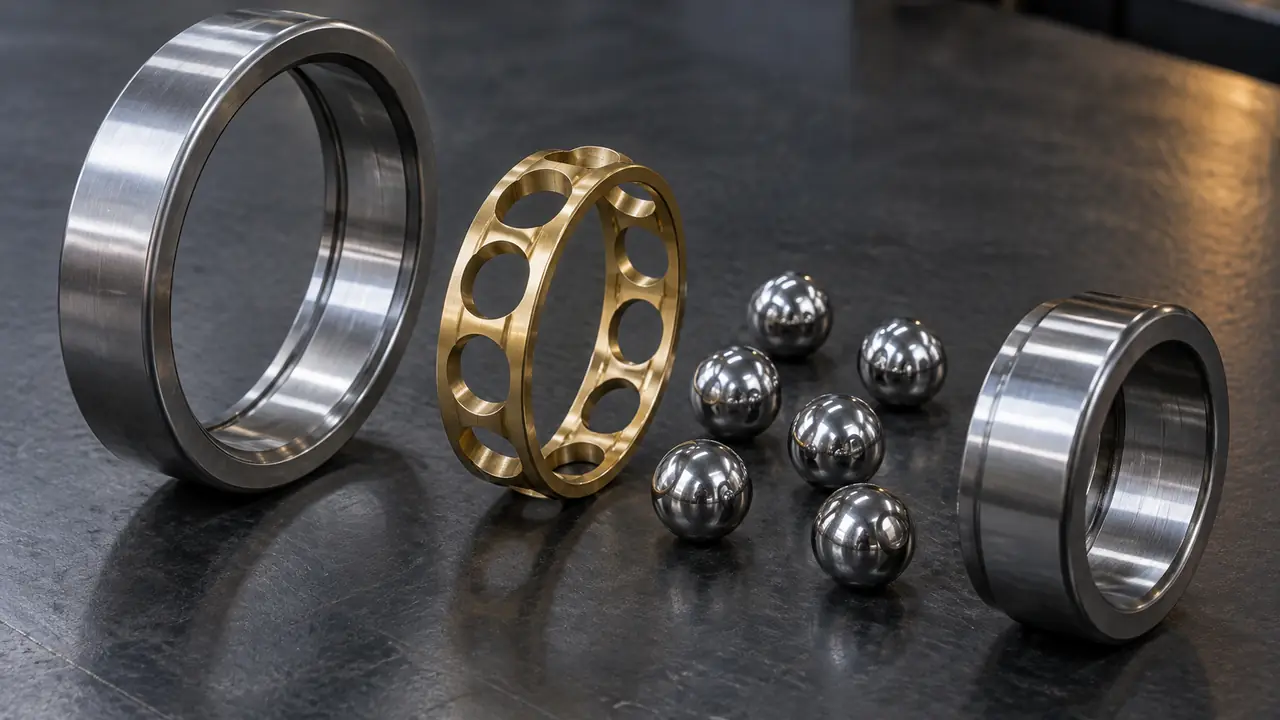
A typical rolling bearing has four parts. Each one is a separate manufacturing process and often a separate supplier, which is why bearing clusters in China include specialist makers of balls, cages and seals as well as complete bearings.
| Part | What it does | Usual material |
|---|---|---|
| Inner ring | Fits on the shaft and turns with it in most designs | High-carbon chromium steel such as GCr15 / 52100 |
| Outer ring | Sits in the housing; carries the outer raceway | Same steel, hardened and ground |
| Rolling elements | Balls or rollers that carry load between the rings | Chromium steel; ceramic in hybrid bearings |
| Cage | Keeps the rolling elements evenly spaced | Pressed steel, machined brass or glass-fibre nylon |
Many bearings add seals or shields on the sides to keep grease in and dirt out, plus the grease itself. A sealed bearing is often lubricated for life; an open bearing relies on oil or grease supplied by the machine.
Why rolling beats sliding for most shafts
Rolling contact needs far less force to start moving than sliding contact. A rolling bearing therefore starts easily, runs cool at speed and keeps its friction nearly constant over a wide speed range. It is also predictable: rating life can be calculated from load and speed using the method in ISO 281, which lets designers size a bearing for, say, 20,000 hours of operation. That calculation is covered in bearing life and L10.
Plain bearings still win in some places. They tolerate shock and contamination well, take up little radial space, run silently and can be cheaper in simple, slow pivots. Engine crankshafts, for example, run on oil-film plain bearings because a pressurised oil film carries very high loads.
Loads: radial, axial and combined
The single most useful question when choosing a bearing is: which way does the load push?
- Radial load acts at right angles to the shaft, like the weight of a pulley or the pull of a belt. Deep groove ball bearings and cylindrical roller bearings are built for it.
- Axial load, also called thrust, acts along the shaft, like the push of a propeller or a helical gear. Thrust ball bearings and thrust roller bearings take axial load only.
- Combined load is both at once. Angular contact ball bearings and tapered roller bearings are designed for it, which is why wheel hubs and gearbox output shafts use them.
Balls touch the raceway at a point, so ball bearings run fast with low friction but carry less load. Rollers touch along a line, so roller bearings carry heavier load at lower speed. That trade-off drives most selection decisions and is compared in ball vs roller bearings.
The main families at a glance
| Family | Strength | Typical place |
|---|---|---|
| Deep groove ball | Versatile, quiet, fast | Motors, fans, pumps, appliances |
| Angular contact ball | Combined load, precision | Pumps, machine-tool spindles |
| Cylindrical roller | High radial load | Gearboxes, large motors |
| Tapered roller | Heavy combined load | Wheel hubs, axles, gear reducers |
| Spherical roller | Heavy load with misalignment | Mining, paper machines, vibrating screens |
| Needle roller | Small radial section | Gear pumps, transmissions, rocker arms |
| Housed units | Easy mounting on frames | Conveyors, farm machinery |
The product catalogue groups the 31 lines this desk handles into ball, roller and specialty bearings, components, and kits and accessories.
Three common misunderstandings
"Same number, same bearing." A designation fixes the size and the basic design, not the quality. Steel cleanliness, heat treatment, raceway finish and cage design vary between plants, and those decide noise and life. Sample testing is the only reliable comparison.
"Sealed means maintenance-free forever." A sealed bearing is lubricated for its expected service life under normal conditions. High temperature, high speed or a wet, dusty site shortens grease life, and the bearing then fails early even though nothing looks wrong from outside.
"A tighter bearing is a better bearing." Internal clearance is chosen for the fit and temperature of the application. Too little clearance after mounting causes heat and early failure; that is why motor bearings are often specified with C3 rather than normal clearance.
How a bearing is identified
Standard bearings are identified by a designation such as 6204-2RS C3. The numbers tell you the type, the dimension series and the bore; the suffixes tell you about seals, internal clearance, cage, tolerance class and grease. Because boundary dimensions follow ISO 15, a designation fixes the bore, outside diameter and width. Two bearings with the same designation fit the same shaft and housing, though they can differ in steel quality, noise and life. The designation guide explains the system line by line.
What a buyer should state when ordering
A useful request for quotation answers the questions the plant will ask anyway:
- Designation, or bore, outside diameter and width if the designation is unknown.
- Seal or shield, internal clearance and tolerance class.
- Cage material and grease type if they matter for speed, temperature or noise.
- Application, load, speed and operating temperature in a sentence or two.
- Quantity per designation, marking and packaging, and the target delivery date.
With that information a supplier can propose matched options and a typical reference MOQ rather than a generic price list. Send it through the quote form.