
The core difference
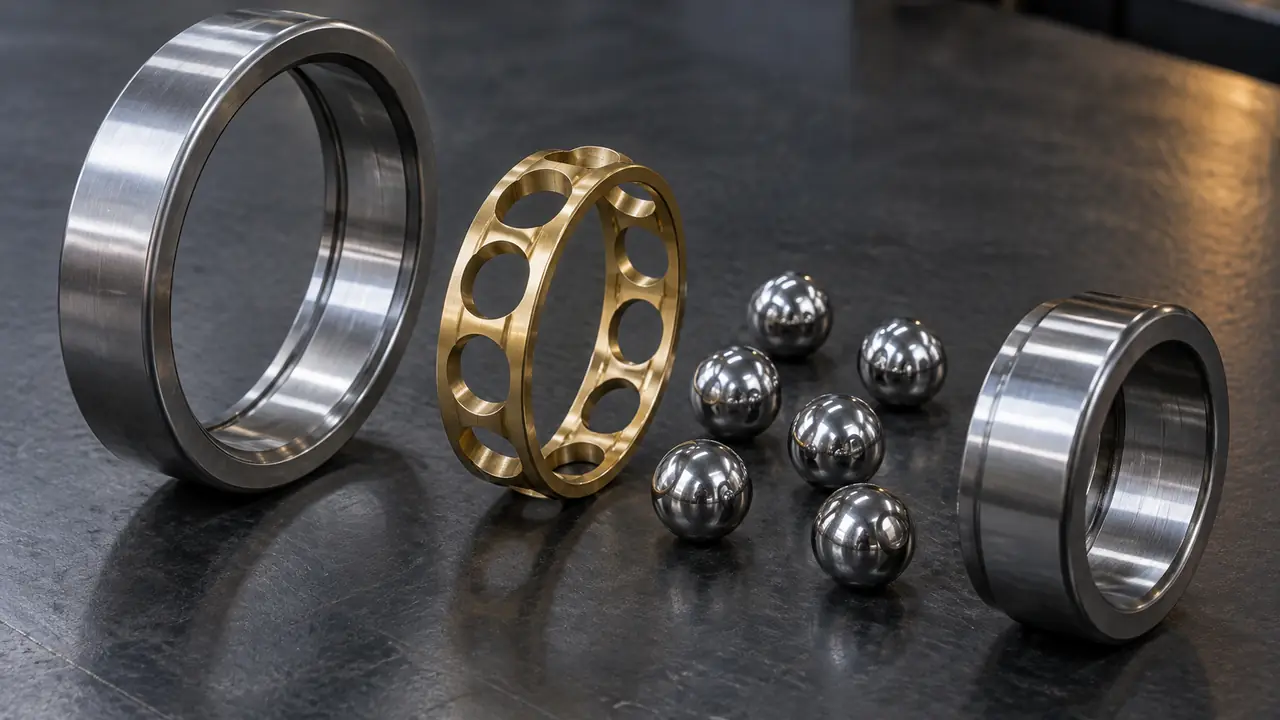
In a rolling bearing, balls or rollers separate the moving surfaces, and the motion between the shaft and housing becomes mostly rolling. In a sliding bearing, the surfaces slide directly on each other, separated by a lubricant film, a solid lubricant layer or nothing but the bearing material itself. Both ideas are old and both are in use in modern machines; they just suit different conditions.
The result is a different friction profile. Rolling friction comes from small deformations at the contact and from the cage and seals, and it is nearly constant with speed. Sliding friction depends strongly on whether a film has formed: it is high at start-up and falls as the shaft speeds up and a film builds, which is the reason sliding bearings are often described as having a "breakaway" torque that rolling bearings lack.
Side-by-side comparison
| Criterion | Rolling bearing | Sliding bearing |
|---|---|---|
| Start-up friction | Low, close to running friction | Higher, falls once a film forms |
| High-speed continuous rotation | Strong, especially ball types | Possible with oil film and pressurised supply |
| Slow oscillation | Can suffer false brinelling and wear in place | Strong |
| Shock and impact | Moderate; raceways can dent | Strong, conforming surface |
| Contamination | Needs seals; dirt shortens life | Tolerates dirt better, within limits |
| Radial space | Larger section, except needle types | Thin wall, compact |
| Noise | Audible at speed | Quiet |
| Life prediction | Calculated by ISO 281 method | Estimated from wear and pv limit |
| Shaft requirements | Standard ground seat | Hard, smooth running surface |
| Standardisation | Wide ISO and GB/T series | Many supplier-specific forms |
Some of these entries need a sentence of context. "False brinelling" is the damage that appears on raceways when a rolling bearing vibrates or swings through small angles without turning; the rollers keep pressing on the same place and push the lubricant out. It is covered in the post on false brinelling in transit. And while the ISO 281 method lets designers estimate rating life of rolling bearings from load and speed, no equivalent universal formula exists for plain bearings, which depend on the wear characteristics of each material pair.
Energy, heat and efficiency
Rolling bearings save energy in motors, fans and pumps, because they have a lower friction torque in continuous rotation, and the saving is noticeable for equipment that runs for thousands of hours a year. Sliding bearings can run at low friction when operating hydrodynamically, but only if the shaft is moving fast enough to build the oil film. At low speeds, the film collapses, torque rises and heat builds.
Heat flows differently as well. In a rolling bearing, most of the heat comes from the lubricant churning and from the cage and seals; in a sliding bearing, it comes from shear in the film or direct contact. Plain bearings are better in carrying heat away if the housing is a good conductor, while rolling bearings depend on the grease or oil to carry it away. Either way, keeping temperature within the lubricant limit is the real design goal.
Cost and maintenance across the life
A plain bush costs less than a rolling bearing of equal bore, and it fits in a smaller envelope. But the total cost depends on the machine. A rolling bearing needs lubrication, seals and a precisely finished seat; a bush needs a hard, finished shaft, which may cost more than the bush itself. In heavy equipment, such as excavator pins and press linkages, bushes are replaced regularly as a service item, while in motors and gearboxes, rolling bearings are fitted for life and expected to outlast several years of service.
- Choose rolling bearings where continuous rotation, low torque and predictable rating life matter.
- Choose sliding bearings where the movement is slow, oscillating, dirty or shock-loaded, or space is tight.
- Consider composite bushes where lubrication is difficult or must be avoided, as in food areas.
- Consider a spherical plain bearing for swinging joints with misalignment.
Typical failure modes compared
Knowing how each family fails helps when deciding which to specify and how to inspect it. A rolling bearing usually fails by subsurface fatigue, which shows up as flaking or spalling of the raceway after a long time, or earlier if contamination, poor lubrication, misalignment or electrical current has damaged the surface. Warning signs are rising noise, vibration and temperature, and they can be monitored with a handheld vibration meter or a simple stethoscope.
A sliding bearing usually fails by wear, scoring or seizure. Wear shows as growing clearance and knock; scoring comes from hard particles or a rough shaft; seizure happens when lubrication stops and the surfaces weld together. Because wear is gradual, a regular check of play at the joint often shows the problem long before breakdown, which is why plain bushes are common in equipment that is inspected on a schedule.
The lesson for buyers is that quality control also differs. For rolling bearings, incoming inspection focuses on dimensions, clearance, noise and hardness against the agreed designation and tolerance class. For sliding bearings, it focuses on material, lining thickness, bore after pressing and surface finish. Tell the supplier which of these checks you want recorded, so the report matches how the part will actually fail.
Hybrid solutions
Real machines often use both. A gearbox may run rolling bearings on its shafts and a bronze bush in a gear idler or a thrust washer behind a helical gear. A conveyor may use housed units on its drum shafts and plain bushes in its idler pivots. A lifting arm may use a spherical plain bearing at the joint and ball bearings in the electric drive. The practical question is not which family is better, but which one suits each position.
Where sourcing is concerned, the families behave differently too. Rolling bearings are catalogue items, defined by ISO 15 dimensions and a designation, and are compared by tolerance class, clearance and noise. Plain bearings are specified by material and dimensions, with the supplier confirming the pv limit. A buyer who needs both can send one combined list to the desk through the quote form, and the desk will coordinate partner plants for each. Reference MOQs and lead times for standard parts are on the MOQ and lead time page.
A short decision checklist
- Is the shaft turning continuously above a few hundred rpm? Favour rolling.
- Is the motion a swing or a short stroke? Favour sliding.
- Is there dirt, water or shock and no practical sealing? Favour sliding.
- Is torque or energy use important? Favour rolling.
- Is radial space tiny? Consider needle rolling or a thin plain bush.
- Can the shaft be hardened and ground? If not, favour rolling with an inner ring.