
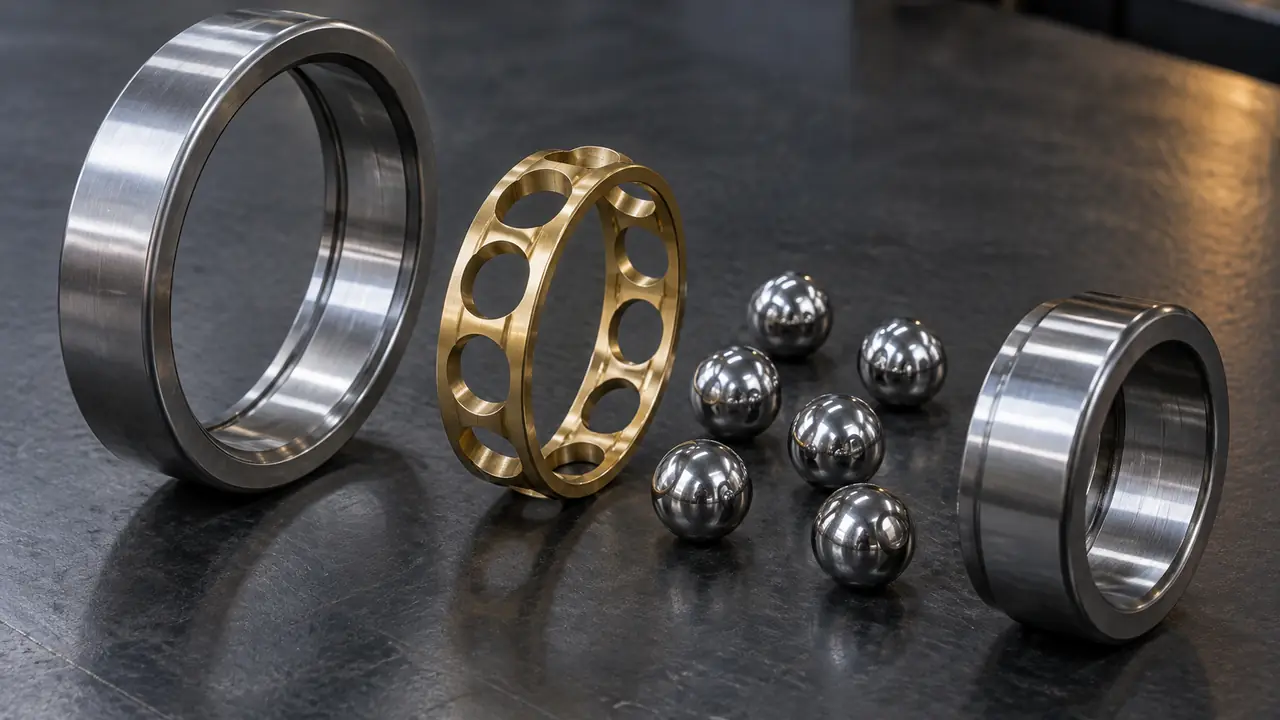
A bearing with no moving parts inside
A plain bearing is the simplest bearing there is: a cylinder, flanged cylinder or flat strip of material that the shaft or sliding part moves against. There are no balls, no rollers and no cage. The shaft slides on the bearing surface, and the design job is to make that sliding as low-friction and as wear-resistant as possible. The part is usually pressed into a housing bore, and is called a bush, a bushing, a sleeve or a liner depending on the industry.
The lack of complexity is a real advantage. A plain bearing is cheap to make, takes up little radial space, runs quietly and has no fatigue limit set by rolling contact. It is also tolerant of dirt, shock load and short oscillating movement, which are exactly the conditions where rolling bearings suffer. Its price is higher friction, especially at start-up, and a service life tied to wear rather than to a rating life calculation.
The three lubrication regimes
How a plain bearing behaves depends on what separates the shaft from the bush.
- Boundary lubrication. The surfaces touch with only a thin layer of lubricant or solid film. This is the case at low speed, in oscillation and in start-up. Wear is steady and predictable.
- Mixed lubrication. Part of the load is carried by a film and part by surface contact. This is the transition range as speed rises.
- Hydrodynamic lubrication. At sufficient speed, the rotating shaft drags oil into a wedge and floats on a pressurised film with almost no contact. Engine crankshaft bearings work this way, and can carry very high loads with a long life as long as clean oil arrives continuously.
Most commercial bushes in the catalogue run in the first two regimes, and are chosen for load and surface speed. The designer looks at the product of pressure and sliding speed, called the pv value, and keeps it under the limit published by the material supplier.
Common materials
| Material | Lubrication | Strengths | Watch for |
|---|---|---|---|
| Cast or sintered bronze | Oil or grease, sometimes oil-impregnated | High load, robust, tolerant of shock | Needs a hardened, smooth shaft and regular lubrication |
| Steel-backed bronze with grooves or pockets | Grease with solid inserts | Heavy load, slow oscillation | Pockets must be refilled in service |
| Composite with PTFE layer | Self-lubricating | Dry running, low friction, light weight | Lower temperature and load limits than bronze |
| Polymer (e.g. nylon, acetal) | Self-lubricating | Quiet, corrosion free, cheap | Swells with moisture and creeps under load |
The composite family combines a steel or bronze backing with a thin sliding layer on the inside. It is common in hinges, lifting equipment and agricultural pivots, since it runs without grease and avoids contamination of the surroundings. The bronze vs composite bushings note compares them in detail.
Shaft and fit matter more than for rolling bearings
The shaft is the other half of a plain bearing. Hardness and surface finish decide the wear rate. A hardened and ground shaft with a fine finish will outlast a soft or rough one many times over, because roughness acts like a file on the bush. Corrosion on the shaft has the same effect, so stainless or plated shafts are common where water is present.
Clearance between bush and shaft has to be right. Too tight and the bearing seizes as it warms; too loose and the shaft knocks, giving noise and edge loading. Typical practice is to press the bush into the housing with an interference fit and then allow for a running clearance on the shaft as given in the supplier datasheet. Do not cut or ream the bush after pressing without checking with the supplier, since the inside layer can be thin.
How a plain bearing wears out
A rolling bearing ends its life with fatigue spalling at a time that can be estimated from load and speed. A plain bearing fails differently, by gradual wear, and the wear rate depends on the combination of pressure, sliding speed, temperature and lubricant. The result is slow, visible and easy to monitor: clearance grows, play appears in the pivot, and noise increases. That is a useful warning pattern, since a worn bush can be replaced during scheduled maintenance rather than after a sudden breakdown.
Several causes shorten life sharply. Dirt embedding in a soft bush scores the shaft. Edge loading from a bent shaft or misaligned housing concentrates wear at one end of the bush, and a chamfer or crowned bore can reduce this. Overheating softens polymer layers and thins lubricant. Starved lubrication, particularly in grease-lubricated bronze, causes scoring and, finally, seizure. If a bush wears quickly, look at the shaft surface, alignment and lubrication supply before simply fitting a thicker bush.
For repetitive duty, many designers specify a flanged bush, which takes a small axial load on the flange face as well as radial load in the bore. A separate thrust washer is used when the axial load is larger. Both items are listed among the bearing washers.
Where plain bearings are the better answer
- Oscillating or slow movement. Hinges, linkages and pivots swing through small angles where rolling elements would press on the same spots.
- Shock and heavy intermittent load. Presses, loaders and excavator pins.
- Dirty, wet or hard-to-seal sites. Composite and bronze bushes tolerate contamination better than a sealed ball bearing.
- Tight radial space. A bush needs only a thin wall.
- Low cost, low speed duty. Appliances, office equipment and simple conveyors.
Where continuous high-speed rotation with low friction is needed, a rolling bearing is the better choice. The wider comparison is in rolling vs sliding bearings. For swinging joints with misalignment, see also the spherical plain bearing line, which pairs a ball-shaped inner part with an outer race to allow tilt.
What to give a supplier
Plain bearings are sold by dimension and material rather than by a universal series number, so the enquiry needs to be specific: inside diameter, outside diameter and length (and flange diameter if present), material and lining, tolerance on the bore after pressing, the load direction, sliding speed or oscillation angle, temperature, and lubrication available in service. The partner plant can then confirm the suitable pv range in writing. Non-standard sizes and surface finishes are managed through the custom bearings route, with MOQs set per drawing.
Standard bush sizes are often held in stock, with typical reference MOQs and lead times given on the MOQ and lead time page and confirmed in writing for each program. Send your list through the quote form.