
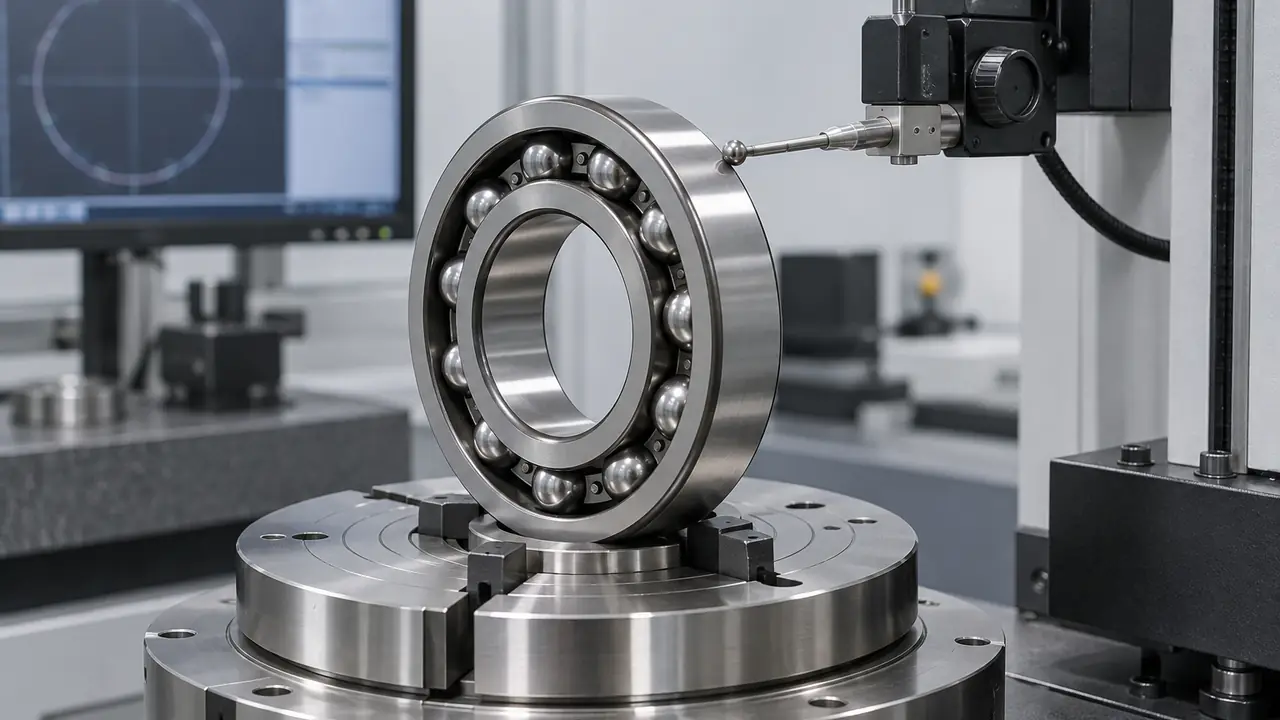
What a precision class actually controls
A precision class, also called a tolerance class, limits how far a bearing may deviate from its nominal size and how true it runs. Two groups of limits are involved. The first is dimensional accuracy: bore diameter, outside diameter, width and the variation of each around the circumference. The second is running accuracy: how much the inner or outer ring wobbles, or runs out, when the bearing turns. The class is a statement about these limits, not about material, life or load rating.
That distinction matters for buyers. A P5 bearing is not stronger than a P0 bearing of the same size and series. It is made, ground and measured to tighter limits, so it positions a shaft more accurately and usually runs smoother. If your machine does not need that accuracy, a higher class adds cost without adding life.
How the class names line up
The international standard for rolling bearing tolerances is ISO 492 for radial bearings. It names the classes Normal, 6, 5, 4 and 2, with the number falling as the limits tighten. Chinese practice under GB/T uses the prefix P, so the Normal class appears as P0, and the others as P6, P5, P4 and P2. Many datasheets and catalogues use the P forms, which is why buyers meet "P0" even though the ISO name is "Normal".
| Chinese / GB/T name | ISO 492 name | Relative accuracy | Typical use |
|---|---|---|---|
| P0 | Normal | Standard | General machinery, motors, appliances, conveyors |
| P6 | Class 6 | Tighter than Normal | Higher-grade motors, gearboxes, quiet running |
| P5 | Class 5 | Tight | Machine tools, precision instruments, higher speed |
| P4 | Class 4 | Very tight | Spindles, high-speed precision equipment |
| P2 | Class 2 | Tightest | Specialist measuring and spindle work |
The exact micrometre limits for each class depend on bearing size and are published in the standard and in the supplier datasheet. We do not reproduce them here because they change with bore and outside diameter, and a single figure in an article can mislead. Ask for the table that matches your designation.
Where each class is normally specified
P0 (Normal) is the default for catalogue deep groove ball bearings. It is correct for the large majority of fans, pumps, farm machinery, appliances and conveyor idlers. If a drawing says nothing about class, P0 is assumed.
P6 is a step up for equipment where noise and smooth running count: higher-grade electric motors, small gearboxes and some automation axes. It is often paired with a vibration grade, covered in vibration grades Z1 to Z3 and V1 to V3.
P5 and P4 belong to spindles and precision positioning, usually in angular contact ball bearings and in the high-speed bearing line. Here the shaft position and runout determine part quality, so tight classes pay for themselves. These are normally mounted in matched pairs with a defined preload.
P2 is rare outside specialised spindle and instrument work. If an enquiry asks for it, expect a longer lead time and a smaller number of capable partner plants.
Costs, lead time and what changes in production
Tighter classes cost more because the process changes. Rings need more grinding passes and finer honing, measurement takes longer, and the reject rate during sorting is higher. Ball grade also moves up with the class, which is why precision bearings are usually built with better balls under ISO 3290. We do not quote prices in articles, but the relative direction is clear: each step up the class ladder adds processing and inspection, and the supplier pool narrows. Lead times follow the same pattern. Reference ranges are on the MOQ and lead time page and are confirmed in writing for each program.
Does a tighter class need tighter housing and shaft work?
Yes, and this is where many upgrades fail. A P5 bearing fitted on a shaft with poor roundness or in a housing with uneven bore will deform and lose the accuracy it paid for. Before moving to a higher class, check that the shaft seat and housing bore have matching geometry and surface finish. The usual practice is to tighten the shaft and housing tolerances in step with the bearing class. The reasoning behind the fit classes is in shaft and housing fits for bearings.
Common misunderstandings
"Higher class means better quality." The class is a tolerance statement. A P0 bearing from a well-run plant with clean steel and consistent heat treatment can outlast a P5 bearing from a weak one in an ordinary application. Class and overall quality are independent, so compare samples as well as paperwork.
"The marking proves the class." A class printed on the ring or the box is a claim until measured. For critical programs, ask for the partner plant's inspection record for the batch and, if needed, have a sample set measured independently before the full order. The desk can coordinate this through the testing and inspection process.
"All classes are defined the same way for every bearing type." Tapered roller bearings, thrust bearings and some small bearings follow their own tables or class names. When you move between bearing types, check that the class name you quote is the one defined for that type, and ask the supplier to state which standard table it follows.
Choosing a class: a practical sequence
- Start from the function. If the shaft only needs to turn and carry load, P0 is normally sufficient.
- Add noise or smoothness requirements. If quiet running is a selling point, move to P6 and agree a vibration grade.
- Check positioning accuracy. If runout affects product quality, such as machining or measurement, consider P5 or P4 with matched pairs.
- Check speed. High-speed spindles typically need P5 or better to keep heat and vibration under control.
- Confirm that the shaft and housing can be machined to match.
What to put in the enquiry
State the class explicitly using one naming system, for example "P5 per ISO 492 / GB/T", rather than "high precision". Add the designation, clearance group, cage, preload for paired bearings, and the application. The desk will then shortlist partner plants that run the required class and arrange samples with the measurement records. Send it through the quote form. Certificates such as ISO 9001 or IATF 16949 belong to partner plants and are verified per project.