
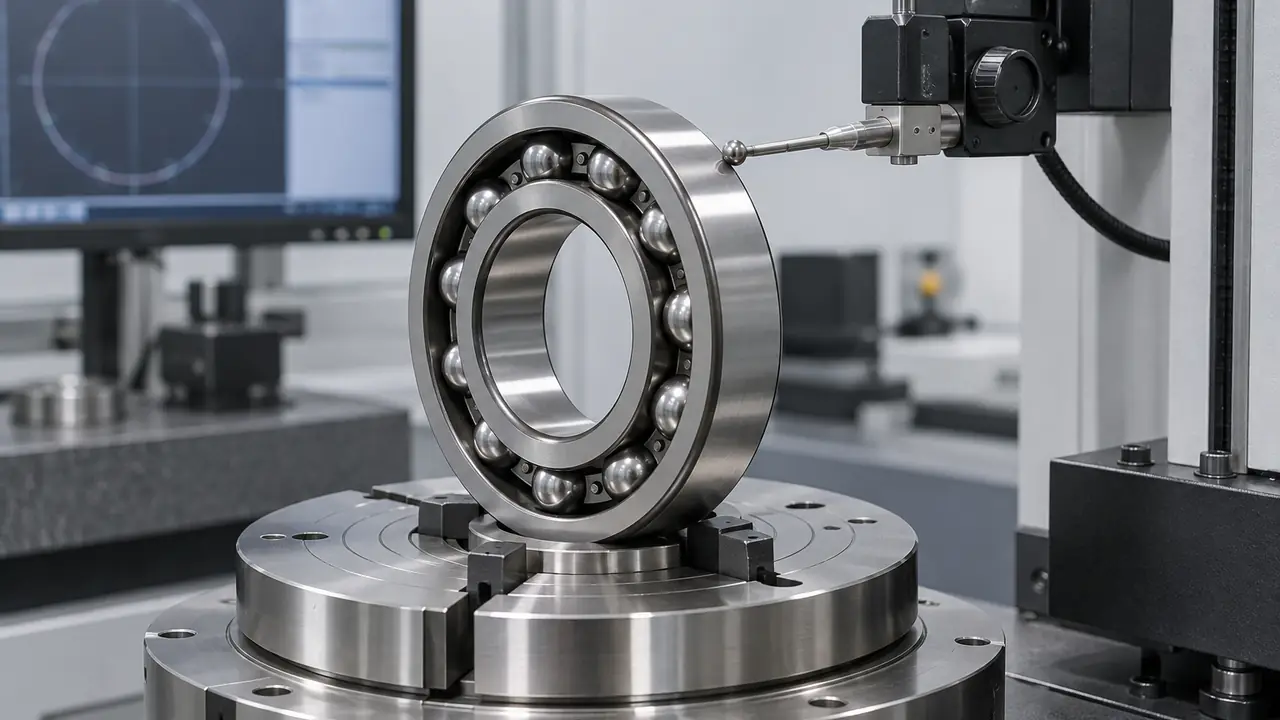
Two systems, one purpose
Both ABEC and ISO tolerance classes answer the same question: how closely is this bearing held to its nominal size and how true does it run? They come from different standards bodies. ABEC is the Annular Bearing Engineers Committee scale published by ABMA, the American Bearing Manufacturers Association. ISO 492 is the international standard for radial bearing tolerances, and GB/T standards in China align with it. Because the two systems grew up separately, buyers regularly meet both on the same enquiry, often from different departments.
The practical result is confusion. A retailer asks for "ABEC 7 bearings", the drawing says "P4", and the supplier datasheet says "Class 4". Are these the same request? Mostly yes, with some important gaps, which is why it helps to understand how the scales relate before you write an order.
The approximate correspondence
ABEC uses odd numbers: 1, 3, 5, 7 and 9, with higher numbers meaning tighter tolerances. ISO uses Normal, 6, 5, 4 and 2, where lower numbers are tighter. The two ladders line up step for step, as shown below.
| ABEC grade | ISO 492 class | GB/T name | Relative accuracy |
|---|---|---|---|
| ABEC 1 | Normal | P0 | Standard |
| ABEC 3 | Class 6 | P6 | Tighter |
| ABEC 5 | Class 5 | P5 | Precision |
| ABEC 7 | Class 4 | P4 | High precision |
| ABEC 9 | Class 2 | P2 | Ultra precision |
Treat this as a guide to the level, not a statement that every limit is identical. The tables are maintained by different bodies and there are small differences in some sizes and some parameters. Where the difference matters, such as for a spindle program, ask the supplier to name the standard and the table it follows rather than relying on an equivalence chart.
What an ABEC number does not tell you
The biggest practical issue is not the conversion; it is what the ABEC number leaves out. An ABEC grade concerns dimensional and running tolerances of the rings. It says nothing about the following, which often matter more to the user:
- Noise and vibration. A smooth, quiet bearing depends on raceway finish, ball grade and cage fit. These are specified separately, for instance with vibration groups described in Z1 to Z3 and V1 to V3.
- Internal clearance. Clearance is a separate group such as C2, CN or C3. See internal clearance groups.
- Materials and heat treatment. The steel grade, cleanliness and hardness are separate.
- Lubricant and seal. Grease type and seal arrangement affect speed and life.
- Ball grade. Balls follow ISO 3290 grades, which are a different scale again.
This is why sellers' claims such as "ABEC 9 skate bearings" should be read carefully. The rating by itself does not ensure a faster or smoother bearing. A well-made lower grade bearing with a good ball set and clean lubrication can run better in practice than a poorly made higher grade bearing.
Where ABEC is used and where it is not
ABEC wording is common in consumer and light-duty markets: skates, scooters, fishing reels, fidget spinners, hobby motors and some small instrument bearings. In these markets the number acts as a marketing grade, and the most popular sizes are small deep groove bearings such as 608, covered in 608 bearing dimensions.
Industrial buyers, OEM equipment makers and machine-tool users specify ISO or GB/T classes. Drawings from these buyers say P5 or Class 5, and the inspection plan checks the bearing against the matching table. ABEC is also defined mainly for radial ball bearings; other bearing types, such as tapered rollers, follow their own class systems, so a single ABEC number does not translate across the catalogue.
Why equivalence charts can still mislead
Three practical points explain why a conversion table should be the start of a conversation, not the end of it.
First, a class is a bundle of limits. Bore deviation, outside diameter deviation, width deviation, ring runout and several others are each tabulated per class. Two standards can be aligned on most of them and still differ on one parameter in one size range. For a general-purpose bearing this is harmless; for a matched spindle pair it may not be.
Second, the way the limit is measured matters. Standards describe the measuring method, such as how to take mean diameters or runout, and a supplier's inspection room must follow the same method for the numbers to be comparable. When a buyer re-measures a sample and disagrees with the supplier, the cause is often a different method rather than a bad bearing.
Third, a class label is only as reliable as the plant behind it. Sorting and sampling practice varies. For this reason the desk asks partner plants for batch inspection records and treats a class marking as something to verify on the first lot, not as proof.
How to write an unambiguous requirement
Whichever system the end customer uses, write the requirement so that it can be checked. A short formula works for most programs:
- Name the class in the supplier's standard, for example "P5 per ISO 492 / GB/T", and add the retail term in brackets if the customer uses it, for example "(ABEC 5 equivalent)".
- Add the vibration or noise requirement separately if it matters.
- State the internal clearance group.
- State the ball grade for precision or low-noise work.
- Agree how the class will be verified: sample measurement, batch record, or third-party inspection.
When the end customer is a consumer-brand buyer, we often see that the actual need is low noise and smooth feel, not tight tolerance. A conversation about the use case can save cost, and the desk is happy to compare options through the quote form.
Sourcing notes for private label and catalogue sellers
If you resell small bearings under your own marking, avoid printing a grade you cannot document. Marketing claims should match the partner plant's inspection records for the batch, and the grade on the pack should match the grade on the order. Private label marking and box options are described on the OEM and private label page. Certificates such as ISO 9001 belong to the partner plants and are verified per project; they do not transfer to the reseller.