
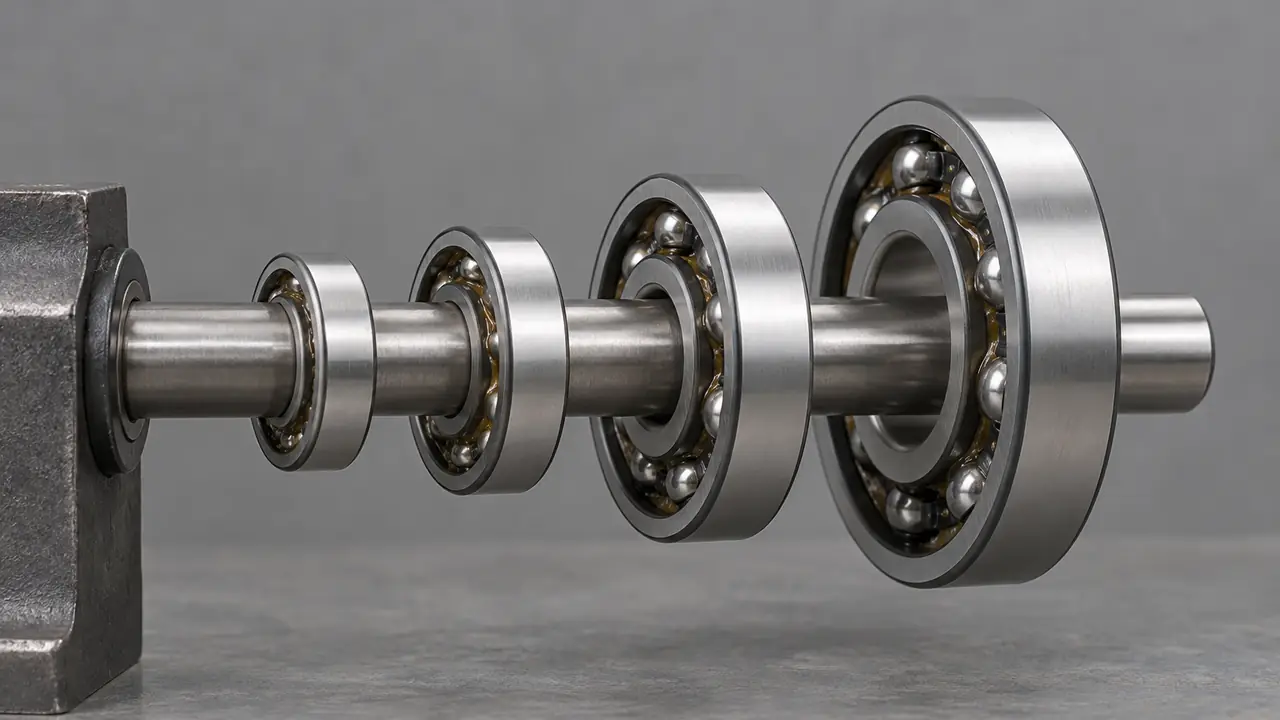
The nominal size of a 608
The 608 follows the miniature numbering style rather than the regular two-digit bore code. In a three-digit number the last digit is the bore itself, so 608 means an 8 mm bore. The nominal ISO boundary dimensions are:
| Dimension | Symbol | Nominal value |
|---|---|---|
| Bore | d | 8 mm |
| Outside diameter | D | 22 mm |
| Width | B | 7 mm |
These are nominal values from the standard series. The actual tolerance class, corner radius and shoulder diameters are stated on the supplier drawing or datasheet, and that is where you should confirm them. Load ratings and limiting speed are not quoted here: they depend on the exact design, ball count, steel and cage, and come from the datasheet of the bearing being supplied.
The 608 is formally a member of the 60 family in the small-bearing range. Strictly, the miniature bearing definition covers bores of roughly 10 mm and below, so the 608 sits near the top of that range. That placement explains its popularity: it is small enough for compact products yet large enough to be stiff, easy to handle and easy to fit.
Neighbouring small sizes
Engineers often need to know what else is available when the 608 is too big or too small. The table lists nearby deep groove sizes from the standard tables, all nominal.
| Designation | d x D x B (mm) | Comment |
|---|---|---|
| 607 | 7 x 19 x 6 | One size down in the 60 line |
| 608 | 8 x 22 x 7 | The reference size |
| 609 | 9 x 24 x 7 | One size up |
| 688 | 8 x 16 x 4 | Same bore, thin section |
| 698 | 8 x 19 x 6 | Same bore, narrower than 608 |
The 688 and 698 are useful when the housing is shallow. They share the 8 mm bore, so the same shaft can be kept while the housing is redesigned. Note that the letters and digits are easy to confuse: 608, 688 and 698 are three different bearings, and a wrong digit means a wrong housing size.
Closures and material options
The base 608 is open, but nearly all buyers specify a closure. The common forms are shown below.
| Form | Description | Typical use |
|---|---|---|
| 608 | Open | Oil lubricated, or pre-cleaned for later greasing |
| 608ZZ or 608-2Z | Metal shields both sides | Low friction, clean dry conditions |
| 608-2RS | Rubber seals both sides | Dust, splash, general products |
| 608 in stainless | Rings and balls in 440C or similar | Wet, washdown, corrosion-prone sites |
| 608 hybrid | Steel rings with ceramic balls | Higher speed, lower heat, electrically insulating |
For corrosion-prone work see the stainless steel bearing page, which also notes that stainless bearings usually carry a lower load than chrome steel ones of the same size. For ceramic balls and hybrids see ceramic bearings. Seal and shield differences are in 2RS vs ZZ bearings.
Where the 608 is used
The 608 turns up in a very wide range of products because it is cheap, compact and widely stocked. Typical examples include skateboards, inline skates and scooters, fidget toys, small fans and appliance motors, 3D printer axes and idler pulleys, drawer and door slides, model equipment, and light conveyor rollers. Consumer wheel use has its own notes in 608 bearings in skates and scooters.
The conditions in these uses differ greatly. A scooter wheel sees shock, grit and water. A 3D printer idler sees light load, constant slow motion and a clean workshop. A small fan motor sees speed and heat. The same designation covers all of them, so the closure, grease and tolerance class should be chosen to suit the real duty rather than defaulting to the lowest cost version.
Precision, noise and handling
Small bearings are sold under several quality tiers, and buyers often meet an accuracy grade named ABEC. That scale comes from the American bearing standards body and maps only loosely to ISO tolerance classes; the comparison is explained in ABEC vs ISO tolerance classes. A higher grade number does not by itself mean lower noise or longer life. Noise depends on raceway finish, ball grade, cage and grease as much as on the tolerance class.
Handling matters more at this size than many buyers expect. Small bearings are easily dented by hammering on the wrong ring, and a few grams of grease more or less change running torque noticeably. Keep them sealed in their packs until fitting, press with a tool that bears on the ring that has the interference fit, and avoid solvent washing on greased shielded bearings, which removes the grease.
Design-in notes for small shafts
With an 8 mm shaft and a 22 mm housing bore, the wall around the bearing is thin when the housing is molded plastic or die-cast aluminium. A light press fit that is correct in steel can crack or distort a plastic housing, and a loose fit lets the outer ring creep and wear the seat. Decide the fit with the housing material in mind and test it on samples. Where the housing and shaft expand differently with temperature, ask whether a clearance larger than normal is advisable.
Small deep groove bearings also run better with a small, steady axial preload, for example from a wave spring against the outer ring. Preload removes the free play that lets balls skid at light load and makes noise. Whether it is needed, and how much, depends on the application and should be agreed with the supplier from the datasheet rather than assumed. For measuring unknown parts before you order, use how to measure a bearing.
Specifying and sourcing a 608
A useful enquiry for the 608 states the closure, the material, the tolerance class, the grease or noise requirement, the application and the quantity. Standard 608 variants are typically available from a reference MOQ of 100-500 pieces per designation; laser marking or branded boxes usually raise it to about 1,000-5,000 pieces per designation. Sample lead time for stock items is typically 3-7 working days. All figures are indicative and confirmed in writing for each program; see MOQ and lead time.
The partner plants for small deep groove bearings are concentrated in the eastern Zhejiang cluster, which industry sources describe as strong in small and miniature types. Which plant suits a given program is decided by sample testing, not by region alone. Send your requirement through the quote form.