
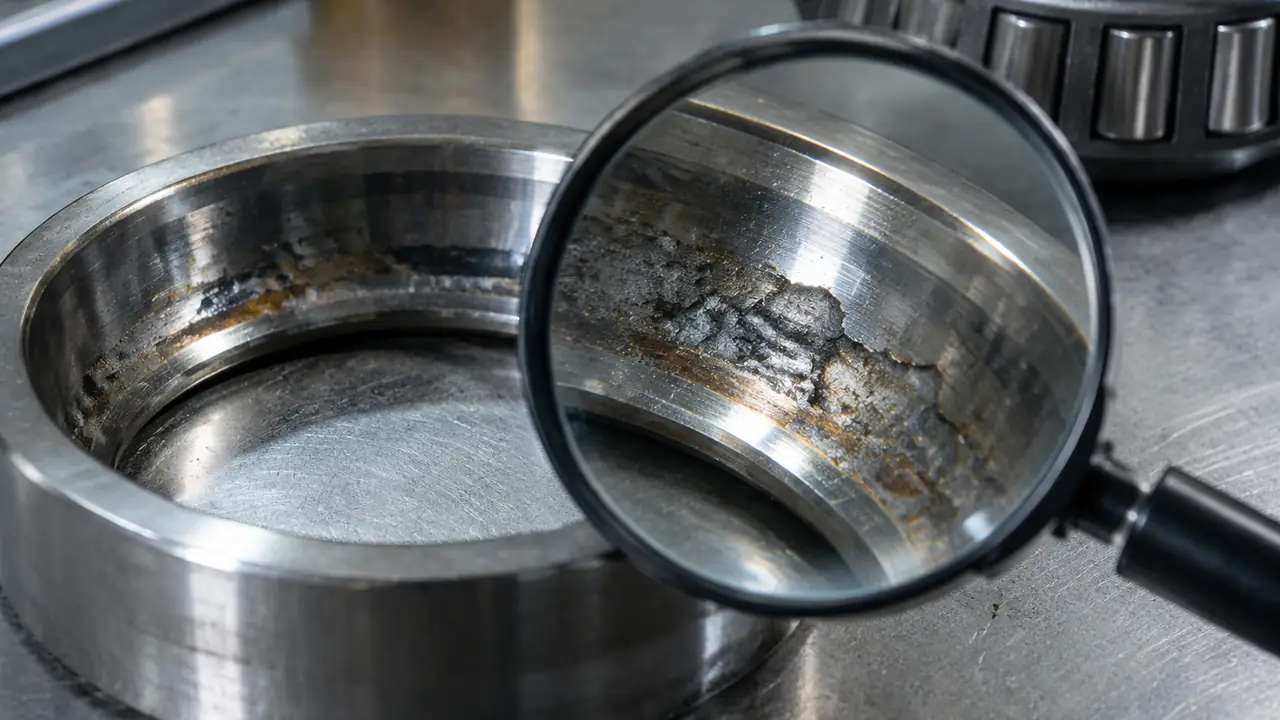
What electrical erosion is
Electrical erosion is the damage caused when current passes through the thin lubricant film between a rolling element and a raceway. In the general classification of ISO 15243 it is its own main failure mode, separate from fatigue and wear. At each contact the current can jump the film as a tiny spark. The spark melts a microscopic spot of steel, and the spot is thrown out or re-solidifies, leaving a small crater. Repeated thousands of times per second, the craters cover the track in a dull, frosted grey band under a microscope.
The craters themselves are small, but they have two effects. They roughen the surface and raise vibration and noise. They also break down the grease: heat from the sparks darkens it and oxidises the oil, so the bearing is also starved of lubricant. The result is early failure in bearings that appear well fitted and run at normal load.
Why variable-speed drives raise the risk
In a motor fed from a mains supply, shaft voltage is usually small. With a variable-speed drive, the output is a series of fast switching pulses. The pulses create a common-mode voltage that couples through the motor's internal capacitances to the rotor, and a voltage can build up on the shaft. When it exceeds the breakdown strength of the lubricant film, the shaft discharges through the bearing. Higher switching frequency, long cable runs and poor grounding all increase the problem. Large motors can also have circulating currents in the shaft, bearing and frame loop.
Wind generators, traction motors, pump drives and many industrial and appliance motors with inverters have shown this damage. Small motors are not immune: the bearings are small, the film is thin, and the grease volume is limited.
Recognising the damage
| Stage | Appearance | Symptom in service |
|---|---|---|
| Early | Matt grey or frosted track, fine craters under magnification | Slightly higher noise; grease darkening |
| Developing | Dark discoloured grease, craters widening, pits on balls | Noise and temperature rise |
| Fluting | Regular washboard-like grooves across the raceway | Whine or hum at a pitch tied to speed; vibration |
| Late | Surface destroyed, secondary fatigue, cage damage | Loud noise, heat, seizure |
Fluting has a characteristic look: parallel grooves at regular spacing across the track, caused by the rolling elements passing over the cratered surface at a constant rate. The pattern differs from mechanical false brinelling in that the grooves are shiny and shallow with a frosted finish, while brinelling marks are discrete and sharp. If a pit-and-groove pattern appears in a motor bearing, with the grease darkened, electrical erosion should be suspected before mechanical overload.
Why the damage is often misdiagnosed
Because electrical erosion looks like wear or a lubricant problem at first glance, it is commonly misdiagnosed. A maintenance team sees dark grease, noise and a rough raceway, replaces the bearing with the same type and repeats the failure after a similar interval. The giveaway is repetition: a motor that fails bearings at regular intervals, especially after a drive was installed or replaced, should be checked for shaft voltage before another bearing is fitted.
Another common mistake is to blame bearing quality and switch suppliers, which changes nothing about the electrical path. The remedy lives in the motor and drive system, and the bearing is the place where the damage becomes visible. A supplier cannot cure a shaft voltage problem with better steel; it can only supply an insulated or hybrid design if asked. Clear communication about the drive, the cable and the earthing arrangement at the quotation stage saves several failed batches later.
Remedies
The sources of shaft voltage can be addressed in the drive and the motor, and the bearing can be changed so that current cannot pass or is diverted away.
- Shaft grounding. A carbon brush or conductive ring gives the current an easier path to the frame than through the bearing.
- Insulated bearings. The outer or inner ring carries an insulating coating or the bearing has a ceramic layer, blocking the current path. Specify the coating and the voltage it should withstand.
- Hybrid bearings. Steel rings with ceramic balls break the circuit because the ceramic does not conduct. They also run well at speed. See ceramic bearings.
- Drive measures. Filters, shielded motor cables, correct earthing and lower switching frequency reduce the voltage at source.
- Conductive grease. Used in some small motors, but results vary and should be validated.
Often two measures are combined, for example an insulated bearing at the non-drive end and a grounding brush at the drive end, so that the current has no path through either bearing. The choice should be agreed with the motor builder, since the remedy depends on motor size and drive setup.
Specifying bearings for inverter-fed motors
If a motor is run from an inverter, the request for quotation should say so. A good specification for the partner plant includes the designation, internal clearance (often C3 as in C3 clearance explained), the grease type, whether insulation or ceramic balls are needed, and the quantities per designation. Coated insulation and hybrid options are usually special orders, so the MOQ and lead time are higher than for stock standard bearings; see MOQ and lead time for the typical reference ranges, confirmed in writing for each program. The motor and appliance solution page, motors and appliances, describes common requirements.
Checking a suspect motor
- Pull the bearing and inspect the raceway under good light, with magnification if available. Look for frosting and washboard grooves rather than only deep pits.
- Note the grease colour. Dark, burnt or hard grease at low temperature suggests spark heat.
- Measure shaft voltage with an oscilloscope or a suitable probe by a qualified electrician, using the equipment maker's safety procedures.
- Check cable type, earthing, filter fitting and drive switching frequency.
- Decide on a combination of grounding, insulated or hybrid bearings, and drive changes, and test it in one motor before rolling out.
Measurements on live drives must be done by trained staff following the equipment maker's safety rules. For the wider list of failure modes, see bearing failure causes; for quiet-running motor bearings in general, why bearings get noisy.