
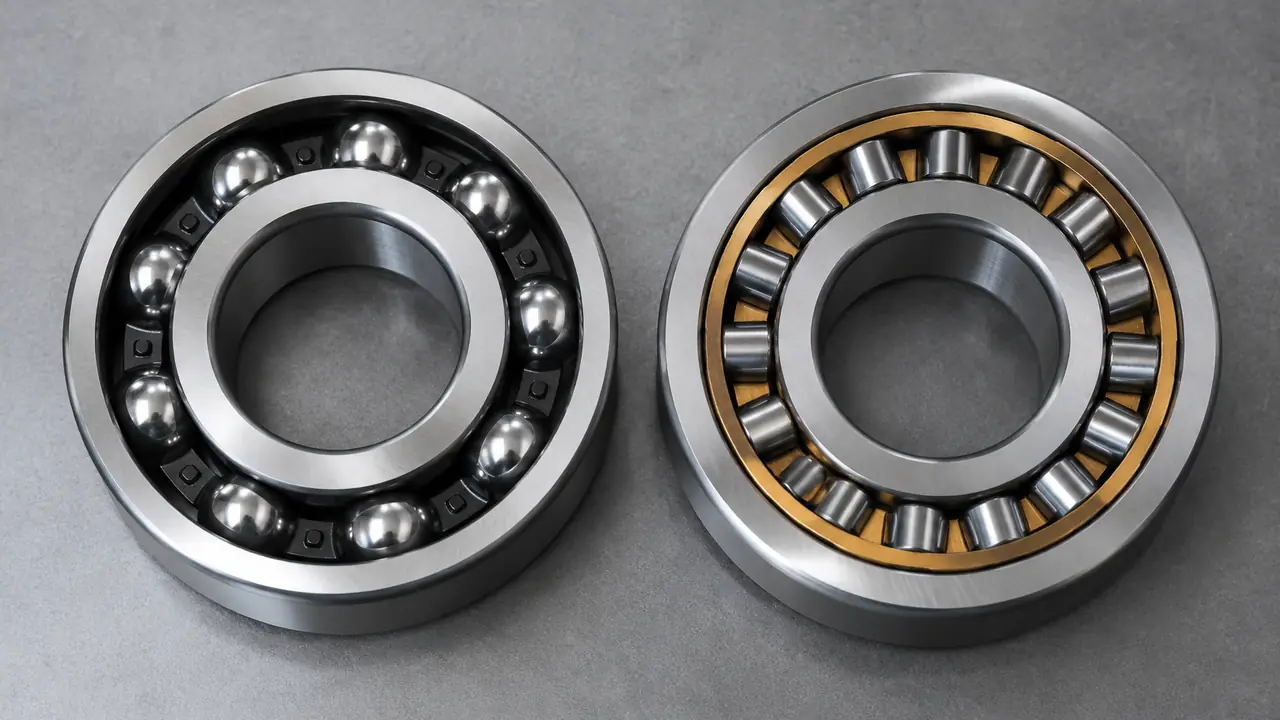
Three material choices, not two
The phrase ceramic bearing covers two quite different products. A hybrid ceramic bearing keeps steel rings and uses ceramic balls, usually silicon nitride (Si3N4). A full ceramic bearing has ceramic rings as well as ceramic balls, in zirconia (ZrO2) or silicon nitride, and normally a polymer or ceramic-compatible cage. The reference is standard chrome steel, a high-carbon chromium grade such as GCr15, comparable to 52100 and 100Cr6, described in the bearing steel page.
These behave differently, so the comparison below treats hybrid and full ceramic separately where it matters. All three are made in the same dimension series under ISO 15, so ceramic variants of common sizes fit the same shafts and housings.
Side-by-side comparison
Relative terms only. Load ratings, limiting speeds and temperature limits vary with size and supplier, and are taken from the datasheet.
| Criterion | Chrome steel | Hybrid ceramic | Full ceramic |
|---|---|---|---|
| Load direction | Any, according to bearing type | Same as the steel type of the same design | Light to moderate; sensitive to shock |
| Load capacity | High, best for shock | Similar to steel; ceramic balls are stiff | Lower; brittle under impact |
| Speed | Good | Higher; lighter balls, less centrifugal force and heat | High, with a limit set by the cage |
| Misalignment tolerance | As the bearing type allows | Same as steel; no gain | Lower; edge loading can crack rings |
| Friction and noise | Low | Lower friction, smooth running at speed | Low friction; can be quiet |
| Maintenance | Needs grease; sensitive to corrosion | Longer grease life in many cases; steel rings still rust | Corrosion-free; often runs dry or with water |
| Typical applications | Most industrial and automotive machines | Spindles, turbochargers, motor drives with shaft currents | Chemical, food, vacuum, high-temperature, non-magnetic |
| Relative cost factors | Lowest; high volumes | Well above steel, driven by ball material and grinding | Highest; low volume, long sintering and finishing |
Speed and weight
Ceramic balls are much lighter than steel balls and much harder. At speed, a ball in a bearing is pushed outward by centrifugal force, and that force presses it harder against the outer ring and generates heat. Lighter balls produce less of it, so a hybrid bearing can run faster or run cooler at the same speed. Silicon nitride also has a low friction coefficient against steel, which lowers torque and reduces the risk of skidding at start-up.
That is why hybrid bearings are a staple of machine-tool spindles and high-speed motors. They sit in the same family as the precision angular contact bearings on the high-speed bearing page. In slow machinery, the advantage is small, and standard steel bearings are the better value.
Electrical insulation and corrosion
Ceramic is an electrical insulator, steel is not. In motors fed by variable-frequency drives, stray currents can pass through the bearing and burn small pits into the raceway, which later develop into a washboard pattern called fluting. A hybrid bearing blocks the current path at the balls, and a full ceramic bearing blocks it entirely. See electrical erosion in motor bearings for the failure pattern. Insulated outer rings or grounding brushes are cheaper alternatives, so compare before specifying ceramic purely for this reason.
Full ceramic bearings resist corrosion, so they suit wet, chemical and food environments, where even stainless steel can pit. Hybrid bearings do not: their steel rings still rust. For moist environments where a steel ring is acceptable, the stainless steel bearing line is the middle option. The comparison of stainless and chrome steel is in stainless vs chrome steel bearings.
Where ceramic loses
Ceramic is hard and brittle. A full ceramic ring can crack under shock load, press-fit stress or a hammer blow in assembly. Hybrid bearings are more forgiving because the steel rings absorb the fit, but ceramic balls can still damage the steel raceway if a contaminated or misaligned bearing is overloaded. Ceramic also does not forgive poor handling: dirt, impact and uneven press forces matter more than with steel.
Cost is the other limit. Ceramic balls require longer firing, finishing and inspection, and the supply base is smaller. The cost factors in words: ball material, grinding and inspection grade, cage material, and low volumes. Quotations for ceramic variants should include the ceramic grade, ball grade under ISO 3290 and the tolerance class. Reference MOQ and lead time ranges are on the MOQ and lead time page, confirmed in writing for each program.
Lubrication and temperature
Ceramic changes the lubrication picture, but not in the same way for hybrid and full types. Hybrid bearings run well on the same greases and oils as steel bearings, and in many cases the lubricant lasts longer because of the lower friction. Full ceramic bearings can run in conditions where grease would fail, such as vacuum, with water or with aggressive chemicals, although the cage material then sets the limit. For high temperature, ceramic itself has no problem, but the cage and the seal are the weaker parts. Check them in the datasheet, and see the lubrication guide for the grease side.
Quality checks specific to ceramic
Because ceramic is harder to inspect than steel, buyers should ask for more evidence, not less. Request the ceramic material name and ball grade in writing, and ask whether balls are inspected individually for surface defects such as pits and cracks, since a single flawed ball can fail early. Check that the label states hybrid or full ceramic, the cage material and the grease, and compare sample torque and noise with a steel reference. Counterfeit and mislabelled ceramic is a known risk in the market: steel balls sold as ceramic can be separated with a simple magnet and weight check on a sample. The counterfeit bearing risks note covers screening in more detail.
How to decide
- Is there no special condition beyond ordinary load and speed? Use chrome steel.
- Is speed high enough that heat or grease life limits the design? Consider hybrid.
- Do shaft currents damage motor bearings? Consider hybrid, or insulated rings as a lower-cost alternative.
- Is the environment wet, chemical, vacuum or non-magnetic? Consider full ceramic, or stainless steel if the load is high.
- Is shock load likely? Avoid full ceramic; choose steel or hybrid.
- Compare the extra cost against the cost of downtime. Ceramic pays back only where the failure mode it prevents is the one you have.
Describe the failure or the target in the quote form and the desk will shortlist options across steel, hybrid and full ceramic from partner plants.