
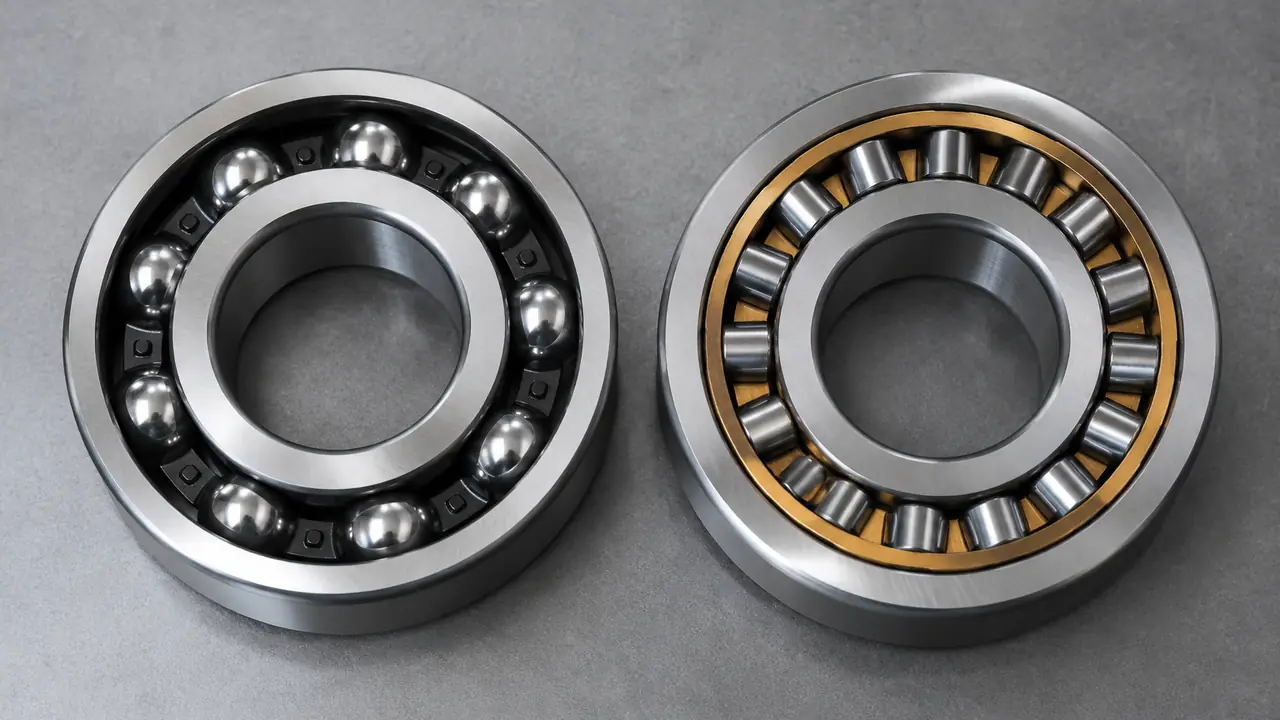
What the two materials are
Chrome steel in bearings means a high-carbon chromium steel, GCr15 in Chinese practice, comparable to AISI 52100 and 100Cr6. It is through-hardened to a high hardness, is very clean for fatigue life, and is the default for almost all rolling bearings. Its weakness is corrosion: bare chrome steel rusts in moisture, and bearings rely on grease, oil film or a rust-preventive coating to survive storage and use.
Stainless steel bearings come in two broad groups. The first is hardenable martensitic stainless steel, such as 440C, which can be hardened to a level suitable for raceways and balls. The second is austenitic stainless such as AISI 304, which resists corrosion well but cannot be hardened in the same way, so it is used for housings, shields, cages and light-duty or low-speed parts. A bearing described as stainless should state which grade is used for the rings, the balls and the shield. The tests and standards behind these grades are covered in the notes on GCr15 and 52100 and 440C stainless bearings.
Side-by-side comparison
All terms are relative. Where a figure matters, take it from the supplier datasheet or material certificate for the exact grade.
| Criterion | Chrome steel (GCr15 / 52100) | Stainless steel (440C) |
|---|---|---|
| Load direction | Any, according to bearing type | Same designs, usually deep groove and similar |
| Load capacity | Highest for the size; best fatigue life | Lower than chrome steel for the same size |
| Speed | Higher; wide range of precision grades | Moderate; fewer precision grades offered |
| Misalignment tolerance | As the bearing design allows | As the design allows; not a material factor |
| Friction and noise | Low; very quiet at high quality | Slightly higher noise; surface finish matters |
| Maintenance | Needs rust protection; fine in dry areas | Resists water, steam, mild chemicals; still needs lubricant |
| Typical applications | Motors, vehicles, gearboxes, general machinery | Food and beverage, marine, medical, washdown, chemical plants |
| Relative cost factors | Lowest; highest volumes | Higher raw material and processing cost; lower volumes |
Corrosion: the reason to pay more
Stainless steel earns its place in wet, washed-down or chemically aggressive environments. Food processing lines are cleaned with water, steam and cleaning agents several times a day; a chrome steel bearing that gets wet will start to rust at the raceway, and a rusted raceway means noise, then failure. Marine equipment, pumps for water treatment and outdoor machinery face the same problem. In these places, stainless steel with a food-grade or water-resistant grease is the established choice. The food-grade bearing lubricant note covers the grease side.
Stainless resists corrosion but is not immune. 440C resists water and mild chemicals; strong chlorides, acids and salt can still attack it, and for those cases a full ceramic or a polymer bearing may be better. Buyers should describe the actual medium rather than just writing wet environment.
Hardness, load and life
Martensitic stainless can be hardened, but it does not reach the same combination of hardness and cleanliness that chrome steel has, and its fatigue life under heavy load is shorter. For the same bearing designation, a stainless version is rated for a lower load. That matters in a heavily loaded drive; it is irrelevant in a light conveyor roller or a conveyor in a bottling line. The conclusion is not that stainless is weaker, but that you should compare the ratings of the exact designation in each material using the datasheet.
Hardness is checked on the finished part, typically with a Rockwell (HRC) test according to the order. Ask for hardness records for the batch, and for the material grade stated on the certificate. Mixed grades are a known risk when a bearing is described only as stainless.
Noise, finish and lubrication
Stainless bearings are produced in smaller volumes, and the finishing of the raceways is harder, so noise performance may be a little behind a high-grade chrome steel bearing. If quietness matters, ask for a vibration grade and compare a sample with your reference. Lubrication is the other half: a stainless bearing in a washdown line is only as good as the grease in it and the seal around it, so a contact seal (2RS) is common in these places. See 2RS vs ZZ bearings for the closure trade-off, and the bearing grease page for the grease choices.
Temperature and magnetism
Two further points are easy to overlook. First, temperature: standard chrome steel bearings are heat-stabilised for a normal operating range, and hot applications need a stabilised grade, a suitable cage and a high-temperature grease. 440C copes with moderately high temperature well, but the lubricant and cage still set the limit. Second, magnetism: 440C is magnetic, like chrome steel, so it is no help in equipment that must be non-magnetic. Austenitic stainless and ceramic are the options there. State any magnetic or temperature requirement in the enquiry, since it changes the material, the cage and the grease together rather than one at a time.
Sourcing notes
Stainless bearings carry a higher relative cost because of raw material, harder machining and low volumes. MOQ is often higher per designation than for a standard chrome steel bearing, and lead times are longer when the material needs to be sourced. The reference ranges on the MOQ and lead time page apply, confirmed in writing for each program. When the desk shortlists partner plants, it asks for the material certificate for rings and balls, a sample for a salt-mist or water exposure check if the application needs it, and the grease datasheet.
How to decide
- Will the bearing see water, steam, washdown or corrosive medium? If not, choose chrome steel.
- Is the load heavy or the life target long? Choose chrome steel if the environment allows, or increase the size in stainless.
- Is food, beverage or medical contact involved? Choose 440C or a stainless bearing with food-grade grease.
- Is the environment extremely aggressive? Consider ceramic or polymer; see ceramic vs steel bearings.
- Can corrosion be solved with a housing seal and grease instead? That is often cheaper than stainless.
- Specify the grade for rings, balls, cage and shield in the enquiry.
Send the environment and the cleaning method with your request through the quote form.