
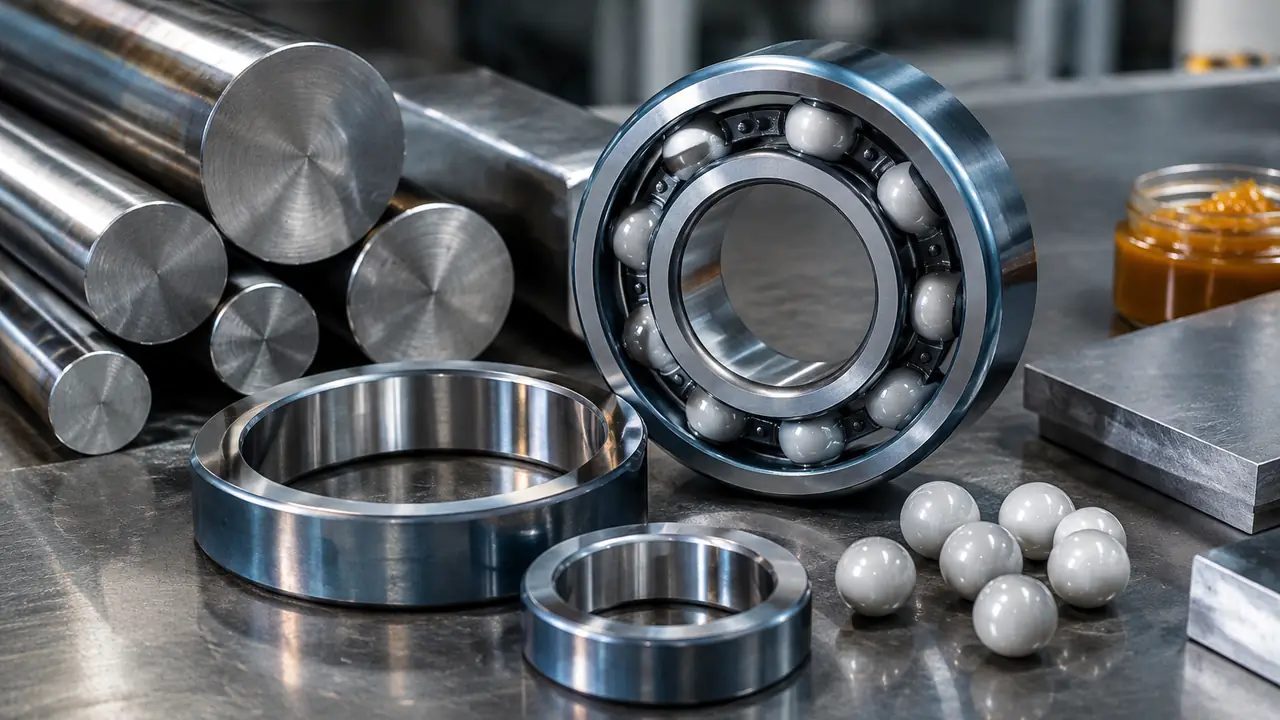
What 440C actually is
440C is a martensitic stainless steel with high carbon, around one percent, and about seventeen percent chromium. Because of the carbon it can be hardened by heat treatment, which is what lets it serve as a bearing steel at all. Most other stainless grades, such as 304 and 316, are austenitic: they resist corrosion well but cannot be hardened by heat treatment, so they are poor choices for a raceway that must carry rolling contact stress.
That split explains why a "stainless bearing" is rarely made entirely from one grade. A typical stainless deep groove ball bearing uses 440C for the rings and balls, a stainless shield or a polymer cage, and a grease selected for the environment. Housed units often use a stainless or plated insert with a 304 or polymer housing. Always ask which grade is used for which part.
What you gain and what you give up
Chromium forms a thin passive oxide film that protects the surface. That gives much better resistance to humidity, washdown water, mild chemicals and steam than standard chromium bearing steel. The cost is a lower hardness ceiling and a lower fatigue limit, and as a result the dynamic load rating of a 440C bearing is typically lower than that of the same-size chromium steel bearing. Many catalogues apply a reduction factor, so the rating on the datasheet must be taken from the 440C line and not copied from the standard bearing.
| Item | Chromium steel (GCr15 / 52100) | 440C stainless |
|---|---|---|
| Corrosion resistance | Low; needs oil or grease film | Good in moisture, washdown, mild chemicals |
| Typical hardness | Roughly 60 to 66 HRC | Roughly 58 to 62 HRC |
| Load capacity | Highest in the standard range | Typically lower; use the stainless datasheet |
| Speed and noise | Excellent, large range of grades | Good; fewer low-noise options in stock |
| Relative cost | Baseline | Several times higher per bearing |
| Magnetic | Yes | Yes (martensitic) |
Do not expect 440C to be fully immune. In salt spray, strong acids or chlorides, even stainless can pit, and standing water in a crevice around the shield can start corrosion. Where chloride exposure is severe, 316-type housings, polymer bearings or coated components are considered instead.
Cages, seals and grease matter as much as the rings
A stainless bearing with a carbon steel cage and a standard grease is not a stainless solution. The weak point moves from the ring to the other parts. Check these:
- Cage. Stainless pressed steel, glass-fibre nylon PA66 or PTFE-based cages avoid rust. Nylon limits temperature, so see bearing cage materials.
- Shield or seal. Stainless shields resist rust but do not keep water out. For washdown, a contact rubber seal is the safer choice, with the compound confirmed for cleaning chemicals.
- Grease. Food plants usually need an H1-registered grease, selected through the plant's own hygiene programme. See food-grade bearing lubricants.
- Housing and mounting. A stainless bearing in a cast-iron housing creates a rusting weak point and an electrochemical pair.
Passivation, finish and handling
The corrosion resistance of stainless steel depends on a clean, intact passive film. After grinding and polishing, quality-minded plants wash and passivate the parts so that free iron picked up from tooling is removed and the film can form evenly. A bearing that skipped this step can show surface rust spots within weeks even though the alloy is correct. Ask the partner plant whether passivation or an equivalent clean-up is part of the route for your designation.
Handling in your own plant matters too. Pressing a stainless bearing with a carbon steel tool can embed iron particles in the surface, and those particles rust. Use clean tools, avoid contact with ordinary steel chips, and keep the bearing in its sealed packaging until the moment of mounting. Stainless balls and rings are also more prone to galling at high contact pressure with dry surfaces, which is another reason to keep the grease fill intact and avoid running a stainless bearing dry, even briefly.
Finally, remember temperature. Standard 440C bearings with a full set of stainless parts can run warmer than polymer-caged versions, but the seal compound and grease normally set the real limit. State the maximum operating temperature in the request and let the plant propose the matching cage, seal and grease combination.
Where 440C is worth the cost
Stainless bearings are a problem-solving product, not an upgrade for general use. They earn their cost where corrosion would otherwise shorten life or contaminate the product:
- Food and beverage lines with daily washdown, such as conveyor rollers and mixers.
- Marine and coastal equipment, including deck machinery and water treatment.
- Packaging, pharmaceutical and medical equipment where rust particles are unacceptable.
- Pumps and valves in mild chemical service, where media compatibility has been checked.
- Low-speed, light-load mechanisms that sit in damp conditions for long periods.
Where a plain chromium steel bearing with a good seal and the right grease would survive, it is almost always the better value. The side-by-side logic is in stainless vs chrome steel bearings.
Specifying and sourcing stainless bearings
Because 440C stock is smaller than chromium steel stock, lead times and minimum quantities are less forgiving. Typical reference ranges for catalogue sizes are listed on the MOQ and lead time page and are confirmed in writing for each program. A complete request should state:
- Designation and whether rings and balls must both be 440C, or only the rings.
- Seal, shield or open design, and the cage material.
- Grease type and any certification needed by your hygiene programme.
- Environment: water, cleaning agents, temperature range, chlorides.
- Marking, packaging and corrosion-protection requirements for transit.
Be sceptical of listings that say "stainless" without naming the grade. Some products use a plated or coated steel and are sold under the same word. A simple magnet test will not separate 440C from coated steel, since both are magnetic; ask for a material statement and, for critical use, a short corrosion test agreed with the partner plant. For packaging, stainless bearings still benefit from clean, dry shipping, since contamination in transit can mark the surface.
When you have the application details, the desk can shortlist plants that run stainless lines and confirm the grade in writing. Send the specification through the quote form.