
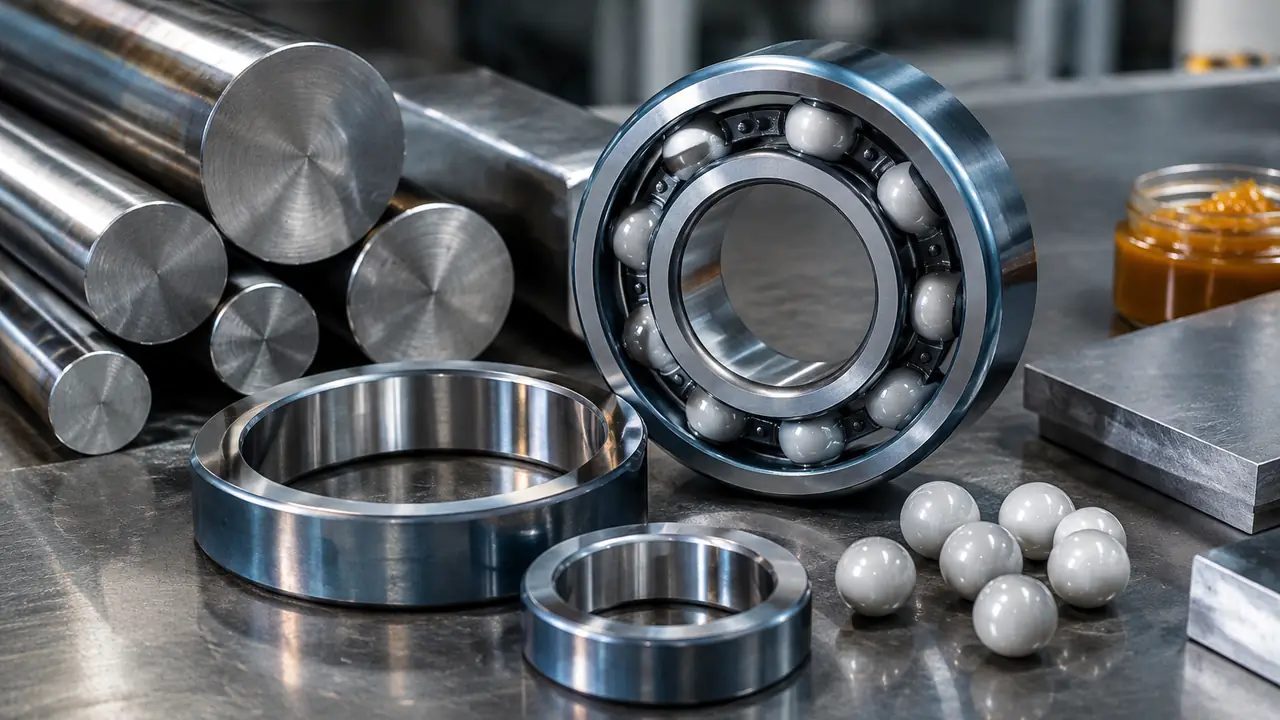
One steel, three names
GCr15, AISI 52100 and 100Cr6 describe the same basic alloy family: roughly one percent carbon and about one and a half percent chromium, with small amounts of manganese and silicon. The designations come from different national systems, so a Chinese drawing, a US specification and a European standard may each use a different label for what is, in practice, a very similar material. Small differences in permitted limits exist between the standards, which is why a purchase specification should name the exact standard and not only the nickname.
The reason this steel dominates is simple. After heat treatment it combines high hardness, good resistance to rolling contact fatigue and stable dimensions, at a cost that suits volume production. It is used for inner rings, outer rings and balls in deep groove ball bearings and in most other standard types. Related lines are made from other steels: large-section rings often use a deeper-hardening variant, and heavy-shock roller bearings usually use carburising steel, covered later in this note.
Why the composition matters
Carbon gives the hardness, because it forms the hard carbides and the martensite that carries the load. Chromium improves hardenability, so the steel hardens through the section of a ring instead of only at the surface, and it also helps form fine, hard carbides. Manganese and silicon support hardening and deoxidation. The balance is tight: too little carbon and the raceway is soft, too much and the steel becomes brittle.
What buyers rarely see on a drawing but that matters just as much is what the steel should not contain. Oxygen, sulphur, phosphorus, titanium and large non-metallic inclusions are limited, because a hard inclusion near a raceway acts as a stress raiser from which fatigue cracks start. Bearing life under ISO 281 assumes steel of good quality; real life depends on the actual steel cleanliness of the heat that went into your batch.
Typical properties after heat treatment
The figures below are widely published typical values for through-hardened chromium bearing steel. They describe the material family, not any specific lot, so treat them as reference and confirm against the partner plant's own specification.
| Property | Typical reference | Why it matters |
|---|---|---|
| Carbon content | About 1 percent | Sets the achievable hardness |
| Chromium content | About 1.3 to 1.6 percent | Through-hardening and carbide formation |
| Rolling-element hardness | Roughly 60 to 66 HRC | Resistance to contact fatigue and indentation |
| Ring hardness | Roughly 58 to 65 HRC | Wear and fatigue life of the raceway |
| Standard operating limit | About 120 to 150 degrees C, depending on heat treatment | Above this, dimensional stability and hardness can drift |
| Corrosion resistance | Low without protection | Needs oil, grease or packaging protection |
The last row is the practical weakness. Chromium bearing steel rusts, and a bearing left unprotected in a humid warehouse can show stains within days. That is why anti-rust packaging is part of the specification and not an optional extra. Where wet or chemical exposure is part of the duty, a different material applies; see 440C stainless bearings.
Heat treatment: where the properties are made
The steel grade only sets the potential. Heat treatment turns it into a bearing material, and this is where plants differ most. The usual route is austenitising at a controlled temperature, quenching in oil, washing, then tempering to relieve stress and set the final hardness. Small rings and balls are processed in continuous furnaces with controlled atmospheres; large rings may be batch treated.
For applications that run warm, partner plants offer dimensional stabilisation treatments, often shown as a suffix on the designation, so that rings do not change size slowly in service. Retained austenite, the soft phase left after quenching, is one of the things a good process keeps under control. Ask the plant which treatment applies to your designation, and whether it is stated on the datasheet or only agreed by correspondence.
Other bearing steels you may meet
- Deep-hardening chromium steel. A variant with extra manganese and silicon for thick rings, such as large spherical roller bearings, where standard grade would not harden to the core.
- Carburising steel. A low-carbon alloy steel with a hard case and a tough core, common in tapered roller bearings for shock loads and heavy automotive duty.
- Martensitic stainless steel. The 440C family for corrosion resistance at lower load capacity.
- Cold-rolled and stamped steel. Used for pressed outer shells in needle bearings and for shields and some cages.
When a drawing only says "bearing steel", ask which one is intended. The answer changes both the price and the failure mode.
What buyers can reasonably ask for
A sourcing desk cannot rewrite metallurgy, but it can make the conversation concrete. For a program with meaningful volume, these requests are normal and fair:
- The steel standard and grade named in the plant specification, plus the source mill or supplier category.
- A material certificate or heat-lot record that can be linked to your batch number.
- Hardness test records on a sample of rings and balls, reported as a range against the drawing.
- The heat-treatment route, including any stabilisation or special tempering for temperature.
- Confirmation of the RoHS or REACH declaration if your market requires it.
None of this requires special equipment from the buyer. It requires that the plant keeps records, and plants that serve OEM customers usually do. Quality-system certificates such as ISO 9001 or IATF 16949 belong to the plant and are verified per project; the certifications page explains how the desk handles that. Typical checks at shipment are covered under testing and inspection.
Supply context: components and steel in the cluster
Steel is only the first step. In the bearing clusters of eastern and northern China, rings, balls, cages and seals are often made by different specialist firms around a central assembler. The Liaocheng area in Shandong, for example, is known for cage production and component trading, with ball and seal suppliers in the surrounding towns. A desk that knows the cluster can match a steel and component specification to a plant that already runs it, and can also split a program between a ring maker and a ball maker when that gives a better result. See industry clusters for the wider picture.
If you already have a drawing or a datasheet with a material callout, send it through the quote form with target quantities, and the desk will shortlist plants that can state the grade and heat treatment in writing.