
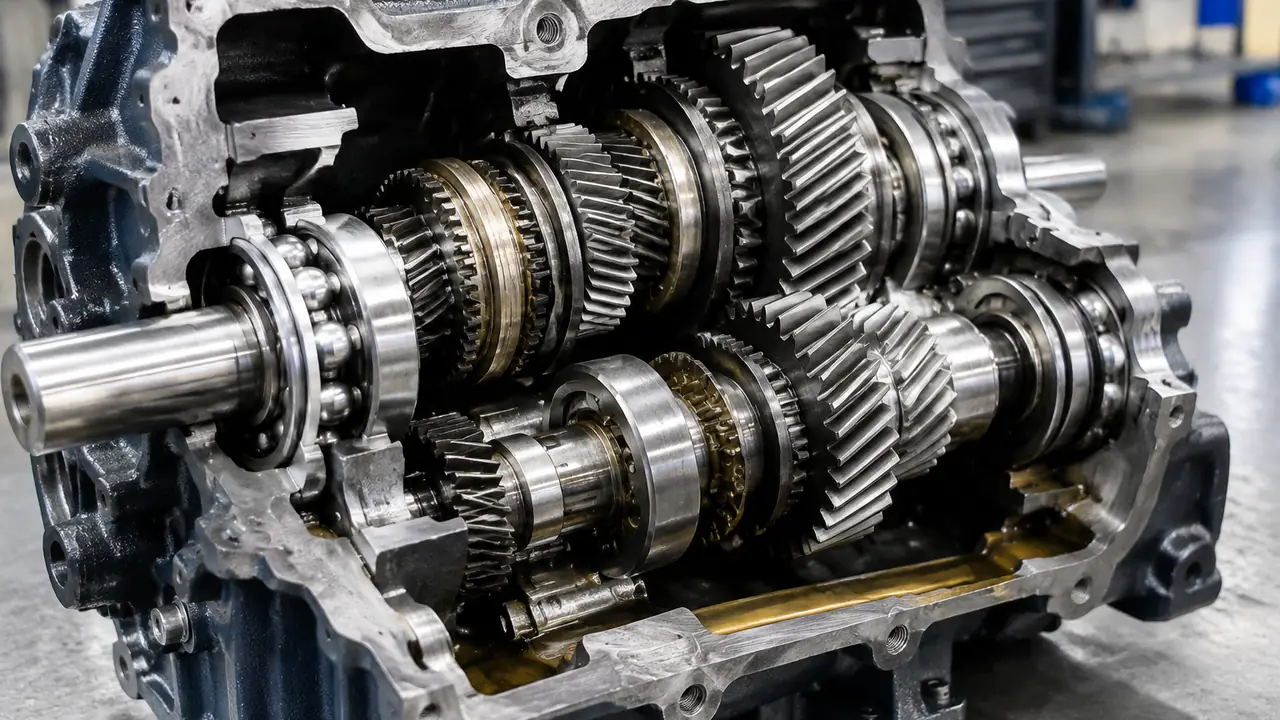
What a spindle asks of its bearings
A machine tool spindle has to hold a tool or workpiece to a very small radial and axial error while rotating at high speed and carrying cutting forces. The bearings must be stiff, accurate and cool. Stiffness comes from preload and from the rolling element geometry; accuracy comes from the tolerance class of the rings and balls; and low heat comes from the speed capability of the design, the cage and the lubrication.
The standard answer is the precision angular contact ball bearing, usually in a set of two, three or four. For the highest speeds, a high-speed bearing with ceramic balls is used. Heavy turning and grinding spindles may add a double-row cylindrical roller bearing at the front for radial stiffness.
Why bearings are supplied in pairs
A single angular contact bearing carries axial load in only one direction, so a second bearing is needed to oppose it. In a spindle, the pair is ground so that when the two are clamped together they have a defined preload or end play. This removes the clearance that would otherwise let the spindle wander. Universal-matched bearings can be mounted in any order; others are matched to one arrangement.
| Arrangement | Common name | Effect |
|---|---|---|
| Back to back | DB | Wide effective spread, high moment stiffness, tolerates some misalignment |
| Face to face | DF | Narrower spread, more tolerant of housing misalignment, lower moment stiffness |
| Tandem | DT | Both bearings load in the same direction, doubling axial capacity |
| Three or four bearing sets | DBD, TBT, QBC and similar | Combine tandem and opposed pairs for higher axial load or stiffness |
The letters and codes are shared across the industry, but the exact preload classes and ground offsets are supplier specific. Ask for the preload class in writing and verify it against the datasheet of the exact designation.
Precision classes in practice
Standard bearings are made to the normal tolerance class. Precision bearings use P6, P5 and P4, which ISO 492 describes as classes 6, 5 and 4, with tighter limits on bore, outside diameter and runout. For spindles, P5 and P4 are the common choices; the very high-accuracy tiers apply to grinding and jig spindles. The note on bearing precision classes compares the grades, and the tolerance and clearance guide explains the system. Precision is not the same as speed capability: tolerance class describes dimensional accuracy, while speed depends on size, cage, preload and lubrication.
Hybrid ceramic balls
High-speed spindles often use steel rings with silicon nitride balls, called hybrid bearings. Ceramic balls are lighter, so centrifugal force on the outer ring is lower, and they generate less heat and tolerate marginal lubrication. They also allow a stiffer preload at the same temperature rise. The trade-offs are higher cost and sensitivity to impact. The ceramic bearing page and the note on hybrid vs full ceramic cover the options. Limiting speeds for each series come from the supplier datasheet, not from general tables.
Preload: stiffness against heat
More preload makes a stiffer spindle but raises friction and temperature. Light preload gives a cooler spindle with more deflection under cutting load. Spindle makers choose the preload for the machine duty: a high-speed finishing spindle uses light preload, a heavy roughing spindle uses more. At high speed the centrifugal force on the balls changes the contact angle and effectively raises preload, which is why designers consider the preload at the operating speed, not just at rest. Never adjust preload without the supplier's procedure and measuring equipment. Spacers between bearings are ground to a matched length, and a different spacer changes the preload.
Fits, spacers and housing accuracy
A precision bearing only performs inside a precise seat. The spindle shaft and the housing bore are ground to tight form and size tolerances, and the shoulders are square to the axis, because any error in the seat is copied into the bearing ring. Spacers between the bearings are ground flat and parallel and are usually supplied or specified with the bearing set. A spacer that is a few microns off changes the preload, so do not reuse or swap spacers between sets. The rear bearing of a spindle is often allowed to float in the housing so that thermal growth does not add axial load, while the front set is clamped through a locknut with a defined torque.
Thermal behaviour deserves a mention. Spindles warm up in the first minutes, and the inner ring grows with the shaft. Designers choose the preload with a warm-up condition in mind and sometimes use spindle cooling jackets. When a rebuilt spindle runs hotter than the original, the usual suspects are over-tight preload, excess grease or a spacer that does not match the set, not the bearing steel itself.
Lubrication and cleanliness
Grease-lubricated spindle bearings are common in medium-speed machines and are greased for life with a small, exact fill. High-speed spindles use oil-air or oil mist systems that supply tiny amounts at intervals. The point is to keep the film thin enough to avoid churning and thick enough to protect the contact. Cleanliness at assembly is critical: a single particle between the ring and the spacer can destroy the preload geometry. The lubrication guide gives the basic selection logic for grease and oil.
What to verify when sourcing spindle bearings
- Designation with contact angle, precision class, preload class and arrangement code.
- Whether the bearings are universal-matched or matched to a defined set, and how the set is marked.
- Material and ball type: bearing steel (GCr15 / 52100 equivalent) or ceramic balls, and the cage material.
- Grease or oil specification and cleanliness requirement for assembly.
- Inspection records for bore, outside diameter, width and runout on the lot or the set, as agreed with the plant.
Precision spindle bearings are not general stock items, and their MOQ and lead time depend on the grade and the programme. The reference ranges on the MOQ and lead time page apply to standard items and are confirmed in writing for each program. Partner plants for precision grades are selected and checked case by case through the factory audit process. Send the spindle bearing list through the quote form.