
Why screening comes before quotes
Two plants can quote the same designation at similar terms and deliver very different bearings. The difference lies in steel supply, heat-treatment control, grinding stability, cleanliness and the discipline of the inspection room. A catalogue or a sample photo shows none of this. The desk therefore treats plant screening as part of the sourcing, not as an optional extra, and it applies to every partner plant before the first order. Rolvane is a sourcing desk: the plants belong to their owners, and what the desk adds is a consistent way of selecting, checking and following them.
Screening is scaled to the project. A one-off order of stock deep groove bearings needs a lighter check than an OEM program with a drawing and a vibration grade. The stages below are the full version.
Stage 1: documents
Before anyone visits, the plant is asked for the business licence, a company profile with the product lines it actually makes, quality system certificates if it holds any, the quality manual or inspection procedures, and a list of recent export markets in general terms. Certificates are checked with the issuing body for scope and validity, as set out on the certifications page. A plant that says it holds IATF 16949 but cannot show a certificate covering the product line is simply treated as not certified.
Stage 2: process walk
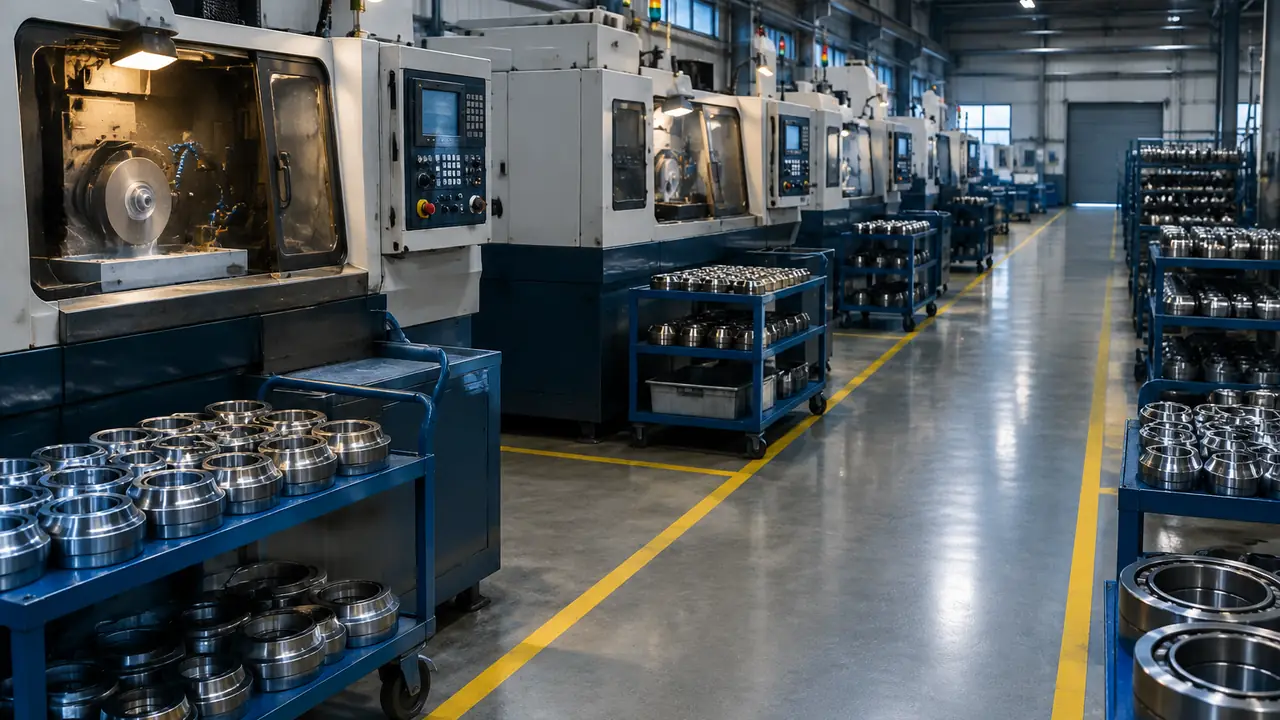
The walk follows the product, from incoming steel to the packing table, in the same order as the production process. The question at each station is the same: what is controlled, who records it, and what happens when a reading is out of range. Typical observations include whether heat-treatment loads are logged, whether ground parts are washed before assembly, whether the assembly area is separated from grinding, and whether rejected parts are marked and segregated or quietly mixed back.
Stage 3: equipment by category
Equipment is assessed by type and parameter class, not by brand or model. What matters is whether the machine class matches the tolerance grade promised. The categories checked are:
- Forging presses or tube-cutting lines for ring blanks, depending on size.
- CNC lathes for ring turning, with consistent stock allowance for grinding.
- Heat-treatment lines with controlled atmosphere, quenching and tempering that can be logged.
- Grinding machines for faces, outside diameter, raceway and bore, and superfinishing machines for the raceway.
- Automatic assembly lines for ball insertion, cage fitting and seal pressing, where volume requires it.
- Cleaning lines for finished parts and assembled bearings.
- Vibration testers for noise and vibration grade.
- Roundness and profile measurement equipment, plus hardness, roughness and clearance gauging.
A plant aiming at P5 work with machines suited to P0 will be flagged, however friendly the sample looks.
Stage 4: QC records and sample trial
The desk reads the actual inspection records for a recent comparable lot: incoming material checks, in-process checks, final inspection sheets and nonconformity logs. Missing records are a finding. A sample trial follows: samples are ordered to the project designation and tested against the agreed plan (see testing and inspection), then kept as the golden sample for later lots, as described under quality control.
The screening checklist
| Area | What is checked | Evidence asked for |
|---|---|---|
| Legal and scope | Registered business, product lines actually made | Business licence, company profile |
| Quality system | Certificate scope and validity, procedures in use | Certificate copy verified with issuer, quality manual |
| Raw material | Steel grade, supplier traceability | Material certificate samples, incoming inspection records |
| Process control | Heat treatment logs, grinding checks, cleaning | Process records, walk observations |
| Equipment | Machine classes against tolerance grade | Equipment list by category |
| Inspection capability | Vibration, roundness, hardness, clearance, roughness | Instrument list, calibration labels |
| Traceability | Lot numbers from steel to carton | Lot records for a recent order |
| Sample trial | Result against agreed plan | Test report, golden sample |
After approval
Approval is per product line and per project, not forever. The desk keeps following the plant through first-article checks and lot reports, and a repeated nonconformity reopens the screening. Buyers who run their own supplier approval can join the process walk or ask for the documents above; where a customer audit is required, the desk arranges it. Start by describing the program in the quote form, or read how clusters shape the plant shortlist.