
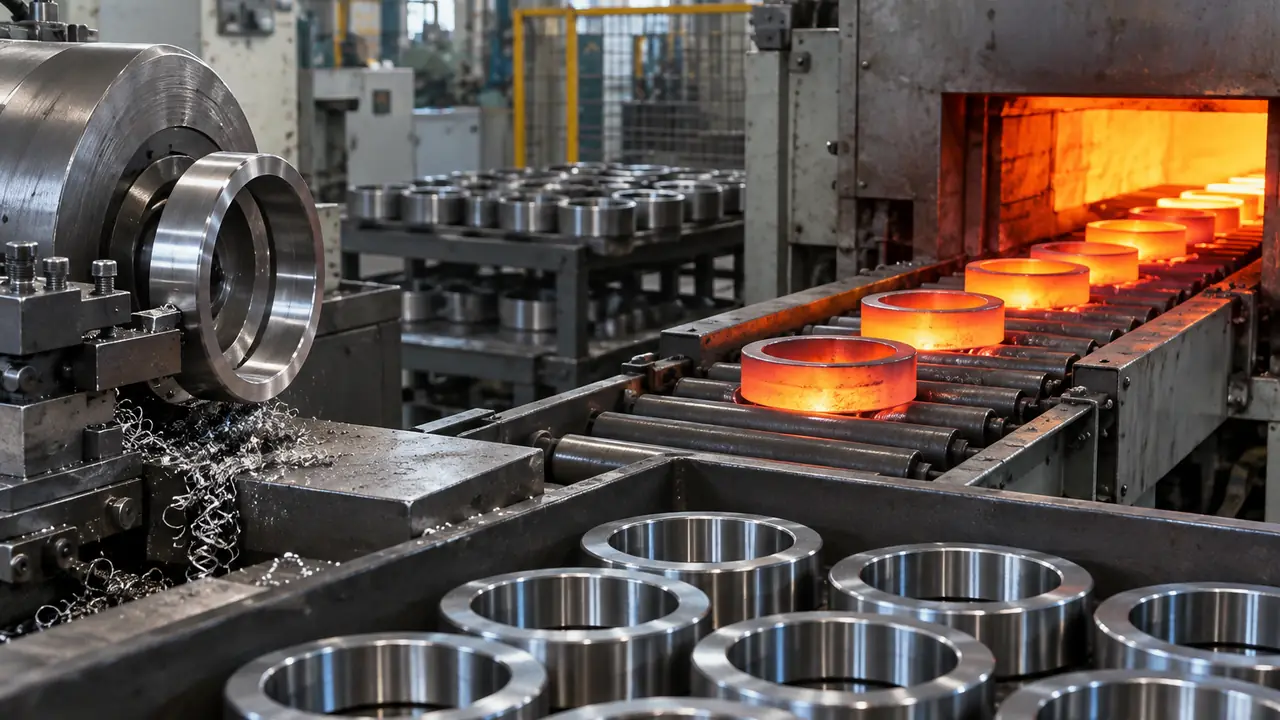
The sequence in one view
The route below is the common one for a standard ring-and-ball bearing made from high-carbon chromium steel. Roller bearings add roller manufacture; other routes, such as carburised steels for heavy tapered rollers, change the heat-treatment step but keep the same logic. Rolvane does not run this line itself: the desk coordinates partner plants and checks, through the plant screening, that each step is controlled.
- Steel bar or tube. Bearing steel arrives with a material certificate. Incoming checks cover chemistry, cleanliness records and bar size.
- Forging or tube cutting. Smaller rings are cut from tube or forged; larger ones are forged and rolled to a near-net shape to cut material waste.
- Turning. CNC lathes turn faces, outside diameter, bore and a rough groove, leaving a consistent stock allowance for grinding.
- Heat treatment. Rings are hardened and tempered in a controlled atmosphere to reach the hardness range and stable structure the bearing needs.
- Grinding. Faces, outside diameter, raceways and bore are ground to size and form; this step sets dimensional accuracy and much of the noise level.
- Superfinishing. The raceway is finished to a fine surface and low waviness, which strongly influences vibration and life.
- Component sourcing. Balls to a stated ISO 3290 grade, cages and seals arrive from specialist makers, often from the Liaocheng area, with their own incoming checks.
- Assembly. Rings are matched, balls inserted, cages fitted and seals or shields pressed in. Radial clearance is set by ring and ball selection.
- Cleaning. Parts and assembled bearings are washed to remove grinding residue and particles.
- Greasing and sealing. Grease type and fill are applied as ordered, then seals are fitted and checked.
- Testing. Sample or full testing for vibration, rotation, clearance and appearance, per the agreed plan.
- Marking, anti-rust and packing. Marking, rust-preventive coating, wrapping and cartons, as set out in packaging and anti-rust.
What is controlled at each step
| Process | What is controlled |
|---|---|
| Steel incoming | Grade, chemistry, material certificate, lot traceability |
| Forging / cutting | Blank size and weight, absence of cracks and laps |
| Turning | Dimensions and stock allowance for grinding |
| Heat treatment | Furnace atmosphere, temperature and time records, hardness and structure |
| Grinding | Dimensions, roundness, raceway profile, burn control |
| Superfinishing | Surface roughness and waviness of raceways |
| Balls, cages, seals | Ball grade and diameter group, cage fit, seal material and lip condition |
| Assembly | Clearance group, ball count and spacing, seal seating |
| Cleaning | Cleanliness, residue-free surfaces |
| Greasing | Grease type, fill amount, absence of contamination |
| Testing | Vibration, rotation, appearance against the agreed plan |
| Marking and packing | Marking legibility, rust protection, carton labels and counts |
Why heat treatment and grinding decide most of the result
Hardening turns the steel into the hard, wear-resistant structure a raceway needs; tempering relieves stress and sets stability. Poor atmosphere control or uneven loads show up later as soft spots, distortion or early fatigue. Grinding then removes the distortion left by heat treatment and sets the geometry. A raceway that is slightly out of round or has chatter marks makes noise regardless of how clean the assembly is. This is why the desk asks plants for heat-treatment logs and checks roundness and profile measurement, rather than only reading the final dimension report.
Components: what is made and what is bought in
Many bearing plants make the rings and buy the rest. Balls, cages and seals are specialist products: the ball grade under ISO 3290 influences noise and smoothness, the cage material limits temperature and speed, and the seal compound decides how the bearing handles dust, water and heat. The desk keeps the component sources on the record for each program, and if you want to influence them, say so at the quote stage. You can also source them directly: balls, cages, seals and grease.
How this connects to your specification
Every item you write on a request maps to a step. Tolerance class (ISO 492) is settled in turning and grinding, clearance group in grinding and assembly, vibration grade in superfinishing and cleaning, cage and seal in component choice, and shelf life in anti-rust and packing. When a specification is vague, a plant fills the gap with its default, which is rarely what an OEM program wants. Define the designation, tolerance class, clearance, seal, cage and grease up front, and the inspection plan can be written to match. For how results are verified, see quality control and testing and inspection.