
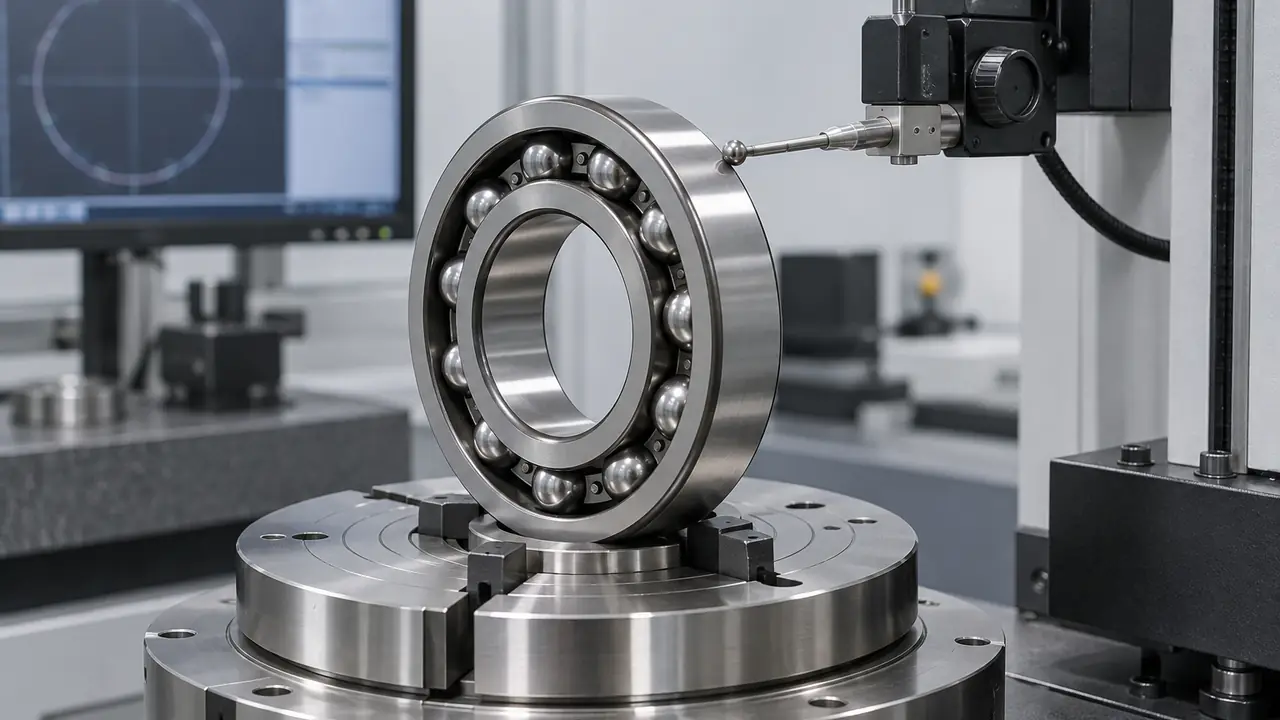
Two ratings for two different questions
A bearing can be overloaded in two ways. It can fail slowly by fatigue after many revolutions under a load that is acceptable in the short term. Or it can be damaged immediately, or by slow permanent denting, by a load that is too high even at rest or at very low speed. The two ratings correspond to these two ways.
- Basic dynamic load rating, C. Used for bearings that rotate. It is a reference load for life calculation.
- Basic static load rating, C0. Used for bearings that are stationary, rotate very slowly, or oscillate. It is a reference limit against permanent deformation of the raceways.
Both are published for each designation in the supplier catalogue or datasheet, in kilonewtons. This article does not give values, because they depend on size, series, internal design and steel quality.
What C means
The dynamic rating C is defined in ISO 281. It is the constant radial load (or axial load for thrust bearings) under which a group of identical bearings would reach a basic rating life of one million revolutions, with 90 percent of them still running without fatigue damage. It is not a limit on load; a bearing can run above and below C. It is a reference point on a curve.
The life equation then links load to life. In its simplest form, life in millions of revolutions rises as the ratio C divided by the equivalent load P rises, raised to a power. The power is 3 for ball bearings and 10/3 for roller bearings, which is a standard textbook result. Two consequences follow: a small drop in load gives a large gain in life, and a roller bearing is somewhat less sensitive to load than a ball bearing. The full method, including adjustment factors for reliability and operating conditions, is in bearing life: the L10 calculation.
What C0 means
The static rating C0 is defined in ISO 76. It corresponds to a contact stress at the most heavily loaded contact that produces a very small permanent deformation of the raceway and rolling element. The deformation is so small that it does not impair operation in many applications, but larger loads would. C0 is therefore the quantity to compare against shock loads, loads at standstill, and the heaviest peak load a bearing will ever see.
Designers use a safety factor on C0, often written s0, which is the ratio of C0 to the equivalent static load. Its value depends on how smooth and quiet the bearing must run. A bearing that must be very quiet needs a high factor, while a robust application tolerates a lower one. The appropriate factor comes from the bearing supplier or a design handbook.
Where each rating is used
| Situation | Rating used | What you check |
|---|---|---|
| Continuous rotation, normal speed | C | Calculated life against required hours |
| Standstill under load | C0 | Equivalent static load against C0 |
| Very slow rotation or oscillation | C0 (and C for long life) | Peak loads against C0 |
| Shock or impact loads | C0 | Peak load against C0 with a safety factor |
| Preloaded precision pairs | Both | Preload plus operating load |
Equivalent load: mixing radial and axial
Real bearings seldom see a pure radial or pure axial load. For a combined load, the designer calculates an equivalent dynamic load P from the radial and axial components using factors in the supplier catalogue. Those factors depend on the bearing type and on the ratio of axial to radial load. For this reason a deep groove, an angular contact and a tapered roller bearing of the same bore have different handling of axial loads, which is explained in bearing types explained. Do not compare ratings between types without using the matching equivalent load method.
A conceptual example
Suppose a fan shaft carries a steady radial load and runs all day. The designer picks a deep groove ball bearing, reads C from the datasheet, calculates P from the belt pull and the rotor weight, and compares C with P. If the ratio is comfortable, the life equation gives a long life. Now suppose the same fan is started under a heavy start-up shock, or the machine is moved by crane with the rotor resting on the bearing. Those events do not belong in the life equation; they are checked against C0. A bearing can have an excellent calculated life and still carry a dent from transport, which later shows as a noise at every revolution. This is the same mechanism described in false brinelling in transit, and it is why packaging and handling are part of quality, not an afterthought.
Common misreadings
"C is the maximum load." It is not. C belongs to a life of one million revolutions. Real operating loads are normally a fraction of C, and the smaller the fraction, the longer the life.
"A higher C means a better bearing." A higher C for the same size usually indicates a bearing with more or larger rolling elements, or an improved internal design. It does not tell you about noise, speed capability or quality of manufacture. Compare it together with speed ratings and tolerance class.
"Ratings are the same across suppliers for the same designation." Standards define the method for calculating ratings, but the result depends on the internal geometry that each plant chooses. The same designation from two plants can carry different published values. The values must come from the datasheet for the bearing you are actually buying.
"Static rating is just C divided by something." The relationship between C and C0 differs between types. Roller bearings have a much higher C0 relative to C than ball bearings, which is one reason they handle shock better.
What to ask a supplier
- The datasheet value of C and C0 for the exact designation and series.
- The standard used to calculate them, ISO 281 and ISO 76 or the GB/T equivalents.
- Any life modification factor offered for steel quality, if the claim is used in your calculation. Treat it as supplier-stated and verify by test.
- Clearance, class and cage for the designation, since these affect running behaviour.
A rating in a datasheet is a calculation, not a test result for your batch. For critical programs, ask the partner plant for evidence such as hardness records, material certificates and life test summaries, and ask the desk to coordinate verification. The testing and inspection page lists what the desk can request. When you are ready, send your load, speed and life target through the quote form; for matching series, the tapered roller bearing and deep groove ball bearing pages describe typical options.