
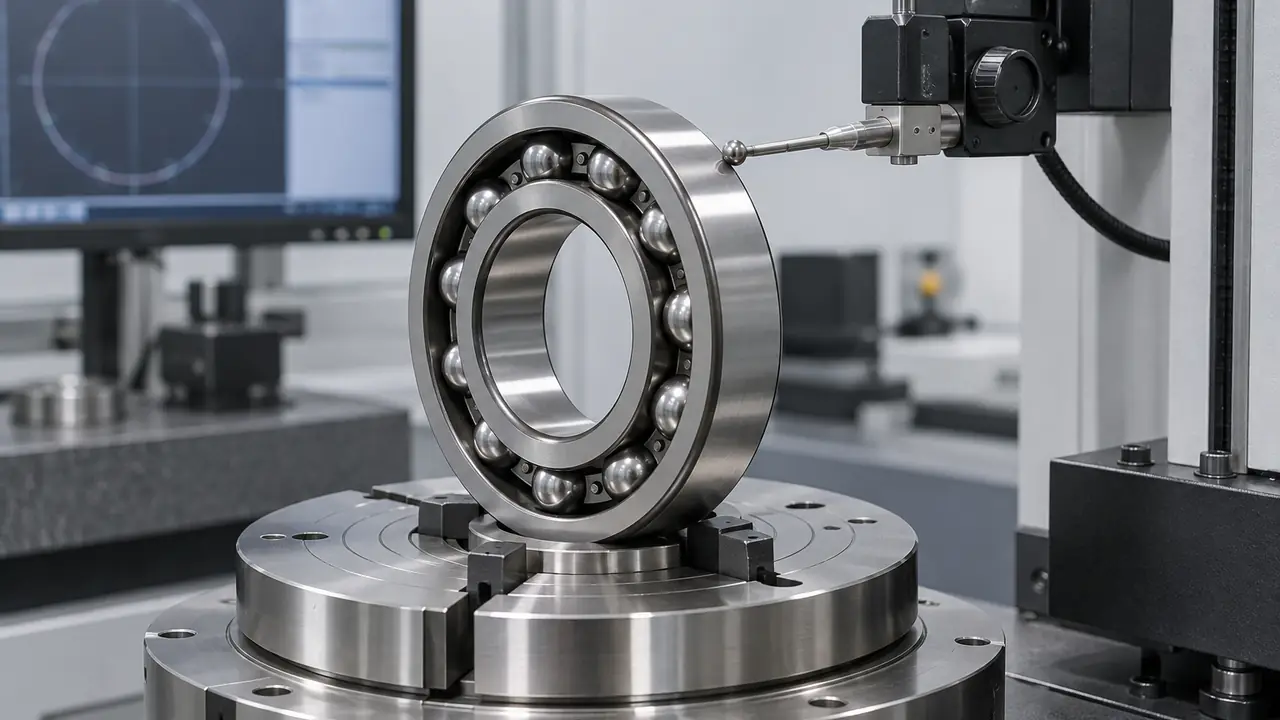
Why bearings have a speed limit at all
Speed raises friction heat, centrifugal force on the rolling elements and stress in the cage. A bearing that runs too fast heats up faster than the lubricant and housing can remove the heat, and a hot bearing loses clearance and lubricant life. The limit is therefore thermal and mechanical, not a single wall that a bearing hits. It depends on the bearing's size and design, on how it is lubricated and cooled, and on the load.
Because the limit is not one number, suppliers publish two figures that answer different questions, and mixing them up is one of the most common mistakes in datasheet reading.
Reference speed
The reference speed, also called thermal reference speed or thermally permissible speed, is a calculated figure based on heat balance. It is the speed at which the heat generated by bearing friction equals the heat that can be carried away under a set of standard reference conditions: a defined load, a defined temperature and a defined heat dissipation path. It is a way to compare bearings on equal terms, not a statement of what the bearing can do in your machine.
To use it, the designer adjusts the reference speed for the real load, the real lubricant and the real cooling. A bearing under a heavier load, with a thick grease or with poor cooling will be allowed less speed than the reference figure. A bearing with light load, oil lubrication and good heat removal can run above it.
Limiting speed
The limiting speed is the highest speed at which the bearing can be run without mechanical problems, mainly in the cage, rolling elements or seals, regardless of heat. Operating above it risks cage failure or seal damage, even if the temperature looks acceptable. Suppliers usually derive it from experience and test data rather than a single formula, and it often depends on the type of lubrication, with a separate value for oil and grease.
| Item | Reference speed | Limiting speed |
|---|---|---|
| What it measures | Heat balance under standard conditions | Mechanical limit of cage, seal and rolling elements |
| Main use | Comparing bearings; adjusting for real conditions | Absolute ceiling for running |
| Can the machine exceed it? | Yes, with oil, light load and good cooling | No, not safely |
| Typical dependency | Load, temperature, cooling | Cage type, seals, lubricant |
Both values come from the supplier datasheet for the exact designation. This article does not give numbers because they depend on size, series and construction.
What raises or lowers the allowed speed
The choices below shift the allowed speed in a known direction. Treat the table as relative guidance and confirm with the supplier.
| Choice | Effect on speed capability |
|---|---|
| Open bearing vs sealed | Open runs faster; contact seals add drag and heat |
| Metal shield vs contact seal | Shield allows higher speed than a contact seal |
| Oil vs grease | Oil with circulation allows higher speed |
| Stiff grease vs light grease | Light, low-torque grease allows higher speed |
| Larger internal clearance | Reduces heat from tight running, but too much allows skidding |
| Steel vs ceramic balls | Lighter ceramic balls reduce centrifugal load |
| Pressed steel vs brass vs nylon cage | Cage design and material set mechanical limit |
| Higher precision class | Better balance and roundness help at speed |
| Heavier load | Reduces allowed speed |
Seal and shield trade-offs are explained in 2RS vs ZZ bearings, and grease choice in the lubrication guide.
Speed factor: a quick screening tool
Designers often use a speed factor, the product of the mean bearing diameter and the shaft speed, to compare applications quickly. Larger bearings at the same rpm run at higher surface speed, so the same rpm that is easy for a 6001 can be hard for a large bearing. The factor is useful for screening, for example to decide whether grease is adequate or oil is needed, but the permitted values depend on the bearing type and lubrication and come from the supplier. Never copy a threshold from one bearing type to another.
Heat is the real limit in the field
In practice, most speed problems show up as heat long before a cage breaks. A bearing that is too warm to hold a hand on is not automatically failing, but a steady rise in temperature after start-up, or a temperature that keeps climbing, is a sign that the speed, load, grease fill or clearance is out of balance. Overfilled grease is a frequent cause at speed, because the balls have to push through it; the fill guidance in the lubrication guide applies. Another cause is a fit that has consumed the clearance, which is why speed and clearance are specified together. See internal clearance groups.
When a customer reports that a bearing is running hot at speed, the first checks are the running temperature trend, the grease type and amount, the clearance group and the shaft and housing fits. Only after those are ruled out is it worth asking whether the bearing itself is the cause.
Skidding at the other extreme
Speed problems are not only about too much. A roller bearing running at high speed with a very light load can skid, with the rollers sliding rather than rolling, which smears and damages the raceway. High-speed spindles solve this by applying a preload, which keeps the elements loaded enough to roll. For general applications the lesson is to size the bearing for the real load; a bearing much too large for the load is not safer.
Turning a speed requirement into a specification
- State the maximum and normal speed in rpm and the duty pattern (continuous, intermittent, start-stop).
- State the load, direction and temperature range.
- State the lubrication method: grease, oil bath, oil mist or circulating oil.
- Ask the supplier for both the reference and limiting speed values for the proposed designation, cage, seal and grease.
- For high speed, specify the precision class (P5 or P4), cage material, ball grade and, if needed, ceramic balls; see precision classes compared.
The desk shortlists partner plants for high-speed lines and arranges samples for running tests under your conditions, with the reference MOQ and lead time confirmed in writing as described on the MOQ and lead time page. Send the application details through the quote form.