
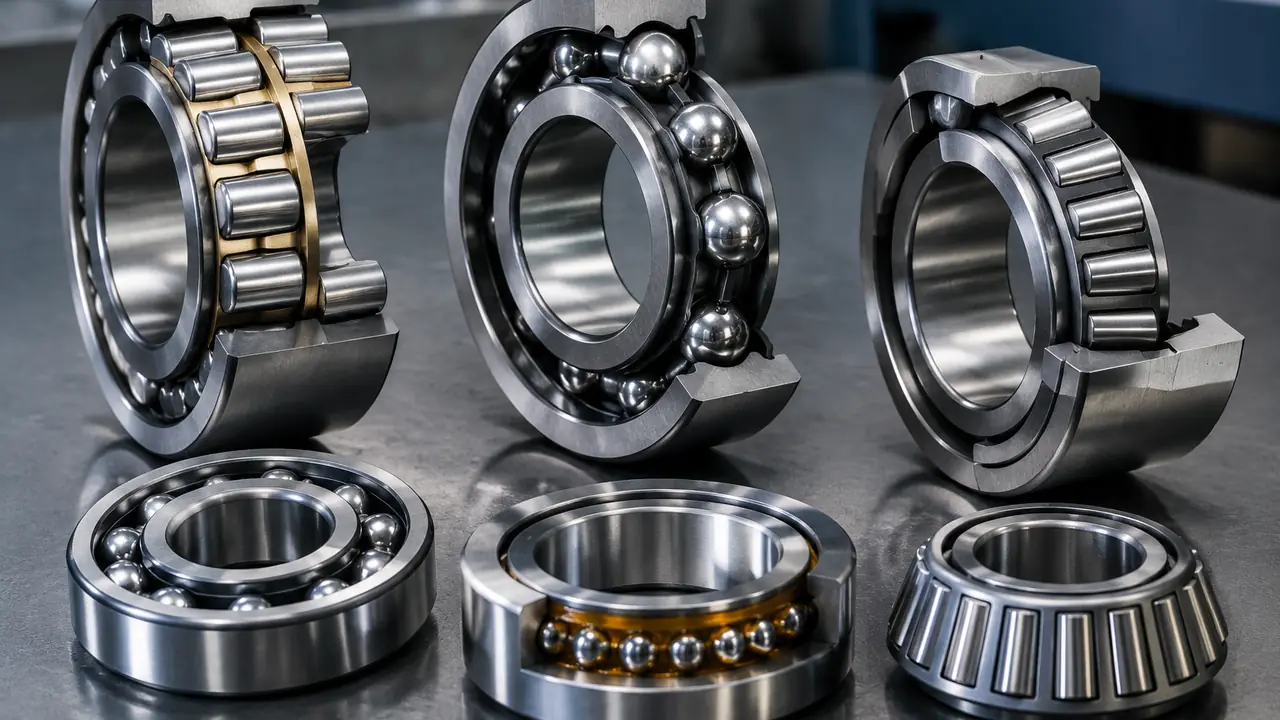
How the geometry works
A tapered roller bearing has conical rollers running between a conical inner raceway and a conical outer raceway. If you extend the surfaces of the cone and the cup toward the axis, they meet at one common point. That is what lets the rollers roll without sliding, and it is what gives the bearing its ability to carry radial load and axial load in one direction at the same time. Rollers touch the raceways along a line, so the bearing carries far more load than a ball bearing of similar size, which is why the type is the default for wheel hubs, axles and gear reducers.
The same geometry has a consequence that surprises new buyers: the bearing pushes itself apart axially when it carries radial load. A single tapered bearing therefore cannot hold a shaft alone. It is used in opposed pairs, and the pair has to be set to the correct axial clearance or preload.
Cone, cup and the parts you order
The assembly is split into separable parts, and the vocabulary is worth learning because quotes and drawings use it.
- Cone is the inner ring assembly: the inner ring with its raceway, the rollers and the cage. It fits on the shaft.
- Cup is the outer ring. It fits in the housing and can be fitted separately.
- Rollers and cage stay with the cone, which is why a cone and cup are not always interchangeable between plants unless the same standard is used.
In the metric system the cone and cup are sold as a matched set under one designation, such as 30205. In the inch system the cone and cup carry separate part numbers and are combined by the buyer or the supplier, so an inch order lists both numbers. Never mix cups and cones from different series or sources without confirmation: tolerances on the angle and the width of the assembly are set so that a pair works together.
Metric series and nominal sizes
Metric tapered roller bearings follow ISO 355. The designation starts with 3, followed by codes for the angle and width series, and ends with the bore code. Common series are 302 (light), 303 (medium), 320 (wide light) and 322 (wide medium). Wider series carry more load in the same bore.
| Designation | Series | Bore d | OD D | Total width T |
|---|---|---|---|---|
| 32005 | 320 | 25 | 47 | 15 |
| 30205 | 302 | 25 | 52 | 16.25 |
| 32205 | 322 | 25 | 52 | 19.25 |
| 30305 | 303 | 25 | 62 | 18.25 |
These are nominal ISO values for reference; confirm against the drawing and supplier datasheet. The bore code follows the usual rule: for codes of 04 and above, multiply the last two digits by five to get the bore in millimetres. More dimensions are in the size chart.
Metric versus inch
Inch tapered bearings come from a different sizing tradition and are common in automotive aftermarket, agricultural and imported equipment. Their bore and outside diameter are expressed in inches, and the cone and cup have their own numbers. A metric and an inch bearing can have almost the same bore in millimetres, but the angle, roller length and fit are not necessarily the same, so a near match is not a substitute. If you only have a part number from an inch machine, ask for the dimensions on a drawing, then confirm before ordering. More on the two systems is in inch vs metric bearings.
Arrangements and setting
Pairs are mounted in two ways. Direct (face-to-face) mounting places the cups close together; it is common on pinion shafts and where the housing is short. Indirect (back-to-back) mounting places the cones close together and spreads the effective load centres, giving more stiffness against tilting, as on wheel hubs.
The key step is setting, which means adjusting the axial position of one bearing against the other until the pair has the specified end float or preload. Bearings run with a small controlled end float on lightly loaded or high-temperature shafts, and with light preload where stiffness matters, as in pinions. A set that is too loose lets rollers skid and the shaft move; a set that is too tight overheats the bearing and shortens life sharply. Setting is done with shims, a threaded nut or a spacer, and the value should come from the equipment design or the supplier application note, not from a general table.
Common problems on incoming lots
Three issues come up repeatedly with tapered bearings from mixed sources. The first is mismatched parts: a cup from one batch and a cone from another can still fit, but the assembled width and running feel may differ. Keep cones and cups packed as sets and ask the plant to mark them together. The second is roller finish: visible scoring or rough ends on rollers raise noise and wear, so inspect a sample under good light. The third is corrosion in transit, because tapered bearings are heavy and often shipped by sea; the packing should use rust-preventive oil, VCI wrapping and sturdy cartons, as described on the packaging page.
Where the type is used and what else to check
Typical homes are wheel hubs for trucks, trailers and farm equipment, axle differentials, gear reducers and gearbox shafts, and rolling-mill and construction-machine supports. For transmission and axle parts in automotive aftermarket programs, plants with IATF 16949 are usually preferred; the certificate is verified per project. Also check the roller profile, the cage type (pressed steel is common), the surface finish and the grease or oil that suits the application.
| Item | What to state |
|---|---|
| System | Metric designation, or inch cone and cup numbers |
| Tolerance | Normal, or a tighter ISO 492 class if specified |
| Packing | Matched set, or cone and cup packed together and labelled |
| Application | Load direction, speed, temperature and lubrication |
Compare the type with its closest relative in tapered vs cylindrical roller bearings. When the specification is ready, send it through the quote form; typical reference MOQs and lead times are on the MOQ page and are confirmed in writing for each program.