
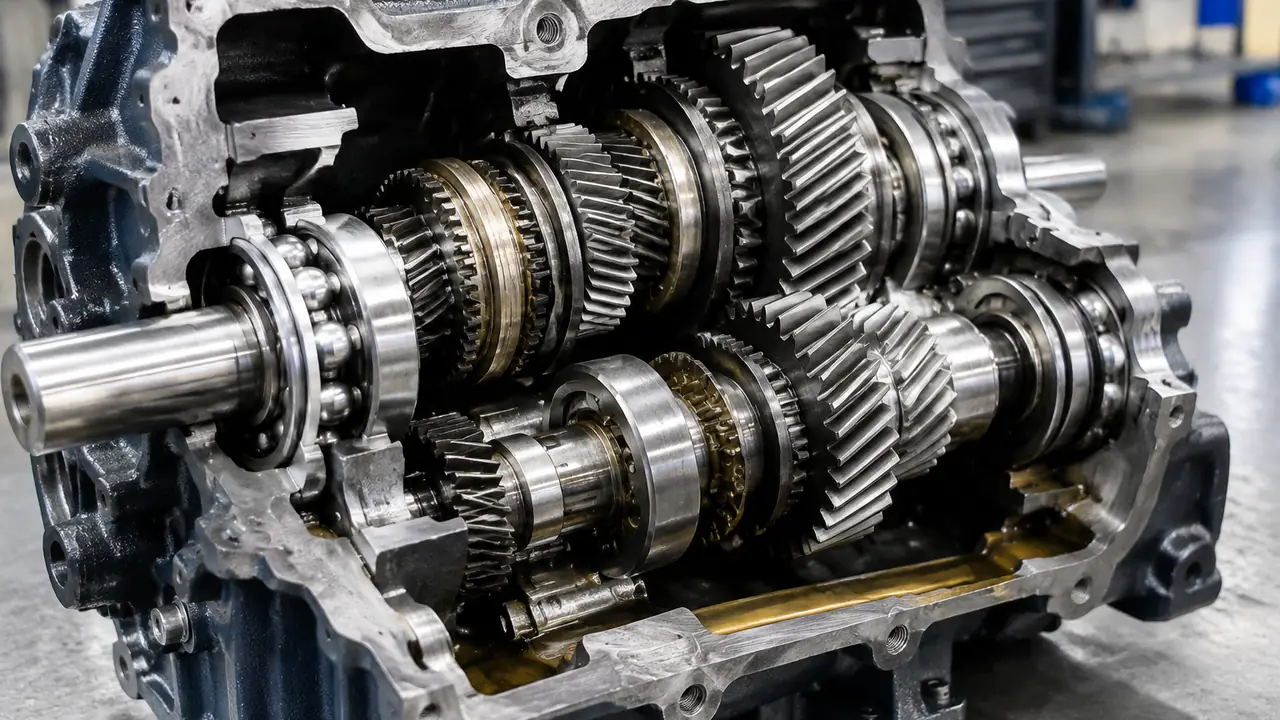
What a wheel hub bearing does
A wheel hub bearing lets the wheel turn on the axle or the steering knuckle while carrying the weight of the vehicle, the side forces in corners and the forces from braking and acceleration. It sees radial load, axial load in both directions and tilting moments, often together, plus water, road salt and heat from the brakes. That combination is why hub bearings are among the more demanding rolling bearings in a road vehicle, and why aftermarket buyers pay attention to the supplier's quality system.
Hub bearings are normally either a pair of tapered roller bearings or a double-row angular contact ball bearing, often supplied as a sealed, pre-greased and pre-set unit. The tapered roller bearing and angular contact ball bearing pages describe the base designs.
Generations in plain terms
The industry describes hub bearings by generations. The labels are descriptive, not a standard, and details differ between vehicle platforms, so treat the table as a general map.
| Generation | General description | Typical handling |
|---|---|---|
| Gen 1 | A bearing or bearing pair that sits in the hub or knuckle; the hub, knuckle and seals are separate parts | Pressed in with the wheel-end parts; preload set at assembly in the case of tapered pairs |
| Gen 2 | The outer ring carries a flange for mounting, and the hub or an inner flange is built in | Bolted to the knuckle; pressed on to the hub |
| Gen 3 | The unit integrates both the hub flange and the knuckle attachment, often with a sensor ring for the ABS system | Bolted as a complete assembly, not pressed apart |
Each step integrates more parts into one assembly, which reduces fitting errors on the workshop floor but makes the part more specific to a vehicle platform. For that reason, hub bearings are ordered by application or by a reference from the vehicle manufacturer, and a buyer should always confirm fit against the drawing and the supplier datasheet.
Tapered pair versus sealed unit
Older and heavier vehicles, trailers and commercial wheels often use two separate tapered roller bearings with an adjusted preload. They are serviceable: the bearings can be repacked with grease and the setting adjusted. Many passenger vehicles use sealed double-row units that are not adjustable and are replaced as a complete part when worn. Neither is better in the abstract. Tapered pairs are tolerant of heavy loads and repair, while sealed units reduce maintenance and fitting errors at the cost of being a less repairable part.
Metric tapered bearings follow ISO 355 for boundary dimensions, and inch-series tapered bearings are also common in trailer and light truck wheel ends. The inch vs metric bearings note explains the difference and why cross-checks must be done against the actual drawing.
Kits and the parts around the bearing
A wheel bearing job rarely replaces the bearing alone. Seals, retaining rings, nuts, cotter pins, sensor rings and sometimes the hub flange are part of the same service. Aftermarket suppliers therefore sell bearing kits that put everything needed into one box, which reduces wrong-part returns for the shop. The desk can help build a kit list around the vehicle applications that matter in your market, with carton labelling and packaging suited to the parts counter.
What a hub bearing specification should include
Because the part is application-specific, a purchase specification for a wheel hub bearing is longer than one for a standard deep groove bearing. A complete request normally covers the following items, and the partner plant will ask for the missing ones anyway.
- Application or reference: the vehicle platform, axle position (front or rear, driven or non-driven) and the reference number used in your catalogue.
- Drawing or sample: bore, outer diameter or flange pattern, bolt circle, spline or sensor details, as nominal values to be confirmed against the datasheet.
- Sensor and ABS ring: whether the unit has a magnetic encoder ring or a target ring, and the connector, because a mismatch here will not be caught by dimensions alone.
- Grease and seals: fill type and seal arrangement; hub bearings run in water and brake heat, so the specification should be explicit.
- Marking and packaging: the part number, lot code and country marking on the part, plus carton layout for the parts counter.
It also helps to define what incoming inspection will measure on each lot: for example rotation feel, axial play for units that allow it, flange runout, dimensions at critical points and seal condition. These checks are agreed before the first order, and the results are kept with the lot record. The method for pre-shipment checks is described in the quality control page.
Quality system and traceability
Because hub bearings are safety-related, many buyers ask for suppliers working under IATF 16949, the automotive quality management standard. IATF 16949 is held by partner plants, not by the desk, and the certificate has to be verified per project, including its scope and validity. The note on IATF 16949 for bearing suppliers explains what it covers. Ask also for batch or lot traceability that connects each carton to production records, and for clear, permanent marking on the part. These elements allow a field return to be traced to a lot.
Safety and installation advice
Replacing a wheel hub bearing is work for qualified mechanics. The bearing is a safety component, the fit and preload are critical and mistakes can lead to heat, noise or wheel-end failure. Follow the vehicle manufacturer's service instructions, use the correct tools, torque the fasteners to the specified values and replace parts in the sets recommended for the vehicle. This article is not a repair manual. If a customer reports growling that changes with steering or speed, the usual first step is inspection by a qualified workshop; our note on wheel bearing noise symptoms describes common signs.
Sourcing steps for aftermarket buyers
- Collect the application list or reference numbers the market actually buys, not an abstract catalogue.
- Decide which parts are unit assemblies and which are separate bearings plus kit parts.
- Ask each candidate plant for its quality certificates and verify scope, validity and traceability.
- Approve samples against the drawing, including dimensions, runout and rotation feel, before volume.
- Agree marking, carton labelling and rust protection for sea freight; see packaging and anti-rust.
- Confirm MOQ and lead time in writing; the reference ranges are on the MOQ and lead time page.
Do not assume that a part matching a reference is equivalent to a branded part. Fit, marking and quality are verified per project through samples and records. Send the application list through the quote form.