
Safety first
A wheel bearing carries the vehicle's weight and holds the wheel on its axis. When it deteriorates badly, play at the wheel can affect braking, steering feel and, in the worst case, wheel retention. If you hear a persistent hum, growl or grinding from a wheel area, do not diagnose it by driving on and listening. Have the vehicle inspected by a qualified mechanic and avoid long or high-speed trips until it has been checked. The information below helps procurement, fleet and workshop staff understand the symptoms; it does not replace a proper inspection on a lift with the right tools.
The usual symptoms
Wheel bearing noise is most often a low-pitched hum or growl that appears at moderate speed and grows louder as speed rises. Many drivers describe it as similar to a road-surface roar or a distant aircraft. Typical features are:
- The sound follows road speed, not engine speed. It continues when the clutch is pressed or the gearbox is in neutral.
- It often changes when cornering: when the car leans onto the damaged bearing, the noise gets louder; when the load shifts away, it can ease.
- It may be accompanied by vibration felt in the steering wheel or floor, or by a loose, wandering feel.
- In later stages the noise turns into rumbling or grinding, and the wheel may show play when rocked by hand with the vehicle raised.
Symptom, likely source and what a workshop checks
| Symptom | Likely source | Workshop check |
|---|---|---|
| Hum rising with road speed, changes in bends | Wheel bearing wear | Wheel raised, spin and rock by hand; measure play |
| Hum that varies with road surface | Tyre tread pattern or uneven tyre wear | Tyre inspection; rotate tyres and compare |
| Rhythmic click on turns | Drive shaft joint, not bearing | Joint boots and play |
| Squeal or grind when braking | Brake pads, discs or dust shields | Brake inspection |
| Vibration at certain speeds | Wheel balance or bent rim | Balance check |
| Clunk over bumps | Suspension bushes or ball joints | Suspension inspection |
| Warm hub after a drive | Bearing friction, dragging brake | Temperature comparison across wheels |
Because several of these overlap, the table is a guide to questions, not a verdict. Tyre noise is the usual false alarm, which is why a mechanic will often swap tyres side to side before condemning a bearing.
Why wheel bearings wear
Hub bearings are sealed units or tapered roller sets, working under combined radial and axial load with road shock, water and salt. Common causes of failure are:
- Seal damage and water entry, which wash out grease and corrode the raceway; see contamination damage.
- Impact from potholes and kerbs, which can dent the raceway and start fatigue.
- Incorrect installation: wrong tool, force through the rolling elements, or wrong nut torque. Over-tightened tapered roller sets run hot; loose ones wander.
- Overloading, oversize wheels or heavy vehicle use beyond the original design.
- Reusing worn related parts, such as a damaged hub seat or axle nut.
Hub designs differ in generation and format, and the choice between a cone-and-cup set and a flanged hub unit affects what is stocked. The comparison is in wheel hub bearings: generations and sourcing, and the roller type is described on the tapered roller bearing page.
How the damage progresses
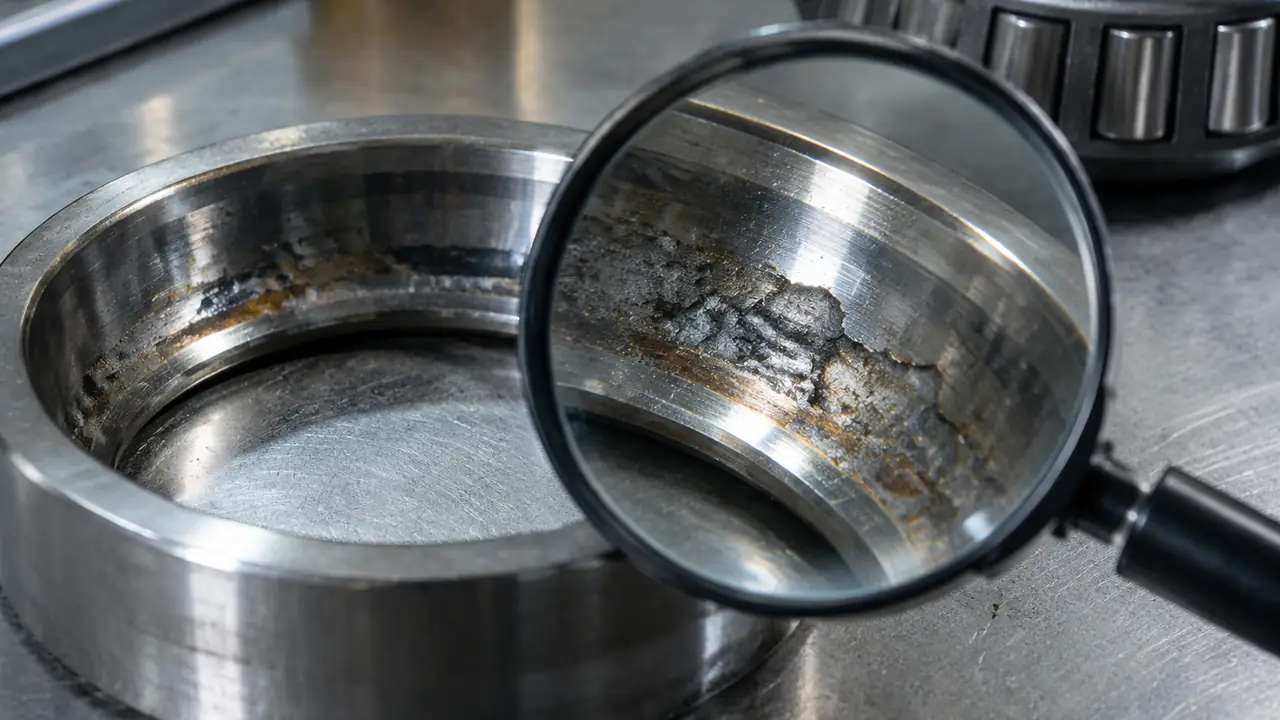
Wheel bearing deterioration tends to follow a pattern. In the first stage the seal admits a little water or the grease ages, and there is no audible change. In the second stage the raceway surface starts to roughen or pit, and a faint hum appears at one speed band, often noticed only on a quiet road. In the third stage the hum becomes constant and louder, and vibration may be felt. In the final stage the bearing develops play, heat and grinding; the hub may discolour from heat, and the risk of a seized or separated wheel rises. The time spent between stages varies with load, road conditions and the cause, so no mileage can be promised.
This progression is the reason fleets and workshops treat early hum as a work order, not a nuisance. The cost of replacing a bearing early is small compared with the cost of a damaged hub, brake components and a vehicle off the road. Fleet teams also benefit from logging which positions fail: a repeated failure at the same wheel position on several vehicles suggests an installation or component issue, while scattered failures across positions suggest age and operating conditions.
Replacement and parts supply
For parts buyers, the practical points are traceability and completeness. A hub bearing job usually needs the bearing or unit, seals, nut or circlip, and sometimes grease and fasteners; a bearing kit bundles these. Wheel bearings are normally replaced in pairs across an axle, and with attention to the condition of the mating hub and knuckle. Replacement parts should be specified by the vehicle maker's reference or the measured dimensions and checked for fit by the workshop; no part should be assumed to fit a vehicle until it has been confirmed against the application data.
What an aftermarket buyer should ask
- Which dimensions and type are required: bore, outside diameter, width, flange pattern, ABS sensor ring or magnetic encoder if fitted.
- What quality system the partner plant runs; IATF 16949 is common for automotive parts and is verified per project, not assumed.
- What marking, packaging and anti-rust protection the order needs, as described in packaging and anti-rust.
- What batch records and incoming inspection are agreed, so that a warranty or complaint can be traced to a lot.
- What MOQ and lead time apply, confirmed in writing using the ranges on the MOQ and lead time page.
The desk works with partner plants for automotive and motorcycle aftermarket programs; the wider solution is described on the automotive aftermarket page.
What to tell the mechanic
Describe when the noise appears: speed range, whether it changes when turning left or right, whether it is constant or intermittent, and whether the vehicle has recently had tyres, brakes or suspension work. Mention any recent impact or deep water crossing. This turns a vague complaint into a short diagnosis and avoids replacing parts that were not at fault.