
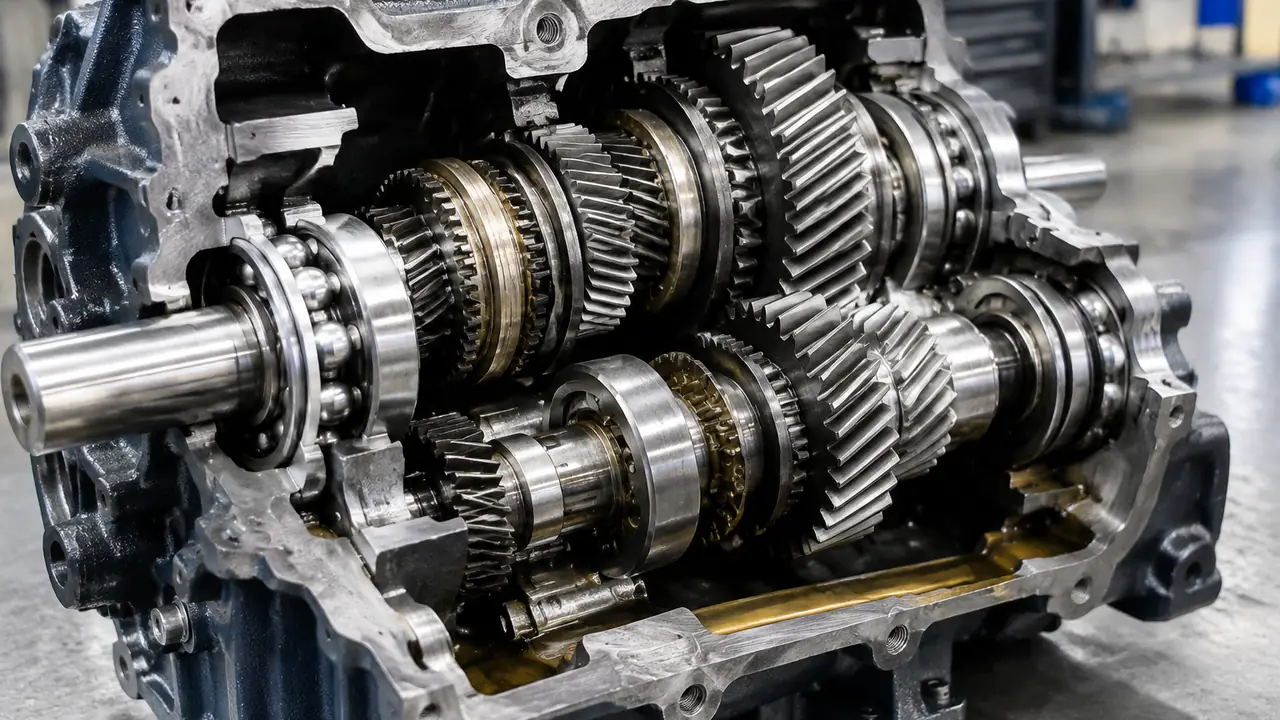
Where the loads in a pump come from
A centrifugal pump shaft sees a mix of loads. The weight of the impeller and shaft and the unbalanced pressure around the impeller produce radial load. The pressure difference across the impeller produces axial thrust, usually toward the suction side, and it changes with flow rate, wear rings and operating point. A pump running far from its design point can see large radial forces and sudden changes in thrust, which is why bearings in pumps that run off curve fail faster than the rating calculation suggests.
The bearing arrangement is usually two bearings in a frame: one carries radial load and lets the shaft float; the other carries radial load and locates the shaft axially against thrust. Knowing which is which is the first step in a replacement.
Common bearing arrangements
| Pump type | Typical arrangement | Notes |
|---|---|---|
| Small end-suction pump | Two deep groove ball bearings, one locating | Common on light duty; thrust moderate |
| Process and general industry pump | Radial ball or roller bearing plus paired angular contact thrust bearings | Pairs are mounted back to back to take thrust in both directions |
| Larger or heavier pump | Cylindrical roller at the drive side, ball or spherical roller at the locating side | Higher radial capacity |
| Vertical pump | Thrust bearing at the top, often with oil lubrication | Carries the weight of the rotor; see thrust roller bearings |
Paired angular contact bearings must be matched. They are supplied as a set with defined preload or end play, and the mounting order (back to back, face to face or tandem) affects stiffness and axial capacity. Mixing single bearings from different batches can leave the pair unbalanced. The angular contact bearing guide explains the arrangements.
Seals: the bearing side and the pump side
A pump has two sealing problems. The first is the shaft seal that keeps the pumped fluid inside the casing. The second is the bearing protection that keeps leaked fluid, wash water and dirt out of the bearing frame. Many bearing failures start with a failed shaft seal: fluid enters the frame, dilutes the lubricant and corrodes the raceways.
- Lip seals and contact seals in the bearing cartridge protect against splashing and light moisture. They add friction and heat.
- Non-contact labyrinth protectors in the frame cover keep a clear path between the shaft and the housing and resist wear, with a good record on process pumps.
- Sealed or shielded bearings work in grease-lubricated pumps; open bearings are used where the frame has an oil bath.
See the bearing seal and bearing shield pages for the options partner plants can supply.
Oil or grease
Small pumps use greased-for-life bearings; larger pumps use an oil bath or ring oiling. Grease is simple and works well at moderate speed and temperature, while oil carries heat away and suits higher speed and temperature. The choice is discussed in oil vs grease lubrication. In oil-lubricated frames the oil level matters: too low and the rolling elements are starved, too high and the churning raises temperature. In grease frames the typical error is over-greasing, which overheats the bearing and pushes grease into the seals. Intervals and quantities are covered in how much grease goes in a bearing and in the lubrication guide.
Temperature affects both choices. Hot service fluids conduct heat along the shaft, so the bearing sees a warmer environment than the room. High-temperature greases and heat-stabilised bearings may be needed, and the bearing clearance may need to be larger, such as C3. Confirm the operating temperature and the service fluid in the specification.
Fits and the bearing housing
Pump frames are usually cast iron, and the bearing sits in a cartridge or a direct bore. The inner ring on the shaft is normally fitted with an interference fit, while the locating bearing is clamped axially by a cover and a snap ring or locknut. The floating bearing must be able to slide in its housing, so its outer ring has a slightly looser fit and the housing must be clean and free of burrs. If the floating bearing seizes in the bore because of rust or an over-tight fit, thermal growth of the shaft is carried as axial load on the locating bearing, and both fail. Fit symbols and tolerance classes are set out in shaft and housing fits.
Bearing life also depends on cleanliness at assembly. Pump bearings are fitted in workshops where dust, grinding debris and old gasket material are common. Wash the frame, check the shaft journals for scoring, fit the bearing cold or with controlled induction heating, never with a torch, and push on the ring that has the interference fit, not through the rolling elements. A bearing that has been struck or pushed through the balls carries invisible damage into service.
Typical pump bearing failures
- Water or process fluid in the oil. A cloudy or milky lubricant is the signal; the cause is usually a failed shaft seal or a missing bearing protector.
- Thrust overload. Running far from the best-efficiency point or against a closed valve raises axial load. The damage pattern is a track offset to one side of the raceway.
- Misalignment between pump and driver causes heat on one side of the bearing and a fretted shaft. Alignment is a pump-fitting issue, not a bearing quality issue; see bearing misalignment.
- Over- or under-lubrication shows as a hot bearing, blackened grease or dry raceways.
- Electrical damage in motor-driven pumps with variable-frequency drives; see electrical erosion.
A bearing replaced without addressing the cause will fail again, so read the damage first and fix the system.
Replacement and sourcing checklist
- Read the designation, including suffixes for contact angle, clearance, cage and pairing, from the old bearing.
- Identify the locating and floating positions and keep them.
- Order angular contact bearings as matched sets with defined mounting.
- Specify the seal and the grease against the temperature and the fluid.
- Record the shaft and housing diameters and check them for wear before fitting.
- Ask the desk for the typical MOQ and lead time on the MOQ and lead time page, confirmed in writing for each program.
Dimensions on the datasheet are nominal ISO values, and load ratings and limiting speeds come from the supplier datasheet for the exact designation. Send the pump list and the bearing positions through the quote form.