
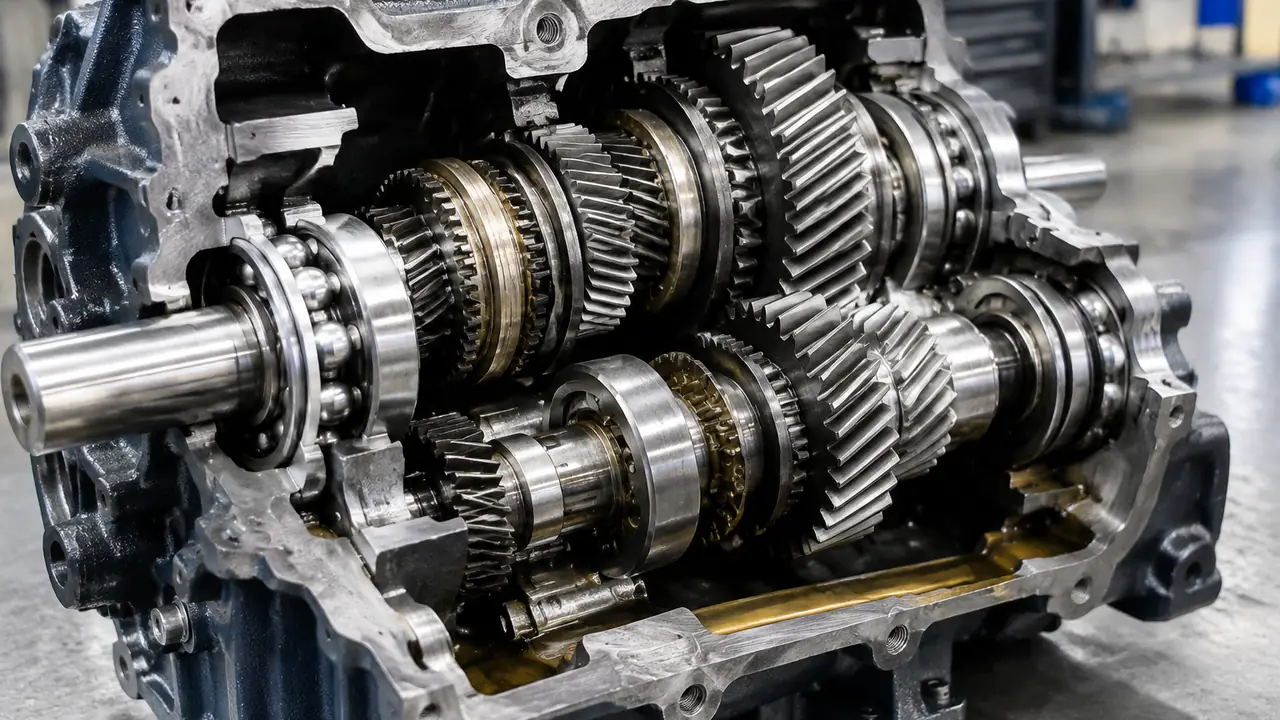
Two kinds of motion, two bearing families
Automation axes divide into rotary and linear motion. Rotary axes, such as robot joints, rotary tables and wrist shafts, use rolling bearings arranged to give stiffness against tilting moments as well as radial and axial load. Linear axes, such as pick-and-place gantries, 3D printer carriages and slides, use linear bushings on round shafts, or rail and carriage systems. The bearing choice follows from load direction, accuracy and the available space.
Both axis types share a few demands: smooth movement without stick-slip, repeatable position, low noise and a stable preload over many cycles. Dust and coolant exposure vary widely, from clean packaging lines to machine tools with spray and chips.
Mapping axes to bearing families
| Axis or position | Typical bearing | Why |
|---|---|---|
| Small linear slide on round shaft | Linear bushing (LM-UU type) | Simple, low cost, easy to fit on ground shafts |
| Robot joint, reduction stage | Paired angular contact or crossed roller designs | Stiffness against moment and axial load |
| Wrist and gripper shafts | Miniature bearings, thin-section ball | Small bore, light weight |
| Motor shaft in servo | Deep groove ball bearings | Low noise, high speed |
| Cam followers and rollers | Needle roller | High load in a small section |
| Clean room, food or wet cells | Stainless or ceramic bearings | Corrosion resistance, low shedding |
Nominal dimensions of the standard series are in the size chart; for example, the LM-UU bushings list nominal bore, outside diameter and length. Confirm each value against the drawing and the supplier datasheet.
Linear bearings and the shaft behind them
A linear ball bushing runs on a hardened and ground round shaft, and the shaft is half of the system. The surface hardness, the finish and the straightness of the shaft decide life and smoothness. A bushing on a soft or rough shaft wears quickly, and a shaft that is not supported along its length deflects under load. The bushing itself is a sleeve with recirculating balls, and the seals at each end keep dirt out. The note on linear bearings covers bushings, shafts and rails in more detail. If the load is large or the accuracy demanding, a profiled rail system is a better fit than round shafts, and the choice should be made at design stage.
Rotary axes: stiffness and backlash
For joints and rotary tables, stiffness and play matter more than raw load rating. Backlash, which is the small free movement in the system, shows up as positioning error and vibration. Rolling bearings reduce it through preload: a pair of angular contact bearings clamped together with a defined axial force removes internal clearance. Preload class is chosen by the designer to balance stiffness, friction and heat, as in machine tool spindles; see spindle bearings. Sizes in robot arms are often small and thin, so thin-section bearings with a constant cross-section across the size range are common. Thin-section designs are typically made to order, with the programme agreed through the custom bearings process.
Miniature bearings, noise and handling
Grippers, camera gimbals, medical devices and small actuators use bearings with a bore of a few millimetres. They are sensitive to dirt and handling. A bearing with a particle or a dent runs rough, and a bearing stored without protection can corrode. Quiet running requires fine grinding, high-grade balls and a clean assembly environment; vibration grades are agreed per order, as in vibration grades. Miniature bearings are normally supplied in small boxes or tubes, and the packaging should protect them from moisture and impact.
Life, duty cycle and lubrication in automation
Automation axes rarely run at steady speed. A pick-and-place axis accelerates, stops, reverses and waits, thousands of times per shift. Small oscillating movements are hard on rolling bearings, because the grease film never fully forms and the balls can press the same spots on the raceway. This is called false brinelling when it occurs without rotation, and it is a known cause of early noise in short-stroke axes; the principle is treated in false brinelling. The remedy is to choose a suitable grease, provide enough travel to redistribute lubricant and avoid constant vibration during idle periods.
Life calculations under ISO 281 need an equivalent load and speed for the duty cycle, which the machine designer prepares. A buyer replacing parts should not guess at these values; use the designation of the original bearing and the supplier datasheet. For relubricable bearings, follow the maker's intervals, and for sealed bearings expect that grease life, not fatigue, will set the service life in a hot or fast axis.
Axes in packaging and electronics lines often run around the clock, so a spare strategy matters. Keep a spare set of the critical bearings per axis type, record the designation, preload class and grease on the spare label, and replace in pairs where the arrangement demands it. A consistent spare record shortens downtime and reduces the risk of mixing a similar looking but different part. Where an axis uses a non-standard size, agree a drawing with the partner plant early, so that repeat orders reproduce the same dimensions, material and grease.
Hybrid and insulating options
Servo motors driven by inverters can suffer from shaft currents, so hybrid bearings with ceramic balls are used to break the current path. Ceramic balls are also lighter and stiffer, which helps high-speed axes. In food or wet applications, stainless steel avoids corrosion and certain greases are approved for incidental food contact. See ceramic bearings and the note on ceramic vs steel bearings.
What integrators should specify
- The axis type, the load directions and the available envelope.
- Accuracy needs: tolerance class, preload class and allowed backlash.
- The environment: dust, coolant, washdown, clean room or vacuum.
- Lubrication: grease type and fill, whether relubrication is possible.
- Quantities per design: trial lots, pilot series and serial volume; MOQ reference ranges for standard items are on the MOQ and lead time page and are confirmed in writing for each program.
The desk shortlists partner plants for standard and custom parts, coordinates samples for fit and noise checks and keeps the specification record for repeat orders. Send the axis list through the quote form.