
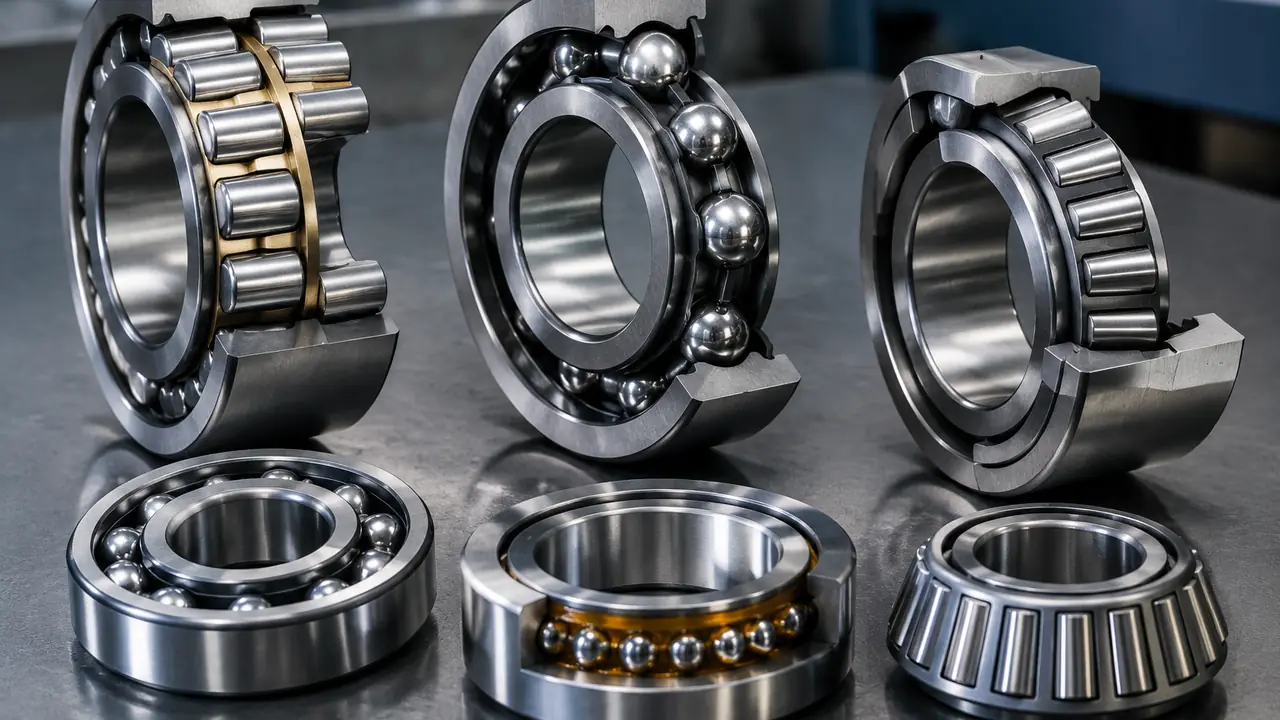
Three families under one name
The term linear bearing covers several products that look different and are specified differently. It helps to separate them before asking for a quote.
| Family | How it works | Typical use |
|---|---|---|
| Linear ball bushing (LM-UU type) | Recirculating balls run between a steel sleeve and a round shaft | Light automation, 3D printers, packaging, small machines |
| Plain linear bushing | Sliding sleeve of bronze, polymer or composite on a shaft | Dirty sites, short strokes, low cost, impact tolerance |
| Profile rail with carriage | Recirculating balls or rollers between a shaped rail and a block | Machine tools and precise, stiff axes |
This guide concentrates on the first two, which are the usual catalogue business for sourcing desks. Profile rails are sold as system parts with their own accuracy classes and preloads; quote them only against a drawing and a defined accuracy class.
How the ball bushing works
Inside the steel sleeve of a ball bushing, balls are arranged in several tracks. As the sleeve moves along the shaft, balls in the loaded zone roll between shaft and sleeve, travel to the end of the track, return through an unloaded path and come back. Because the balls make point contact with the round shaft, the load capacity is modest, and a hard, accurate shaft is essential. The bushing allows only straight movement; unlike a plain bearing it is not designed for rotation, and spinning the shaft in the bushing wears the tracks.
The bushing's sleeve is usually hardened bearing steel, ground on the bore track, and the outer surface is fitted into a housing or pressed into a bore. Plastic or steel retainers hold the balls. The UU suffix means a seal on each end, which keeps grease in and contamination out; open versions without seals are offered for clean conditions.
Nominal sizes
The LM series is named by shaft diameter. The key dimensions are the shaft (bore) diameter, the sleeve outside diameter and the sleeve length.
| Designation | Shaft d | OD D | Length L |
|---|---|---|---|
| LM6UU | 6 | 12 | 19 |
| LM8UU | 8 | 15 | 24 |
| LM12UU | 12 | 21 | 30 |
| LM16UU | 16 | 28 | 37 |
| LM20UU | 20 | 32 | 42 |
The table is nominal reference data; confirm against the drawing and datasheet. Other versions exist: long (LUU) with double length, open type (OP) with a slot to clear a supported shaft, and flanged types (F) with a mounting flange. See more sizes in the size chart.
The shaft is half the bearing
Most linear ball bushing failures come from the shaft, not from the bushing. A shaft for a ball bushing should be hardened, ground and polished to a smooth finish, with a tight diameter tolerance such as h6 as often specified for linear motion. Ask the supplier to state the shaft material, surface hardness and finish, and do not use soft steel shafts with ball bushings, since the balls will mark the surface and the bushing will lose smoothness. A plain linear bushing is more forgiving of the shaft, but still needs a clean, smooth surface and suitable clearance.
- Straightness. A bowed shaft causes binding and noise; check long shafts on a flat surface.
- Support. Unsupported shafts deflect; supported rails or shaft supports raise stiffness.
- Parallelism. Two parallel shafts must be set accurately, or the carriage will bind; use one fixed and one floating guide when the axis allows it.
- Corrosion. For wet or washdown sites, ask for stainless shafts and bushings; see the stainless steel bearing line.
Lubrication, speed and environment
Ball bushings run on a thin film of grease or light oil. Light grease with a regular schedule is the usual answer, and sealed UU types come pre-greased. Load capacity is expressed as a dynamic rating for a given travel life, and the stroke length, speed and acceleration shape the real life; use the supplier datasheet for the exact figure. Ball bushings dislike shock loads and dust, and rails with wipers or bellows are used in dirty sites. Plain bushings are the better option where there is shock, dirt, short strokes or vibration, as in agricultural linkages, because they do not rely on rolling balls. See the plain bearing line and the lubrication guide.
Housings, mounting and alignment
A ball bushing is normally held in a bore or in a purpose-made housing, either a block with a clamp or a flanged type bolted to the carriage. The housing bore must be round and accurate, since a bushing pressed into an oversized or out-of-round bore loses its running clearance. Most bushings are retained with snap rings or a bore shoulder; do not rely on the press fit alone to take thrust along the axis. Some flanged and housed bushings carry a self-aligning element that tolerates a little parallelism error between two shafts, which helps when the supporting frame is not machined precisely.
When installing, slide the bushing onto the shaft rather than forcing the shaft through it, and do it slowly with a slight twisting motion so that the balls are not displaced from their tracks. If the bushing is shipped without grease or with a rust-preventive film, clean and grease it according to the supplier instruction before use. For vertical axes or long strokes, check that the retainers cannot let balls escape when the bushing travels off the end of the shaft; fit end stops to prevent this.
When the shaft is supported along its length, use a shaft support rail with open-type bushings so that the carriage can pass the supports. When it is not supported, keep the span short and size the shaft diameter generously, because deflection grows quickly with length.
Ordering checklist
- Designation with shaft diameter and type: standard, long, open or flanged.
- Seal or open construction.
- Shaft: diameter, length, material, hardness, finish and tolerance, if supplied.
- Application: stroke, speed, load and orientation (horizontal or vertical), environment.
- Quantity per designation, marking and packing.
Standard LM-UU types typically start at about 100 to 500 pieces per designation, with custom lengths and materials assessed from a drawing and often in the thousands (see MOQ and lead time, confirmed in writing for each program). For the application side read bearings for robotics and automation axes, and send the list through the quote form.