
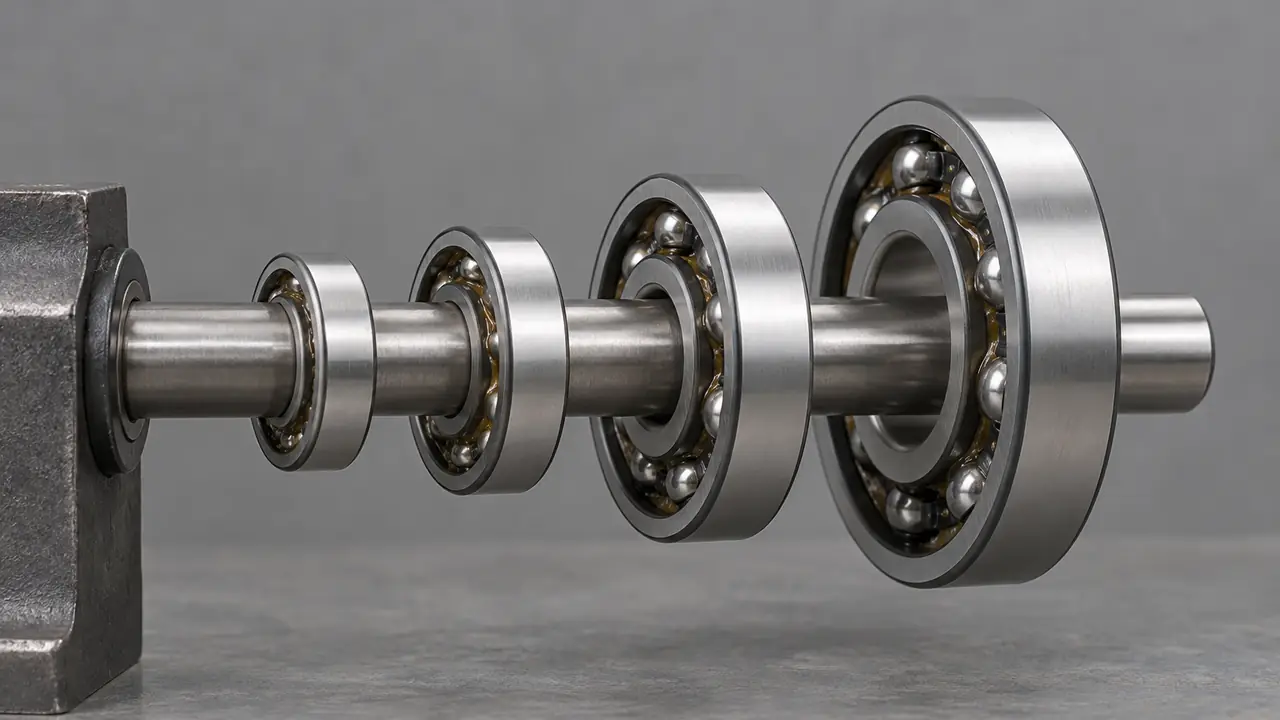
Nominal size of the 6202
The 6 marks a single-row deep groove ball bearing. The 2 places it in the light dimension series, and the final 02 is the bore code for 15 mm. The code 02 is one of the four exceptions to the multiply-by-five rule, alongside 00, 01 and 03; the rule itself is explained in bearing bore codes. The nominal ISO 15 boundary dimensions are:
| Dimension | Symbol | Nominal value |
|---|---|---|
| Bore | d | 15 mm |
| Outside diameter | D | 35 mm |
| Width | B | 11 mm |
These are nominal values. Confirm the tolerance class, chamfer and shoulder diameters on the drawing, and take load ratings and limiting speed from the supplier datasheet for the bearing actually supplied. They differ with the ball count, steel and cage, so a generic figure from a web table is not a basis for a design decision.
The 62 series at small bores
The 6202 sits between the 6201 and the 6203 in the light series. Its neighbours are close in size, which makes it easy to mix them up on a purchase order.
| Designation | Bore code | d x D x B (mm) |
|---|---|---|
| 6200 | 00 | 10 x 30 x 9 |
| 6201 | 01 | 12 x 32 x 10 |
| 6202 | 02 | 15 x 35 x 11 |
| 6203 | 03 | 17 x 40 x 12 |
| 6204 | 04 | 20 x 47 x 14 |
On the same 15 mm bore, the other standard deep groove series give the following sizes: 6802 is 15 x 24 x 5, 6902 is 15 x 28 x 7, 6002 is 15 x 32 x 9 and 6302 is 15 x 42 x 13. Because the bore is common, a shaft can stay fixed while the housing envelope changes, which is a useful option if the 6202 turns out to be too small or too large for the load.
Other bearing types in the same envelope
The 15 x 35 mm envelope also exists in other bearing designs. They are not substitutes without engineering review, but they show what is available when the load direction changes.
| Designation | Type | d x D x B (mm) |
|---|---|---|
| 6202 | Deep groove ball | 15 x 35 x 11 |
| 7202 | Angular contact ball | 15 x 35 x 11 |
| 1202 | Self-aligning ball | 15 x 35 x 11 |
| 30202 | Tapered roller (total width T) | 15 x 35 x 11.75 |
If axial load is high in one direction, an angular contact bearing in the same envelope may fit the housing, but it needs a proper axial location and often a pair. If shaft deflection or housing misalignment is the issue, the self-aligning ball type shown in 1202 tolerates it better, at the cost of load capacity. These are design choices to settle with the datasheet data, not on size alone.
Typical applications
A 15 mm shaft with a light series bearing suits equipment with moderate loads and medium to high speeds. General examples include small electric motors, household appliances such as fans and mixers, hand tools, garden equipment, small pumps, office and medical devices, and light conveyor or idler shafts. Two features matter most in this size: noise, because many of these products are used near people, and sealing, because grease loss or dust ingress ends bearing life early.
For low-noise products such as appliance motors, buyers usually ask for a tighter tolerance class or a vibration group and a low-noise grease. These requirements are agreed per order; ISO 492 defines the tolerance classes but the noise grades are set by the plant or by agreement. For background, see vibration grades.
Variants to specify
- Open, ZZ or 2RS. Metal shields keep friction low in clean conditions; rubber seals suit dusty or splash-prone work. See 2RS vs ZZ bearings.
- C3 or normal clearance. Motor and pump bearings with a press fit are often specified with C3, as explained in C3 clearance explained.
- Tolerance class. Normal class is the default; P6 and P5 are for accuracy and low noise.
- Grease. State the temperature range and whether low noise is required.
When the part number on an existing bearing is unreadable, a bore of 15 mm, an outside diameter of 35 mm and a width of 11 mm point to a 6202-type bearing, provided the measurement is accurate. The steps are in how to measure a bearing.
Common ordering mistakes with the 6202
Three errors recur. The first is a digit slip: 6202 versus 6203 or 6302 changes the housing bore, so a mistyped line item can arrive as a part that physically does not fit. Write the dimensions beside the number on the order, for example "6202-2RS, 15 x 35 x 11". The second is ignoring the closure. A buyer who assumes all 6202 bearings are sealed receives open bearings, or the other way round, and the grease and cleanliness differ. The third is leaving the clearance and tolerance class unstated, so that a plant fills the gap with its own default.
It also helps to separate what is checkable from what is not. Dimensions, closure type and marking can be checked on receipt with a gauge and the eye. Grease type, steel quality and running noise need either supplier documents or a sample test. If a program is sensitive to noise or life, put that test into the sample plan before the bulk order, and hold the retained samples for comparison with later lots. The factory audit and testing and inspection pages describe how the desk handles this.
Sourcing notes
The 6202 is a standard stock size, so partner plants typically quote it from a reference MOQ of 100-500 pieces per designation, with stock samples in about 3-7 working days. Private-label boxes or laser-marked rings raise the reference MOQ to roughly 1,000-5,000 pieces per designation. All of these are indicative ranges confirmed in writing for each program, as described on the MOQ and lead time page.
Because the volume of this size is high, the quality gap between plants is wide. Ask for samples from the plant that will run the order, not from a stock lot, and confirm the grease, the seal and the noise requirement on the sample paperwork. Send your list through the quote form.