
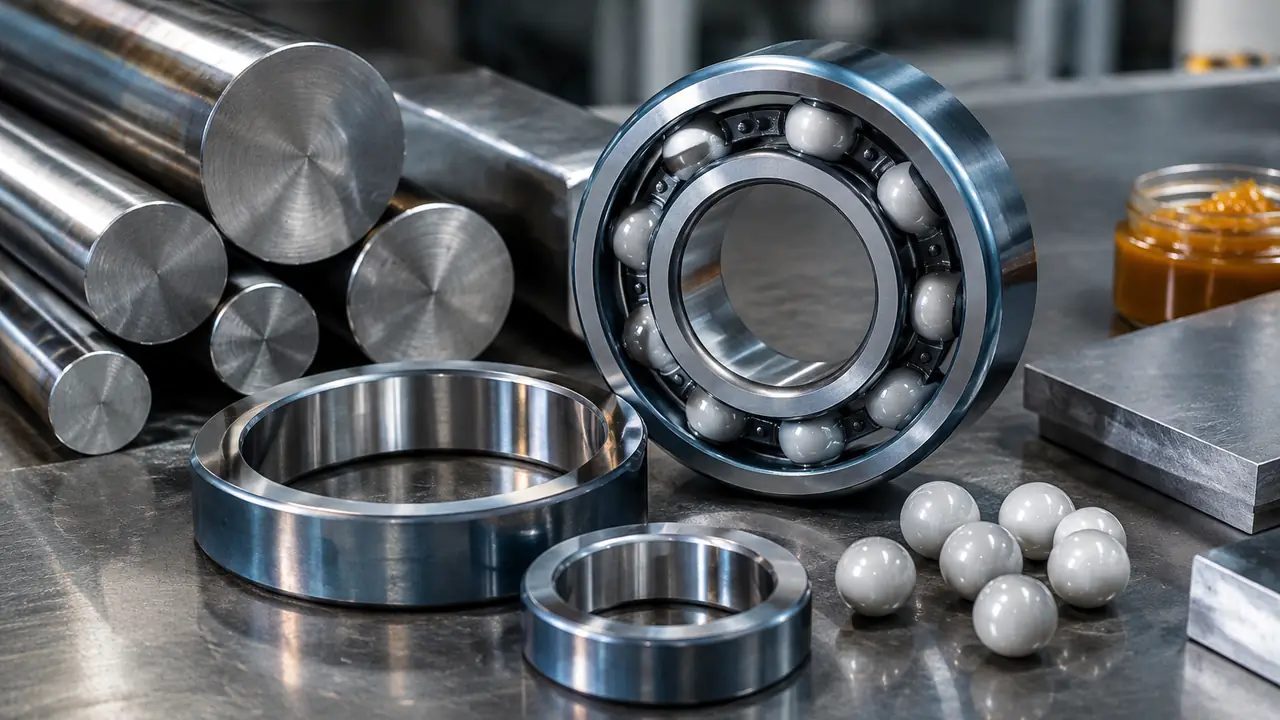
The route in one view
Inner and outer rings follow the same basic path in almost every plant: steel is cut and formed into a rough ring shape, turned to a near-final profile, hardened, ground on the raceway, bore and outside surface, finished, cleaned and inspected. The details differ with size and volume. Small rings for deep groove ball bearings are made on automatic lines at very high rates; large rings for heavy roller bearings may be forged individually and turned on larger machines.
It helps to see the sequence as a series of shrinking tolerances. Each stage removes the error of the previous one, and the last grinding steps work in micrometres. The table summarises the usual stages.
| Stage | What happens | What it controls |
|---|---|---|
| Steel selection | Bar, tube or wire in bearing steel is cut to blanks | Material cleanliness and grade |
| Forming | Hot forging or rolling, or tube cutting for small sizes | Grain flow, material usage |
| Soft turning | Rings are turned to near-final shape with grinding allowance | Roundness, allowance, groove form |
| Heat treatment | Hardening and tempering to the target hardness | Hardness, dimensional stability |
| Hard grinding | Faces, outside surface, bore and raceways are ground | Dimensions, roundness, runout |
| Superfinishing | Raceways are honed or superfinished | Surface finish, noise, life |
| Washing and inspection | Cleaning, sorting, measuring, marking | Cleanliness, dimension, appearance |
Forming: forging, rolling and tube stock
For small and medium rings, plants often start from steel tube, which is cut into rings and turned, because it wastes little material and runs fast. For larger rings, hot forging gives the best control of grain flow and material properties. Forging heats a billet, upsets it and pierces it; ring rolling then expands the ring to the required diameter. The result is a rough ring whose fibres follow the ring, which resists fatigue better than rings machined from solid bar.
Forging is also where the cost conversation starts. Using near-net-shape forgings leaves less to turn away and wastes less steel. A plant that forges its own rings, or buys them from a forging specialist in the same cluster, can also control scrap. For buyers the question is simply whether the steel and forming route are written into the plant specification, since they affect both life and price.
Turning and heat treatment
Turning, done on automatic lathes, gives the rings their near-final profile, with a thin layer of material left on every surface for grinding. Ring faces, outside diameter, bore and the raceway groove are cut. Accuracy at this stage is limited, but consistency matters, because it sets how much stock the grinders must remove. Too much stock lengthens grinding and risks burn; too little leaves cut marks.
Heat treatment hardens the rings. They are heated to a controlled temperature in a protective atmosphere, quenched in oil, washed and tempered. The process is a continuous line for small rings and batch treatment for large ones. Hardness and microstructure are checked on samples. The quality of this stage determines life and how the ring holds its size in service, and the principles are summarised in GCr15 and 52100 bearing steel. For rings that run hot, the treatment includes stabilisation steps so that dimensions stay put.
Grinding and finishing
After hardening, rings are no longer machined with cutting tools. They are ground on accurate grinding machines, in a sequence that usually runs as follows:
- Face grinding to set width and parallelism, which also locates the ring for later steps.
- Outside diameter grinding on the outer ring and bore grinding on the inner ring, to set the mating diameters.
- Raceway grinding, where the groove is ground to the right radius, position and profile. This is the most critical operation.
- Superfinishing or honing of the raceway, which removes the fine grinding marks and leaves a smooth surface.
Most of the final quality in the ring is set at these stations. Grinding burn, where a wheel overheats the surface and softens or re-hardens it, is a hidden defect that can reduce life; plants control it with correct coolant, wheel dressing and sometimes etch inspection. Superfinishing matters most for low-noise bearings: the smoother the raceway, the lower the vibration, as covered in bearing vibration grades.
Cleaning, inspection and marking
Finished rings are washed to remove grinding residue, which would otherwise contaminate the grease and cause noise. Many plants then sort rings automatically by diameter, so that inner rings and outer rings can be matched with balls to the right internal clearance. Dimensional checks cover bore, outside diameter, width and runout, and raceway form is checked by sampling. Marking, usually by laser or stamping, adds the designation and the brand or neutral marking agreed for the order.
The ring is then assembled with balls and cage, and the clearance is controlled by selective assembly. Tolerance classes under ISO 492 and the internal clearance groups are covered in tolerance and clearance.
Ring variants you may meet
Not every ring follows the standard path. Rings for needle roller bearings may be drawn from sheet and hardened as thin shells. Rings for tapered roller bearings, the cone and the cup, use carburising steel and have precise ground rib and raceway angles. Rings with snap-ring grooves, flanges or special bores need extra turning and grinding steps, which add cost and lead time. Split rings for large housings are cut after hardening. When a drawing includes features beyond the standard profile, the plant will quote the extra operations separately, and the program may move from the catalogue range to custom work covered on the custom bearings page.
Where the cluster fits in
China's bearing industry is organised in regional clusters, and industry analyses suggest five main clusters account for most national capacity. Within them, specialist firms often handle single steps: forging, turning, heat treatment or grinding. A ring may be turned in one workshop and heat treated in another, then ground by the assembler. That specialisation can lower cost, but it makes traceability more important, since several firms touch the same part. A good partner plant can name its main steps and subcontractors on request. See production process for how the desk reviews plants.
What buyers can ask partner plants
- Which steps are done in house, and which are subcontracted.
- The steel source category and the heat-lot record linkage.
- Hardness and microstructure checks, and their frequency.
- Grinding burn control and cleaning method.
- Sampling plan for dimensions and runout, with records kept by batch.
Plants that serve OEM customers normally answer these questions without difficulty. If you need an audit, see factory audit; to start a program, send details through the quote form.