
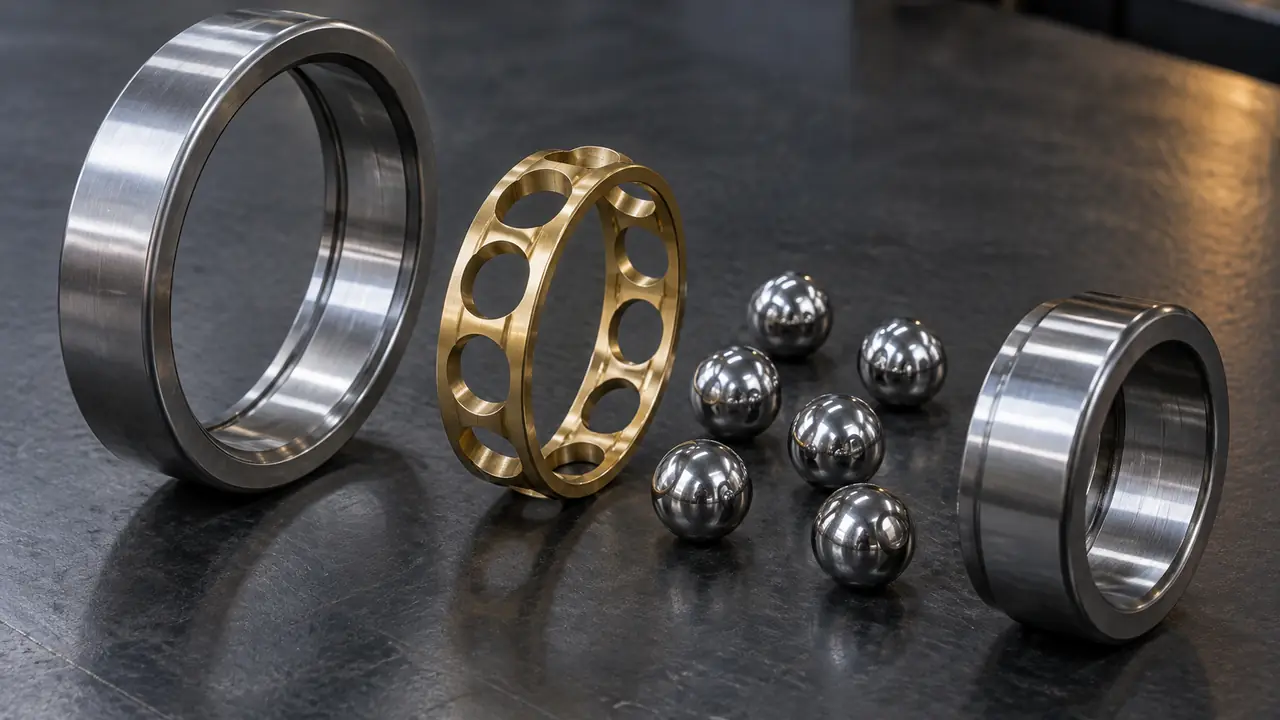
A bearing and a housing sold as one unit
A pillow block bearing, often called a plummer block in some markets, is an assembly of two parts. The first is an insert bearing: a deep groove style ball bearing with a wide inner ring, a spherical outside surface and usually integral seals. The second is a housing with a matching spherical seat. Because the insert can rock in the seat, the unit tolerates misalignment between the two mounting points that a standard bearing cannot absorb.
The result is a bearing that a maintenance crew can bolt onto a frame, slide onto a shaft and lock in place without machining a bore. That convenience is the reason housed units dominate conveyors, fans, agricultural machines, packaging lines and many food and bulk-handling plants. A structure may carry a dozen of them in a row.
Reading the designation
Most housed units follow a simple naming pattern. The prefix of the insert is UC (set-screw locking), SB or SA in some catalogues, with the number giving the shaft size; the housing is named by its shape. The combined unit adds the two.
| Unit | Housing shape | How it mounts | Typical use |
|---|---|---|---|
| UCP | Pillow block with a foot | Two bolts through the base onto a flat surface | Conveyor frames, shaft lines |
| UCF | Square flange | Four bolts on a wall or vertical plate | Machine side panels |
| UCFL | Oval (two-bolt) flange | Two bolts through the flange | Narrow plates, light machines |
| UCT | Take-up housing | Slides in a slot to tension a belt or chain | Belt conveyors, adjustable drives |
A designation like UCP205 combines the UC205 insert and a P205 housing. The two digits after the series code indicate the bore: for example, 05 means a nominal 25 mm shaft, following the bore code rule explained in bore codes. Verify the nominal bore, bolt spacing and centre height against the supplier drawing, because housing dimensions vary slightly between series.
How the shaft is locked
Because housed units are meant for plain shafts, the insert has to grip the shaft without a shoulder. There are three common ways.
- Set screws (grub screws). Two screws in the inner ring press on the shaft. This is the common type for lighter duty and is quick to fit. It works best where the shaft turns in one direction.
- Eccentric collar. A collar with an off-centre bore locks onto an extension of the inner ring when turned against shaft rotation. It suits reversing loads better than screws alone.
- Adapter sleeve. A tapered sleeve with a locknut clamps the inner ring to the shaft. It is gentler on the shaft surface and is used with larger sizes. The accessories page lists sleeves and locknuts.
Set screws can mark the shaft, so for frequently serviced shafts a sleeve or collar is usually the better choice.
Housing materials
The housing matters as much as the insert in damp, dusty or washdown conditions. Cast iron, normally grey iron such as HT200 or ductile iron, is the standard material: strong, stiff and economical. Pressed steel housings are lighter and cheaper but less rigid. Thermoplastic housings, with stainless inserts, resist corrosion in food and chemical areas, and stainless steel housings are used where washdown is frequent. Surface treatment, such as paint or zinc plating, also affects corrosion life. The full list of housing styles is on the bearing housing page.
Seals and relubrication
Insert bearings usually have a contact seal on each side, often with a flinger to throw dust outward. Many housings include a grease nipple so the bearing can be relubricated in service, which is a main reason for choosing a housed unit over a sealed deep groove bearing in a dusty plant. Over-greasing can push out the seal, so the fill quantity should follow the supplier's guidance. The fundamentals are in the bearing lubrication guide.
Where housed units go wrong
Most field problems with housed units are installation problems rather than manufacturing faults, and it helps to know them before specifying a unit.
- Uneven mounting surface. A foot bolted to a bent or twisted frame distorts the housing and squeezes the insert. Shim the base until it sits flat before tightening.
- Two fixed units on one long shaft. Thermal growth needs somewhere to go. On a long shaft, fix one unit and let the other float, using a housing with an open end cap or a slot to allow movement.
- Loose set screws. Vibration can loosen them over time, so fit them to the specified torque and mark them. If the shaft reverses or vibrates, change to an eccentric collar or sleeve.
- Wrong seal for the site. Food plants with hose-down cleaning, or fields with mud and fertiliser, need a heavier-duty seal or a stainless unit rather than a standard one.
Another point is shaft size. Many housed units are used on cold-rolled round bar, whose diameter tolerance is wider than a ground shaft. The insert bore is designed with that in mind, but a loose-fitting bar with set screws will still creep. If the machine is critical, specify a ground shaft or use an adapter sleeve with tight tolerances.
Why housed units suit buyers who resell
For MRO distributors and agricultural or conveyor equipment makers, pillow block units simplify stock. A small set of shaft sizes covers a wide range of machines, and a repair crew can replace a unit without special tools. The units are also easy to private-label in boxed form, and the spare insert can be sold separately. Cluster knowledge matters here: industry analyses suggest that the Shandong cluster around Linqing supports the cage, ball and seal parts used in housed insert bearings, while housing castings come from foundry regions. The desk coordinates both sides, then verifies the combined unit.
Checks before you order
- Shaft diameter and tolerance, with the locking method required.
- Unit family (UCP, UCF, UCFL, UCT) and the bolt pattern or centre height.
- Housing material and finish, and whether stainless or plastic is needed.
- Seal style, grease type and the presence of a grease fitting.
- Quantity per designation, and whether inserts and housings are packed together.
Typical reference MOQs for standard stock units run from about 100 to 500 pieces per designation, with lead times on the MOQ and lead time page, always confirmed in writing for each program. Share the list through the quote form.